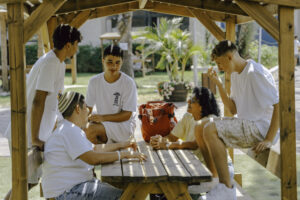

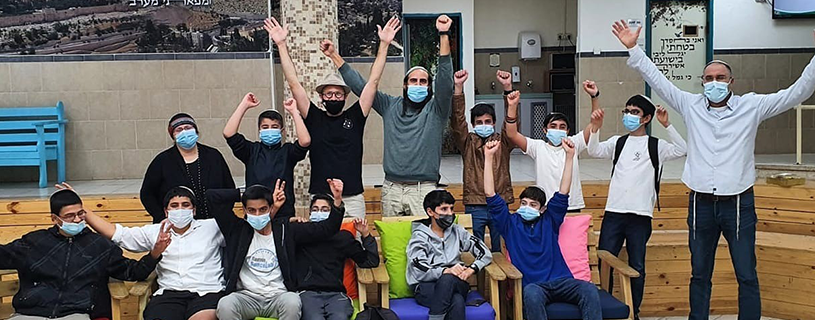
AMIT Florin Taman Junior and Senior High School for Boys in Tzfat won the prestigious SpaceLab competition, run by the Ramon Foundation. Their project experiment will be tested in outer space! The school is located in the Northern most part of Israel, and many of the students come from disadvantaged backgrounds. Given the location of the school and some of the challenges the students and their families face, this achievement is all the more impressive. Over 100 teams participated in the competition and 17 reached the finals, of whom four were chosen as winners of the competition with the AMIT Tzfat team taking first place. The student body has grown from 178 to 500 students over the last seven years, 50% who come from Tzfat and the rest from smaller communities in the region. Over this time the Bagrut (matriculation) scores have gone up from 55% to 92% and 100% of the graduates serve in the IDF. Last year the school won the religious national education prize last year.
Eytan Stibbe, the second Israeli astronaut in Israel’s history announced the winner on January 25. The Education Minister and its Northern Director, the Mayor of Tzfat, and Amnon Eldar, AMIT Director General congratulated the team on a Zoom call as they could not meet in person due to COVID restrictions. Nedavya Na’eh, the school principal, exclaimed, “We are so happy and excited about this opportunity to expose our students to the very best opportunities in the world of science and prove, once again, that when there’s a will, the sky is the limit – both literally and metaphorically!” Stibbe is set to be the first Israeli to visit the International Space Station, where he will be conducting innovative and groundbreaking experiments, based on developments of Israeli researchers and startups including the winning experiments from the SpaceLab competition!
Ramon SpaceLab is Israel’s leading educational program in the field of science. The program gives students a unique opportunity to submit an experiment to the International Space Station through an annual research-based learning program. The SpaceLab program is currently active in 24 schools in Israel and New York, and in the past in New Jersey and Connecticut. Using the fascinating world of space, the program aims to arouse students with curiosity and to motivate them to dream as far as possible, while utilizing they own inherent personal and social potential.
Through project based learning the students perform several tasks, each named after the Columbia team members. The goals of these tasks are to equip the students with a rich toolbox which enables them to send experiments to the International Space Station. The groups of students who participated in the program are escorted by a mentor from the Ramon Foundation along with their teacher. The mentor’s role is to inspire students to fully explore the topics which fascinate them as part of the project and beyond.
AMIT Tzfat’s winning project is called The Power of Moringa: Purifying Water through Moringa Seed Powder and Copper Wires. The goal was to find a way to reduce the amount of water that astronauts had to carry into space because water weighs down the spaceship and reduces much needed space to carry important equipment for experiments. The idea was to find a way to reuse existing water. The experiment proposed is to use Moringa seed powder and add copper wires to the Moringa powder in order to remove turbidity and kill the germs. This purifying system is simple and cheap and does not need a lot of energy. Furthermore, using Moringa seeds to clean water does not remove 100% of the germs in the water, but rather inhibits their growth by sedimentation. The Moringa seeds contain an organic substance that is food for the germs and so they begin to reproduce. The students came up with the idea to add copper wires to the seeds. There are many scientific advantages for using copper wire. Exposure to copper can cause death to microorganisms within minutes. Copper toxicity to microorganisms can be achieved by several mechanisms, and thus a substantial resistance of microorganisms to copper is not formed. And copper is considered safe to human beings.
When the test tube returns to earth, the students will examine the filtered water. They will check the turbidity on a spectrophotometer to see whether there is turbidity and will sow the filtered water in the food agar and check whether E. coli germs are being reproduced. If they managed to purify water using Moringa seeds and copper, this method can be used in long-term space missions and in space stations. In addition, this method can be used to improve water in developing countries.
The students conducting the research and project included Mission Commanders: Elnatan Amitsur , Malachi Cohen, Mission researchers: Ori Kabla, Elyasaf Wadee, Elchanan Costa, Mission Engineers: Elchanan Costa, Ben-Tsion Shamaka, Roee Cohen, Asaf Amir, Mission Experts: Ori Kabla, Malachi Cohen, Horev Burenstien, and PR: Oshri Malka, Nehorai Kcholi.
All groups participating in the project present their experiments – the peak mission, at the final event in front of astronauts, government ministers, NASA officials, the Israeli Space Agency and other leading international space agency representatives who participate in judging the competition. After the winning experiments return from the space station, the results are published in journals and on scientific sites.
To date, over eleven different experiments have been submitted from schools across the country and in the United States to the International Space Station as part of the RSL project. This has inspired hundreds of students and teachers to take a significant interest in the space and science industry and encouraged students to be able to fulfill their dreams. For them, the sky is no longer the limit.