

By Michele Chabin
Petach Tikva, Israel – Raised in AMIT boarding schools from the age of 7-19, Moshe Uziel hoped to one day be able to give back to the AMIT community that nurtured him and his sister Miri through childhood, adolescence and beyond.
Since September, Uziel, now 33, has been able to do just that as the new director of the Pre-Army Junior College (Michlalah) professional training program at the AMIT Kfar Blatt Youth Village – where he was once a student.
“My dream was to use all that I’ve learned from AMIT to help today’s students,” said Uziel, whose charisma and confidence clearly bring out the best in his students.
 “The Michlalah taught me all about automotive engineering and technology, the field I pursued in the army, and where I eventually became a commander. I want my students in the Michlalah to take this profession to a whole new level.”
While some of the junior college’s students focus solely on the career track, many others also enroll in the college’s Mechina (life preparation) program.
For 18 months, the college’s male students spend part of each day learning Jewish studies, Jewish and universal values, and life skills. The other part of the day they pursue professional-level training in auto mechanics or industrial management at the junior college.
Female students spend 18 months in the Midrasha, the Mechina’s sister program, where they learn Jewish studies, life skills, Jewish values, and train to become medical or legal secretaries.
All of the Mechina’s students come from homes with severe socioeconomic and/or family problems, Uziel said. None can afford to pay full tuition, but AMIT makes sure every child receives a quality education that includes career coaching, mental health services, and housing in Kfar Blatt’s dorms.
Danny Strick, a counselor at the Pre- Army College, added that many of the youth village’s students, from seventh grade through junior college, come from problematic homes where economic issues may be exacerbated by a parent’s inability to adjust to life as a new immigrant, drug or alcohol use, sexual abuse, chronic mental or physical illness or incarceration.
Strick, formerly a guidance counselor for Kfar Blatt’s high school for boys, recalled how, when he and his wife received one too many microwaves as a wedding gift, he asked whether any of his students’ families would like it.
“Half the students didn’t know what a microwave was,” Strick said. When he delivered the spare microwave to the home of one of his students, “The boy’s siblings gathered around it as if it was the brightest and most beautiful gift they’d ever seen.”
That boy is now an IDF soldier, but AMIT is still providing him with assistance. For the past year, Strick has been coaching the young man on how to plan his life goals.
If there is one educator who can relate to these kinds of challenges, it is Moshe Uziel, whose entire world changed at the age of seven.
“When I was seven years old, my mother decided to send me and my six-year-old sister, Miri, to AMIT Beit Hayeled in Jerusalem, and a couple of years later my father died,” Uziel recalled. “She needed help in raising us. I feel it was brave of her to decide to put us in a good boarding school.”
Although he lived at Beit Hayeled, Uziel attended an elementary school where the vast majority of students came from and lived in, stable homes. “I didn’t know to read all that well, and my behavior was a little problematic.”
But when Uziel was 14, he moved to Kfar Blatt. “When I arrived, I found that everyone was like me. I lived and studied there, and it was a real home. The AMIT staff gave me what I needed. They gave me the feeling I only needed to ask. They instilled Zionist values in me. Because of this, I wanted to go to the army, and [they] gave me the feeling I could accomplish anything.”
It was at the junior college, where he lived until he was 19 years old, that Uziel said he “internalized” the need to attend university, “but not before serving in the army, to give back to the country.”
The army sensed Uziel’s potential soon after he entered the prestigious Golanibrigade, and sent him to an officers’ training course. Not long afterward, he decided to continue serving beyond the mandatory three years. But when the army decided to send him to Bar Ilan University and pay for his education, the young AMIT graduate found himself potentially homeless.
“I needed a place to live, so I called Amiram Cohen, director of Kfar Blatt, and he said, ‘Of course come to live here. This is your home. And while you’re living here you can be a role model to the students. They’ll see you and learn from you.” But the results of Uziel’s matriculation exam, taken while he was commanding soldiers in the field and getting little sleep, fell short of the university’s standards.
Uziel called Cohen, who in turn called Amnon Eldar, Director General of the AMIT network. “Amnon called the university, and they accepted me on the condition that they would examine my grades in a year,” Uziel said. “I was accepted into a program where I earned both a bachelor’s and a master’s degree. Without Amnon’s help, I wouldn’t have been accepted into Bar Ilan.”
In return for the free tuition, the army required Uziel to serve in the army for four more years.
“When I’d completed my four years, I decided to leave because I wanted to give back to AMIT, the place that saved me,” Uziel said. “I really, really want to give back to the children. I feel no one can understand them better than I can. This is my destiny: To save children.”
Strick said the junior college’s students and staff feel energized by Uziel’s enthusiasm and leadership. “I’ve never seen a man with such leadership skills. Moshe has a big, big vision.”
Strick recalled how, during Uziel’s first meeting with the college’s teachers, even the most veteran educators became excited. Everyone understood that something new and serious is happening here.”
Uziel hopes to turn the junior college’s automotive technology program – already considered excellent – into the most-sought-after place to learn a profession in both the military and private sectors.
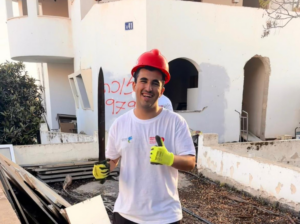
“I know this profession and [I] think this is the future,” Uziel said as he walked around the Kfar Blatt building site where AMIT’s new automotive technology center and other campus facilities are expected to be completed sometime this winter.
Uziel plans to bring the state-of-the-art automotive simulators used in Italy and Germany to the center. With these and other innovations, he predicts the junior college “will be the best school for electronic and mechanical automotive technology in Israel.
Dr. Eldar recalled that he met Moshe and his sister Miri, who also works at Kfar Blatt, when they first moved to Beit Hayeled and where Eldar’s mother Techiya was the director.
“From the beginning, I saw that they both had potential and they were very curious and excited about learning new things.”
Eldar emphasized that Uziel, who in the past year earned teaching credentials, was tapped to head the junior college because he was the best person for the job.
“We didn’t show Moshe any favors. He is a great candidate with all the abilities and certificates he needs for this job. And the fact that he grew up in AMIT schools as a child-at-risk makes him all the more suitable.”
“To see that he came from the same background and had the motivation to do something important with his life shows them it’s possible for anybody to do that.
David Doueck, a second-year student at the junior college, said that when Moshe spoke with all the students for the first time, he was impressed by Uziel’s drive. Said Doueck, “People think people like me can’t succeed. Moshe told us, yes, you can succeed, with or without a home. That your future depends on you as an individual and what you want to do with your life.”
Seated in the cramped prefab building that serves as the junior college’s administrative offices, Uziel insisted that it is the AMIT network that deserves praise.
“All my life AMIT was by my side. I tell everyone I speak to that AMIT is an angel. The people who donate to this organization give money, but what they are really giving is love, warmth, education, values. The same is true of AMIT teachers and counselors. Every day they come to work with smiles on their faces. They give love to the children.”