
Published in Makor Rishon, 12/5/202
By Roni Yishai
What is the secret to educating girls for leadership? The principals of the AMIT Network believe that for young students, only the sky is the limit. A conversation about personal example, education for excellence and personal attention in the screen .
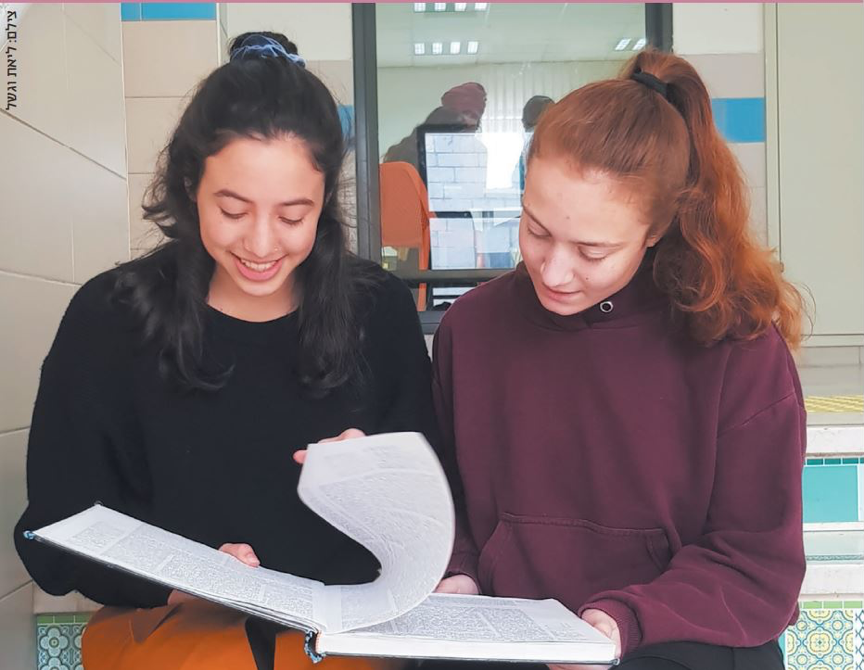
Students at AMIT Midreshet Art and Sciences Jr. and Sr. High School for Girls in Modiin
“The day you were born is the day G-d decided the world could not exist without you.” – Rabbi Nachman of Breslov. This proverb appears on the sign that greets the students at the entrance to Midreshet AMIT in Modiin, and it seems that this idea accompanies the principals in the AMIT Network all the way. They help each student find the message and power she brings to the world, and use the skills she has received in the best way, all while deepening each girl’s spiritual and cognitive world and aiming for meaningful national or military service. It is hard to ignore the fervor in the voices of the four principals we met. They work in the education system and have seen their work as a mission for years.
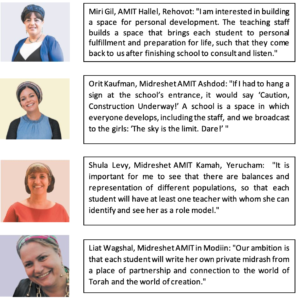
Liat Wagshal, principal of AMIT Midreshet Art and Sciences Jr. and Sr. High School for Girls in Modiin, says that her first decision as the school’s principal was to change the name of the school to Midrasha. “The name of the school is not just a midrasha; our ambition is that each student will write her own midrash, from a place of research— to demand, to search, from self-study and study in groups. There is a Beit Midrash here and a Midrasha for science and art.”
The Midrasha operates under the title “Born to Influence,” and this statement is instilled in the students from the seventh grade onwards. “In the eighth grade there are two hours a week where the girls decide what they want to initiate. It can be in the field of computers, landscaping, sports and athletics, and the idea is to create something of their own and bring it to the outside world. This line continues all the way.”
Miri Gil, principal of the AMIT Gould Hallel Jr. and Sr. High School for Girls in Rehovot, says that as a principal she is primarily interested in giving girls “a space for personal development, to build together a ladder for their development. We are a school that brings each girl to personal fulfillment and preparation for life. The girls come back to us after finishing school to consult and listen.” Gil emphasizes that she educates both for excellence, and also for the realization of abilities: “It is important to me that each girl fulfill herself with the strength she has received.”
Shula Levy, principal of Midreshet AMIT Kamah Jr. and Sr. High School for Girls in Yerucham, calls it a personal growth program for every student. Her school has a variety of girls from all religious and educational backgrounds. “There is a selection of opinions, ethnic backgrounds, homes and worldviews here, and we are here to let each girl do what is right for her, to build her personality. We operate in a triangle, one side of which is the female-religious-family identity. We work to build that identity in each girl according to where she comes from. The second side is academic. The school is open for every girl from Yerucham and the area who says, ‘I want to take part.’ For some of the girls we have to help reduce academic gaps and for others we provide excellence programs. In any case, one hundred percent of the school students complete the bagrut matriculation and 30-40 percent receive outstanding certificates.” The third side of the triangle is the social-emotional side. “We are engaged in building an emotional plan that will personally accompany each student. We give the girls tools to build their personality, literally.”
Orit Kaufman, principal of AMIT Ashdod Arts and Science Ulpanit High School for Girls (Midreshet AMIT Ashdod), says that sometimes she asks the students which traffic sign they would put on the school’s gate. For her, the answer is clear: “Caution, Construction Underway!” “A school is a space that must allow all who come through its gates to develop. The students and the staff are all in a development process. The message to the girls is clear: the sky is the limit and the daring win. See in our own eyes how much we believe in you.” In a conversation with Orit, it is impossible not to feel that the most important thing in her eyes is personal touch. “The importance of pedagogy in the 21st century is critical, learning in open spaces does wonders, but don’t forget that everything is based on the 40 cm-space between the eyes of the teacher and the student. It is a sacred space where a relationship develops. From there, a teacher will tell the student, ‘I trust you, break out and influence’ and she will believe in her”.
Female Inspiration
Liat Washgal from AMIT Midreshet Art and Sciences in Modiin, a mother of five, studied film at Ma’aleh, and has two master’s degrees—one in education and Bible and one in management. She managed to become a director, a film teacher and a teacher for at-risk youth, to be on the founding team of Branco Weiss High School, to teach at Yahad High School in the city, and then she came to AMIT Midreshet Art and Sciences Jr. and Sr. High School for Girls in Modiin. Female management for her is “management with the female forces. I do not aspire to be like a male principal—tough, straight to the point, but rather to come from the soft and round place. It is a management style that has women’s tools, and it manages to bring a true female voice.”
Miri Gil from AMIT Gould Hallel Jr. and Sr. High School for Girls in Rehovot has held educational management positions since the age of 29. She is a mother of three and a grandmother. “The AMIT Network raised me and managed to get me to grow my incubator called the AMIT Hallel School. It is a network that allows us to dream and fulfill our desires, not every principal gets to have a dream and see it come to life.”
What is female management in your opinion?
“Management with a unique internal structure that a woman has, which allows me to maneuver on the one hand and also to understand in depth the secret world of the girls and the team, on the other. To know what is really going on there. I call it ‘enabling management’ that contains the girls. I have the opportunity to be empathetic, to be freer with them; the feminine naturalness that flows in me projects outwards as well, also in the difficulties and challenges that life leads us to. I believe that when a principal reveals herself and is natural, it greatly facilitates the management task, which is very challenging, especially in the shadow of corona.
I try very hard to connect to my inner voice. For example, one of the things I say to the students and teachers is that it is important for us as women to find time for self-fulfillment. If you do not fill the glass to the brim, the glass does not spill over; if you do not fill yourself—with a good lecture, with physical activity, with something that does you good—you will have nothing to provide. Women are also good role models for maintaining balances. I find myself combining three married children and grandchildren. This is the reality of life and everything must be integrated.”
For Shula Levy, principal at Midreshet AMIT Kamah in Yerucham, female management is simply “bringing myself into the role, and when it comes to young girls it is critical in my eyes that a women is the head of school.” According to her, the teachers’ room of the school is also feminine, not from an ideal, but “this is how it turned out.”
The school was created by two mothers, and currently has 45 teachers, and just as the school is diverse, so is the teachers’ room. “It is important for me to see that there are balances and representation of different populations, so that each student will have at least one teacher with whom she can identify and see her as a role model. The issue of identity is critical. It is difficult to produce a state of identity and identification when the principal is a man. Just as I cannot imagine an institution for boys headed by a woman, it is difficult for me to imagine the opposite.”
Orit Kaufman from AMIT Ashdod Arts and Science Ulpanit (Midreshet AMIT Ashdod) identifies with these things. “As a principal, my modeling is to show inspirational women; it’s powerful. The girls experience skills, the ability to connect, and a desire to grow. It builds them as strong women.” Kaufman received the school five years ago as a growing school with forty students. It currently has 300 students. “We are proud of the variety of students that come to us. Today, it is no longer a big challenge for us to provide high quality education to the outstanding students and to every girl in the school. I perceive diversity as a force of healthy living.” Every day she travels 150 km (90 miles) from her home in Peduel and back, she says, “just to get to meet this gorgeous bunch.” She is a mother of four daughters and a grandmother to two grandchildren, and throughout her work, she made sure to combine work and home. “My students are a part of my being and therefore my home is also open to them. This connection allows them to see me as a whole person, just as I aspire to see each one of them.”
AMIT CEO Dr. Amnon Eldar says that education on women’s empowerment and encouraging students to excellence in all areas is part of the DNA of the AMIT Network established by Bessie Gotsfeld, founder of AMIT Women’s Organization in the United States. “We have been rewarded with creative, entrepreneurial and leading principals who serve as role models for the next generation of girls, who will understand that the sky is the limit.”
No school? We will establish one
When AMIT’s female leadership team say that the sky is the limit when it comes to realizing the potential of the students, they really mean it. There does not seem to be a field of study that girls are not exposed to, and emphasis is placed on personal experience.
“The connection between school and what happens in life must not be like the connection between a preparatory course for childbirth and actual childbirth…” Kaufman explains. “As part of the ecosystem concept in the AMIT network, we will always strive for contact with the outside world and thus discover our strengths.” Therefore, at AMIT Ashdod Arts and Science Ulpanit, the team creates real contact with the world in all fields. Biology and physics students participate in a science project with the city’s Assuta Hospital and the Shamoon College of Engineering. “This is no longer a project of exposure and acquaintance but a full partnership. The girls will put into practice their knowledge and take practical part in various developments.” Girls from the art department joined the WIZO organization in Ashdod, headed by Gila Klein. They will design new branding for the place, while learning about brand values and how to build a design line, and the girls in the theater department at the school have their theater lessons on the stage of the Mishkan for the Performing Arts in the city. “These are just some of the projects that give the girls wings. We say build and dare—you can, and we have your back.”
AMIT Midreshet Art and Sciences in Modiin also gives the girls tools to succeed and encourages them to learn and self-explore. Every year, the students in seventh to tenth grades learn about leading female characters and write essays on one of them. “Each student shares about the character who influenced her and writes what she needs to do to be like her—What will break my glass ceiling and help me get the farthest,” says Liat Washgel. The school has high-level art majors, including a dance studio and a theater studio, alongside science majors such as physics, chemistry, biology, computers and Arabic. The last two majors are studied by many of the girls who plan to go into military or national service in intelligence units. In AMIT Hallel in Rehovot they take advantage of the city, which is endowed with many high-tech companies, and integrates the girls there. They study entrepreneurship and combine the knowledge they acquired in their studies in high-end companies. The girls in the scientific majors also study at the Weizmann Institute in the city.
“A special project we have is English diplomacy,” says Miri Gil. “The girls encounter cultures, diplomacy and relationships—and all in English. We also have a “TED” project and debate course to train them to stand in front of an audience, all to adapt their studies to the 21st century.” Shula Levy, Midreshet AMIT Kama Yerucham’s principal, founded the school with her friend Tami Bitton after they could not find a suitable educational institution for their daughters. The school provides a unique solution for girls in the area, as until its establishment the girls had to study in boarding schools or travel outside the city to learn in a religious high school. “Until the establishment of the school, a religious girl had nowhere to study 5 units of physics, or science. We encourage the girls to excel, and yet we engraved on our banner the phrase ‘Your story is our story.’ Every girl is asked where she comes from, what her background is, and we try to produce in the best way the next episode in her life.”
Reinforcing visits
Along with academic excellence, and perhaps even before it, the AMIT Network’s emphasis is on Torah and value excellence. “Love of the Torah is one of the flags that our school raises,” says Miri Gil. In AMIT Hallel in Rehovot, the Beit Midrash “Bina Yitera” opens a window to the richness and depth of Judaism. Talmud, Bible, Chassidut and Jewish thought are studied there. The staff of the Beit Midrash is itself a study team that adheres to regular lessons.
“Through the Beit Midrash we manage to study amazing issues from the Jewish sources,” says Gil. For example, the Beit Midrash dealt with the subject of friendship. Another fascinating topic was economic education through sources in Judaism. “It is important for us to provide a place for experience learning, to strengthen it. ‘Bina Yitera’ is not a Beit Midrash where the studies are only theoretical, but studies that contribute to personal development and fulfillment in real life.”
In Midreshet AMIT Kamah in Yerucham they have an afternoon Torah study program called Ma’ayanot, which includes two lessons, an activity with an instructor from the twelfth grade and experiential activity. During the days of corona, the program was converted into a traveling Beit Midrash—Torah study in the various towns from which the students come, and once a week a distance-learning Beit Midrash. Additional schools receive enrichment classes, such as a class with Sivan Rahav-Meir every Thursday morning.
If there is anything that excites the four principals, it is the graduates who return home for special events, ceremonies, or just to say hello during their national or military service. “It gives us the strength to keep going,” they conclude.