

Published in Makor Rishon 11/25/2020.
By Roni Yishai
After a visit to the AMIT Network’s headquarters in Petach Tikvah, one gets the impression that they are not running schools, but a high-tech company. School management in the year 2020 requires control and supervision of a variety of systems: academic, educational and budgetary, personnel management and more. And when it comes to a network with some one hundred and ten secular, religious and ultra-Orthodox schools with close to 40,000 students of all ages, the system needs to be responsive at any given moment to the needs of many people in a variety of fields.

Amnon Eldar. Photo: Hallel Lederman
How you manage it properly? By means of a special information system tailored to the needs of the network. An information system that at any given moment shares data about the schools’ budget, the average grades and whether they have increased or decreased, and even how the students feel. All of these, of course, are much more critical in the reality of distance learning, due to the corona period.
Dr. Amnon Eldar, CEO of the AMIT Network, says that the Network’s large investment in the field of information systems stems from the understanding that these systems are the basis for everything. “The decision-making process needs to be data-based. When I became CEO, I realized the importance of information systems that provide data—not only for the CEO and the administration, but also for the school principals and teachers. As a result of the information they receive, they can make value-based, educational and budgetary decisions. It is our job to give them a platform to do so in the best way. The system also allows each teacher to check himself and see where his students are.”
In this context, Eldar does not only mean academic metrics: “Grades are easy to measure, but how can values and social processes be identified? To this end, Dr. Michal Aflalo, AMIT’s Director of Assessment and Evaluation, has developed a model based on questionnaires answered by teachers, students, parents and principals. From the information we collect, we create ‘Big Data’ for the principal, who can look and show each educator what his students think about the learning processes, the classroom climate and their feelings about the school. That’s how we make data-based decisions.”
According to Eldar, this model has a crucial impact in managing the corona crisis. “Immediately after the outbreak of corona we started asking questions of the students through the existing infrastructure. We asked them how they were feeling and what was bothering them. Students would answer questions on Thursday, and on Sunday, teachers received feedback from all their students. Students wrote that they felt loneliness and frustration. These are things that lit red lights for us and we were able to take care of them in real time and give them an appropriate response.”
The Key to Success – Managerial Flexibility
The information systems also play a crucial role in the management of the network’s budget, which ultimately affects the quality of
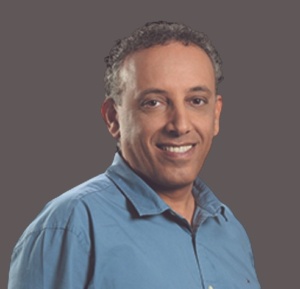
CPA Lior Omesi, CFO of the AMIT Network
studies, infrastructure and staff. CPA Lior Omesi, CFO and Director of Information Systems, says that in contrast to the common equation in schools of “budget = teaching hours”, at AMIT, every principal is given the option to manage a flexible budget according to the needs of the institution he or she runs.
“It is not possible for a school management system to have fixed budgets,” explains Omesi. “The needs vary from institution to institution, from student to student, and from population to population. In many places, the budget is built according to teaching hours, but there are so many other things a principal can use to help his students. It can be emotional needs that require help with appropriate treatments, and sometimes material needs—transportation to school or even a taxi for a student who did not wake up in time for the bagrut exam and who otherwise has no chance to get to the test on time.
The goal is to give everyone whatever he or she needs to succeed in school. Our systems allow the principals to decide how to divide their budget. They are the commanders in the field and they are supposed to solve the problems that arise and help the students reach their full potential. The leading value of the AMIT Network is trust in our principals and working in full transparency. ”
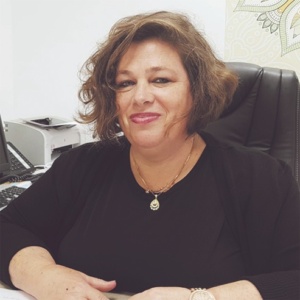
Etti Tzabari, Principal of AMIT Kennedy Junior and Senior High School, Acco
Etti Tzabari, principal of AMIT Kennedy Junior and Senior High School in Acco, says that alongside educational endeavors, school principals also find themselves dealing with financial issues almost 24 hours a day. “The budget management system allows us to navigate correctly between what actually exists and the needs of the school, at the click of a button. Every project and every educational dream is translated into money, and at the click of a button you know if you have coverage for that desire or not.” In the past, Tzabari worked in a different framework, and the current system allows her to navigate school budget matters more easily. “The system means that there is also incredible transparency, and in the end—the responsibility and authority are yours. Do you want to start an educational project? Well, let us check if you have the budget. Do you think it is essential to hire another custodian? Great, but let’s check the economic feasibility.”
Omesi adds that proper budget management also helps with academic success. “’Budget’ is not a dirty word. In our institutions, we allow principals to dream and make their dreams come true. There are budgets that allow for investing in things beyond teaching hours, and ultimately this leads to achievements. It is not for nothing that the AMIT Network has been first place in the ranking of educational networks in Israel for the past three years, according to the Ministry of Education.”
Another financial investment that Omesi emphasizes is investing in physical learning spaces. “The need for flexibility is especially necessary for school principals. In recent years, we have realized that there is a need for change and flexibility in the physical spaces of learning. We have opened spaces in the schools to allow for different type of learning—with the student at the center and the teacher becoming a facilitator. The standard classroom structure of a classroom with a blackboard and frontal learning is disappearing. You could say it’s an end of an era.”
Students who Think Outside of the Box
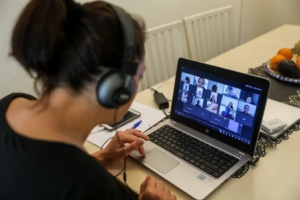
A Zoom lesson. Photo: Flash 90
Eldar clarifies that due to the journey of renewal that began in AMIT about six years ago and the establishment of a development center for the education teams—the “Gogya” Center in Kfar Batya—AMIT was much better prepared for the corona era. The network realized that students sitting for hours in front of Zoom is something that will not last long. Therefore, working with teachers throughout the country, groups of teachers have been set up to develop “Learning Journeys” in all subjects, as well as groups of therapeutic staff to address emotional issues. The goal is to create a learning experience and reduce the hours of sitting in front of the screen, while listening to the teacher. “Most of the learning during this period is through a combination of study units called ‘Learning Journeys’. Each unit in the journey consists of a short opening lecture given by the teacher, followed by independent work that the students perform on their own, and later there is cooperation among the students. There are also units that the students themselves facilitate, as well as research work and personal dialogue with the teacher,” says Eldar.
Omesi clarifies that “in the end, AMIT aims far beyond having every student successfully complete the matriculation exams. We strive to raise students who know how to learn independently, write an algorithm, students who know how to work collaboratively with others. We teach the students skills and try to extract the maximum from each one of them. The goal is that AMIT graduates will have self-confidence, with the ability to be flexible and adaptable to change, will know how to work independently, explore for themselves and think out of the box. Our information systems make it possible to accompany each student individually, check their progress and skills, and see what they have experienced and what they have not. It is an amazing tool for principals and teachers that allows them to accompany each student and give the appropriate help so that they can constantly improve their achievements.”
Professionalism of a High-tech Company
Still, without studies it is impossible. Sahar Sigavi, the head of Pedagogical Development who is in charge of bagrut exams at AMIT, explains how much the information systems help him in his work. “The information systems allow us, with the click of a button, to get a full network-wide picture and a close-up of a particular school on one screen. With a small click you can see the entire current bagrut situation as well as predictions for the coming years, and especially examine the majors offered by each school.”
 According to Sigavi, the data is a tool for learning from the system. “I can identify a school that has raised its bagrut scores significantly and learn from them what they have done for the benefit of other schools. On the other hand, I can see a school that has a drop in the 5-point math group and check what happened. Is it related to a particular teacher? To a particular period? If the students were not prepared and motivated in the 10th grade, I will make sure to provide them with the best teacher in 11th grade. My goal is to tailor a program to each school in light of the trends we identify, to push for study for the five-point bagrut exams in English, mathematics, physics, and even to provide individual responses for each student so that he or she can reach their maximum.”
The method works. According to the Ministry of Education, in comparison to the achievements of the country’s educational networks, AMIT leads in the overall grade and in the number of students studying for five point mathematics bagrut exams, and also those who earn matriculation certificates with honors. Sigavi says he also uses the network’s system that allows him to send messages to students and their parents. “We ask them questions about their feelings about distance learning, if they feel connected even during this time, is their camera turned on during lessons and why, and more. Some of the questions are generic and some of the questions are dictated by specific schools.”
Etti Tzabari, principal of AMIT Kennedy Acco High School, says that the system provides an opportunity to develop a student evaluation model, map the students, check who is at a more advanced level and who less so, and even identify personal difficulties. “It allows us to help to each student individually according to his or her difficulty, and on the other hand to promote outstanding and gifted students. At the click of a button, I also receive answers to the question of which lesson is meaningful and which is not, if there is a particular subject that needs to be strengthened, and which subject needs improvement. We are constantly learning for the benefit of our students. The information systems allow me to do all this with the professionalism of a high-tech company. All the information flows to you and you are responsible for using it. When a principal and teacher use the information correctly, it is a fantastic resource that can propel any student and any educational institution forward.”
Click here to read original article: https://www.makorrishon.co.il/good-to-know/286315/