
The corona pandemic that began in March 2020, between the holidays of Purim and Pesach, caught all of us—the educational teams, students and parents—facing a large and surprising challenge. As time went on, the plague spread, and as it did, the ways in which the educational system dealt with these new challenges needed to expand and increase. So too, the interpersonal relationships between teachers and students began to take on new significance. At our school, we quickly understood that to successfully navigate the new reality, we would need to learn to live alongside the virus. Our school prepared to quickly make the pedagogical and technological adjustments necessary to become a safe space for students, and “distance learning” was structured in such a way that it allowed for a blend between virtual and in-person learning, according to the guidelines. We all understood that this new challenge was facing the entire world, and that questions related to the need to educate, teach, promote and evaluate just kept getting bigger. And most importantly, in my mind, was the question of what is the role of a teacher as a “human factor” in an era when students are in their homes, glued to screens for hours on end.
During the same time, mere days before Yom HaShoah (Holocaust Memorial Day), my students and I, their homeroom and history teacher, were in the midst of a unique project which examines the transition from the Holocaust to our rebirth in the modern State of Israel. Students learn about the story of Mrs. Rachel Herzel, a Holocaust survivor, and Rav Yair Getta, who made Aliyah from Ethiopia in Operation Moses and serves as a homeroom teacher in our school. We host Rachel at our school each year to share the story of her childhood in Hungary, her experiences during the Holocaust, Aliyah to Israel, and the wonderful family she was able to build here. Her grandson, Udi Franklin, is a teacher at our school, and he ensures that his grandmother continues to meet with our students. Due to the corona pandemic, in-person meetings were cancelled, and we needed to find a different way to create an experience for our students. I found myself challenged to find meaningful ways to bring these values-based lessons to our students, within the new environment and the ever-changing Ministry of Education guidelines.
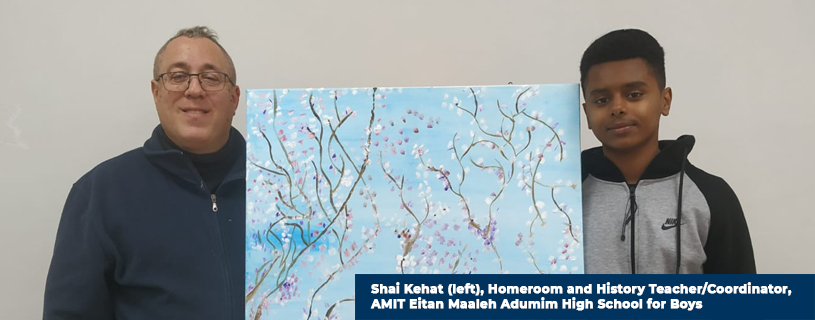
I am also an artist who integrates drawing into my classes, allowing students to connect through art, in an experiential and values-based manner. Together with my students, we painted some powerful moments in history that Rachel shared and gave her the painting. She was incredibly moved, and the students felt that meeting a Holocaust survivor, especially today, as there are not many left from that generation, was something very special.
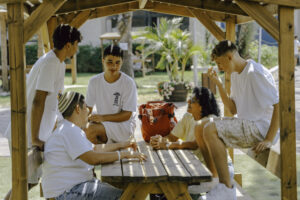
The atmosphere at our school during these challenging times is excellent thanks to the strong feeling of being a family, and camaraderie. Our principal Daniel Beeri provides support, the creativity , transparency, and sensitivity, about the needs of teachers, students and parents. Our staff’s ability to create a sense of trust between all partners enables us to deal with and overcome various roadblocks that come up so frequently. I believe that our staff’s strength is in our flexibility and creativity, and this leads us to educational success even during this difficult time. Our staff go well beyond the distance learning and goes into the community to meet with students and their families in courtyards or parks, building trust and fostering relationships—this is where we see the immediate positive response by students and parents alike.
I believe that the corona pandemic has taught, and continues to teach us, that education is not just about transmitting information, but most importantly, it is about interpersonal relationships. I am confident that down the line, what students and their parents will remember from this time is the human element—the educators who reached out, who were there to listen, who understood their needs and found innovative and unique ways to communicate with them during this challenging time, changing the experience of “distance learning” into one of closeness and connection…and who succeeded in implementing this in our ever-changing world.
Shai Kehat, AMIT Eitan Maaleh Adumim
Once a year, the Department of Education’s Religious Education Arm recognizes unique teachers for their commitment to education, for taking initiative, innovating and creating groundbreaking educational models. Shai Kehat was one of the teachers who was selected this year, a veteran teacher from AMIT Eitan Ma’aleh Adumim, Shai Kehat.