
The Challenges of Managing a Residential Setting for Youth-at-Risk
In the Days of Corona
By Niva Ament
Entering the doors of the modest building of AMIT Frisch Beit Hayeled in the Gilo neighborhood of Jerusalem, one immediately feels as if he entered into a parallel little world with its own sense of time, language, energy, and its own set of rules.
Everything about this residential home for Israel’s at-risk youth is designed to offer a familial therapeutic setting, in order to encourage children who have suffered greatly a chance to heal.
The children of AMIT Beit Hayeled constitute a varied group, ages eight to fourteen, coming from all over the country, some from religious homes, others from secular. All have experienced trauma in one form or another. Some were neglected, some abused, and some witnessed scenes that are beyond a child’s (or an adult’s) ability to properly cope. As a result, many of them have developed significant learning issues, and some suffer from psychiatric illness clearly stemming from trauma.
Most certainly, they are all beautiful—they are children full of life and are abounding with hope for a better future. One by one, they slowly let the staff into their worlds and we take part in their personal journeys.
The hands-on staff at AMIT Beit Hayeled is a mix of exceptional individuals—young married couples (many with their first baby) and 16 b’not sherut (young women in National Service), who together “parent” a group of ten to twelve children. Each group of children resides in a small apartment-like space with up to four children per bedroom, common areas, and many little touches that make their residential space feel like a home (my personal favorite touch is a hanging organizational rack with 12 pockets to hold school lunches).
Over the last three weeks, we sensed more than ever that we live in a bubble existence. Outside of us, everything was closing, beginning, of course, with the abrupt shutting down of the school system. At first it seemed that at-risk youth and children receiving special education would be protected. Since the majority of AMIT Beit Hayeled’s children learn in special education settings, we were hopeful that they would continue to attend school. We soon learned that this was not the case. Our new reality hit us hard—our dedicated staff would need to push themselves even further, caring for the children on a 24/7 basis without the reprieve of school hours. Soon, it became impossible to go outside the borders of our yard, since each small group of children and staff clearly exceeds the number permitted to be outside and would be considered a prohibited “gathering”.
We were told that we were deemed a “mifal chiuni” (an essential enterprise, comparable to the status given to grocery stores)—it soon became clear that we would stay open no matter what was happening in the outside world, and we would need to make adjustments in order to cope with the new coronavirus reality.
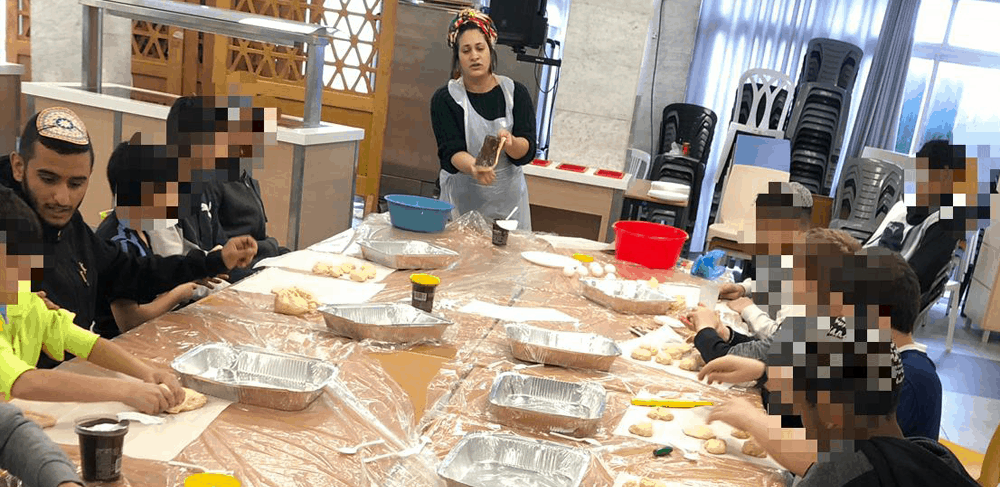
Our new daily reality soon included lesson plans, and lots and lots of creative activities (baking, beat boxing, origami, dog training, petting zoo, soccer with small teams), anything and everything to fill the days with a positive spirit for children. The intricate new daily schedule rotates small groups of children around the various areas of our small building—swing set, study room, lunchroom, art room. Rotate. Repeat. Day after day for three weeks.
AMIT Beit Hayeled is not only home to our fifty-two. In addition, we normally run an afterschool program for roughly thirty additional children who come to AMIT Beit Hayeled every day for a balanced meal, homework time, recreational activities, and one-on-one therapy. During the coronavirus crisis, sadly, these nearly thirty children remain in their homes. It was deemed too risky to allow a revolving door policy and to have children enter and exit the building on a daily basis, not knowing what they were exposed to from the outside. Meanwhile, we are not only worried about preventing illness among our children, we are concerned about maintaining the general welfare of these children’s families, who more often than not are facing severe difficulties, both economic and otherwise. These families are now struggling more than ever. Our therapeutic staff makes phone calls around the clock to check on them. Our counsellors and b’not sherut, donning masks and gloves, facilitate the delivery of food packages to their doors. These families are part of AMIT Beit Hayeled’s larger family and we worry about the devastating toll that this ordeal will have on them.
On nearly a daily basis over the last few weeks, the government’s Social Welfare Department (Misrad Ha’avoda Veharvachah) has apprised us of new instructions. With each of speech of Prime Minister Netanyahu about the coronavirus crisis, we await to hear what the new ramifications for AMIT Beit Hayeled are. The directives are mind-boggling, even for me, a seasoned social worker of twenty-five years. There were clauses pertaining to “group bidud” (group isolation for groups of ten children and staff), to “suicidal children in individual isolation”, strict rules about how to receive children after they have left the premises, and discouragement of parental visits (which is antithetical to our usual practice of course).
It became clear that AMIT Beit Hayeled, as well as the other many therapeutic residential settings around the country, would not be able to protect our bubble existence for much longer. With staff working around the clock, children desperately missing contact and visits with their parents, and employees who live outside the building potentially affecting the building’s relative sterility by coming each day to do their work, we were awaiting some reprieve.
We finally received the new directive: divide the children into groups—one group of children who can return home for an extended Pesach vacation, a second group of children who can return home for a short time, and a third group of children who cannot return home at all.
There were many variables that entered the calculus of deciding who would visit their families and for how long. Of our fifty-two, the majority reside with us due to a court order. Thus, our decision making was shared with the social service agencies responsible for these children’s placement. Among the many factors, we considered the desire of the children to visit their parents; the wish of the parents; the mental health and resilience of the children; in one case, the exposure to grandparents who resided in the same home (who could be especially at-risk if they became coronavirus positive); and most importantly, the parents’ ability to care for them—a challenging assessment to make. How could we possibly predict the level of risk at home, the likelihood of abuse or neglect during these corona days? How can we guess what the effect of this devastating pandemic will have on parents who were already struggling with mental illness, including depression and anxiety?
AMIT Beit Hayeled social workers were forced to make extremely difficult decisions: is it safe to send a child home for an extended Pesach vacation when the child was removed by court order form the home in the first place?
Obviously, our doors will be open to any child who needs to return to AMIT Beit Hayeled during Pesach. According to the government’s regulations, a child who returns early will need to enter isolation. How will our children, many suffering from anxieties and symptoms of PTSD, fare in conditions of isolation? How will the staff take care of a child in isolation with the remaining children to care for? And the most frightening question of all—what if, Heaven forbid, someone gets sick? How will we take care of him? How will we protect our staff and our fifty-two children?
For the several children who cannot go home at all due to the danger in their family settings, what are the emotional ramifications of essentially keeping them in lockdown while their friends have left? What if we need an emergency psychiatric consultation? Who will be willing to visit us?
These questions and many more keep me awake at night.
Meanwhile, our staff has started to dwindle. Several workers have already gone into isolation, several have started to burn out from the overly taxing schedule, and most are understandably terrified by the overwhelming situation.
I spend my work hours in my new, improvised office, a bench in AMIT Beit Hayeled’s garden, in fear that I could Heaven forbid be an asymptomatic carrier and I know that I couldn’t bear the thought of unintentionally harming any of our children or anyone, for that matter.
Over the years, I haven’t burned out. Not even close. One of my tricks is to always find a flicker of magic in every day. That flicker keeps me going until the next flicker. I’ve never had a day yet without noticing a flicker.
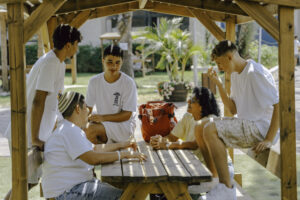
So, from my garden bench, I observe scenes that are simply magical in these days of the ugly coronavirus. A teenager who suffers from depression is enjoying the rabbit hopping on his lap, an anxious child is relaxed in his tire swing, girls are on their cell phones, one is actually doing her remote class assignment, and I am overwhelmed by the b’not sherut and counsellors adding much-needed laughter and song to these stressful days.
The most normal of families is struggling during these terrifying, uncertain times. We are not sure what the next few weeks and months have in store for any of us. We pray that our 52 children will return in good health to our protective bubble.
Niva Ament, J.D.,C.S.W., is the head of the therapeutic staff in AMIT Frisch Beit Hayeled, Gilo.