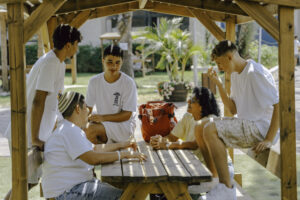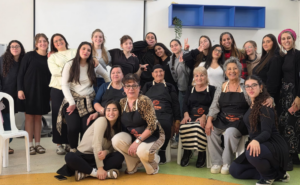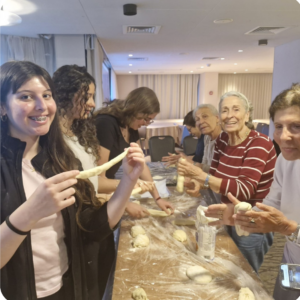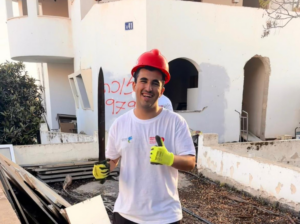

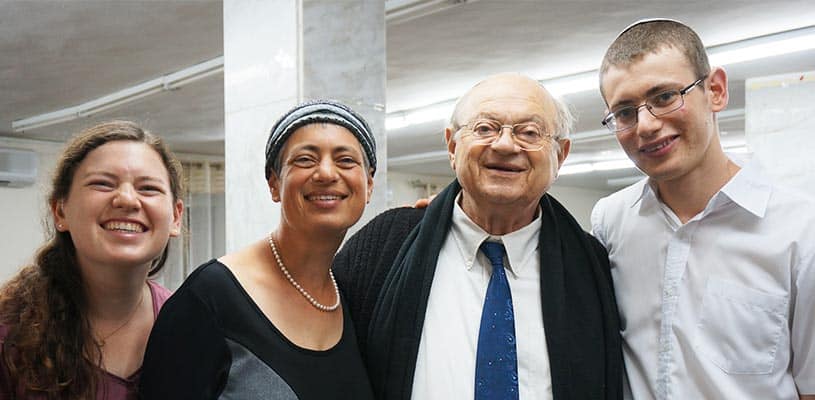
Child survivors of the Holocaust, many of them orphans, were among the first students at the Kfar Blatt youth village and other schools in the AMIT network. More than 90 years have passed since AMIT was founded, and tens of thousands of Israeli children have graduated from AMIT schools—some of whom can trace their family’s roots at AMIT back to the network’s early days.
One of these is the Frankel family. Judge David Frankel, from Jerusalem, studied at the AMIT youth village in Petach Tikva during the British Mandate era; his daughter Dini Deutsch presently teaches at Midreshet AMIT Be’er in Yerucham; his granddaughter Ella Deutsch attended then AMIT Kamah High School in Yerucham; and his grandson Naftali Deutsch studied at the AMIT B’Levav Shalem Yeshiva High School in Yerucham and is currently learning at the AMIT Orot Shaul Hesder Yeshiva in Ra’anana.
Judge Frankel arrived at the AMIT youth village 72 years ago, and spent six years there after surviving the Bergen-Belsen camp. “My brother and I travelled to Israel from Hungary through Switzerland, together with Aliyat HaNo’ar [Youth Aliyah],” he said. “Most of my family was murdered in Auschwitz. By G-d’s grace and with my mother’s help, we managed to survive,” he continued, with great emotion. Miraculously, Frankel’s parents—who stayed in Europe to search for his two older sisters—were saved, too, but the family members were only reunited 13 years later.
Frankel describes life at the youth village as bittersweet. “Half of the students had nowhere to go,” he says. “They had no family in Israel, and there were few adoptive families available in those days. We spent all our time in the youth village.” During that time, the youth village was a religious-agricultural school, where children learned religious studies and general studies like math and English for half the day and worked the other half. “We worked in all areas – in the landscaping garden, the vegetable garden, the chicken coop, the metal workshop, the carpentry shop and the bookbinding shop,” recalled Frankel. “I was one of the few who got to drive a tractor.”
The students, aged 7 to 17, spoke a mix of languages at first but then they decided on a rule—to speak only Hebrew. “That’s how we absorbed the language relatively quickly,” said Frankel.
The youth village also had a vibrant communal life, which included activities such as tree planting on Tu B’Shevat, a Passover seder, Shavuot night learning with all the children and the then-director of the village, Rabbi Yehoshua Bachrach. One of Frankel’s most significant experiences at the village was his bar mitzvah. “I had to manage alone, without parents,” he said. “I learned the cantillation notes in class and I prepared my parashah (Torah portion) on my own. I read the whole parashah as well as the haftarah. I was also asked to be the cantor for the musaf prayer.”
After six years at the youth village, David went on to study at Yeshivat Kfar Haroeh and later enlisted in the army, went to the United States through Bnei Akiva and the JNF. Now he serves as a senior judge at the Jerusalem Magistrate’s Court. “I never dreamed that my daughter and grandchildren would follow in my footsteps and be educated at AMIT institutions, and I am so happy about that,” he said.
“I was excited to continue in my father’s path,” said Dini Deutsch, David’s daughter. “Since childhood, I remember how my father always spoke with great appreciation of the youth village, which was his first home when he arrived in Israel as a child Holocaust survivor. That time was very significant for him and left an impact on the whole family,” she said, tears filling her eyes.
Through her teaching job at AMIT, Dini has grown familiar with the administrative side of the AMIT network. “There’s something here that is unique,” she said, “a network with experience that spans many years and has schools across the country…. This illustrates how much strength the network has, that it can support so many institutions that are all so different from each other. “
Dini’s family continued the AMIT tradition by sending her son, Naftali, to B’Levav Shalem Yeshiva High School, where he excelled in science. He was among a group of students who represented Israel three different times in international competitions, one of which was a contest for young innovators, in Washington, where his team won second place. “When I started learning in the AMIT network, I felt that I was part of something big—it wasn’t just me, but my whole family, which has been part of AMIT for so many years,” said Naftali. “A lot of milestones in my life, like my trip to Poland, were through AMIT, and now that I am studying at the AMIT hesder yeshiva in Ra’anana, I feel a sense of connection between all of the AMIT institutions.”
That sense of connection is also what prompted Dini’s daughter, Ella, to choose AMIT Kamah High School for Girls in Yerucham for her studies. “It fit the spirit of my family,” said Ella, who added that the school itself has its own family-like spirit. “They try to help every girl find her place and to advance each girl in a way that suits her. The continuity [of AMIT in our family] is impressive, and it is exciting to see such things pass from generation to generation.… My grandfather remembers it fondly, and I hope I will remember my school in the same way in 20 years, and that others in my family will be blessed to grow up this way.
“Who knows,” Ella said. “Maybe my children will study at AMIT as well.”