
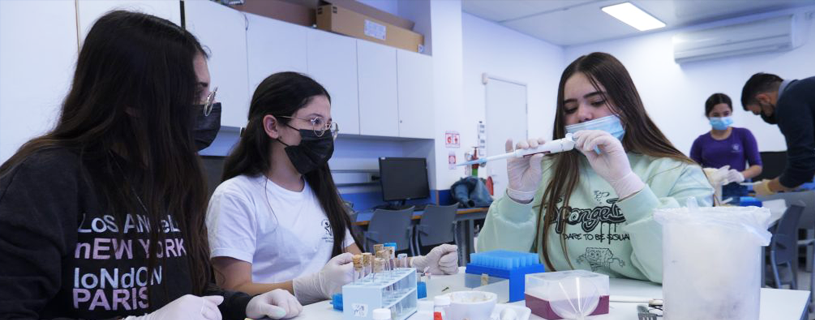
What do high school students do in a hospital lab, and how do students in the classroom develop an app together that testifies to the mood of those who are studying Zoom? The answer is a real-world network ecosystem, a project that connects students to the real world.
It is early in the morning at Shamir Medical Center in Tzrifin. In a few minutes, Mina (pseudonym) will undergo surgery to transplant ovarian tissue. She is already ready for the procedure, and together with the surgeon – Professor Ariel Rebel, director of the fertility innovation service at the hospital – they share with the students of the Amit Ma’ale Adumim school who are present in the room, in a fat treatment, a cancer patient in the past. Professor Rebel teaches students at eye level the background of the process: “According to medical studies, direct radiation to the pelvic area severely impairs the function of the ovaries. Radiation impairs the ability of the ovaries to conceive. To allow the patient to have children in the future In the radiation, we freeze parts of the ovary. “
Mina shares with her students her personal story: “I got cancer twenty years ago when I was a girl. It all happened fast. I was informed from today to tomorrow that I was entering the screenings.” The technology of ovarian tissue transplantation was not developed then, but Professor Rebel knew that one day science would find a solution to the fertility problem in women who had undergone treatments, and that the basis for this solution would be tissue freezing. Mina turns excitedly to Prof. Rebel: “I came especially on Friday to do it before I went into treatment. I was a girl, I did not think about the consequences, but thanks to you I have a girl today.” About eight years ago, the healthy ovarian tissue was implanted in Mina’s body, and thanks to her, she was able to bring life into the world. She is now planning to have another child, so she is required to go through the process again.
The students show interest, ask Prof. Rebel to tell more, and it is clear from their questions that they have already studied the subject in depth. In fact, they are here as part of a collaboration between Amit Network and a company that develops advanced medical equipment. Together with doctors and engineers, they are commissioning the development of a device that will help increase the chances of getting pregnant in women challenged by fertility, and therefore learn closely about the variety of efforts that couples go through to achieve pregnancy and the solutions available today in trying to improve them. Rebel has met them several times, and he is impressed by the thought and creativity they show: “Youth have creativity and groundbreaking thought. I am a very busy person, and yet it is important for me to teach them and invest time in this project, just like investing in interns to expose them to the worlds of medicine and technology.” From a young age. “
This project takes place as part of the ecosystem process in a real network. An ecosystem is a combination of different systems for the benefit of the student and the invention of new solutions. The issue of entrepreneurship, the ecosystem and partnerships in education is a significant part of the process of pedagogical renewal. The Amit network works with the help of experts to assimilate these values in the network’s schools. Thus, they seek to break through the boundaries of the school as we know it today and create the real-world connection systems in the fields of industry, high-tech, medicine and academia, connect and collaborate between different factors from different sectors and worlds and find new solutions out of nothing. All of these are significant abilities and skills for a person in the new world. The field leads and helps the school to move from a school concept to a learning educational community, while emphasizing the opening of the school to the communities around it – parents, graduates and business partners, academia, the third sector and more.
For example, Dr. Michael Cohen, who is entrusted with the development of technological technology in the IVF field, is also involved in the development of technological technology. Cohen, a specialist in mechanical engineering and holds a doctorate in ballistics, is the president and CEO of Jonathan Medical, which develops medical devices. advanced. To date, Cohen has developed and registered over one hundred technological patents in Israel, the United States, Canada, Australia,
“This is a rare model in Israel and around the world, which aims to expand the education of students interested in technology and science and bring them together with physicians engaged in medical research,” says Cohen. “Experience in building and obtaining tools that help establish the development. At the same time, students get to visit the laboratories of hospitals and academic institutions, and watch surgeries accompanied by engineers from the company.
Alona Ben Eliyahu, a ninth-grade student in physics and software engineering, sounds excited just before we enter the operating room wing. “The medical world is fascinating, we have already been exposed to several conversations with professors who talked to us about body systemsThis whole project opens our minds to fill directions, obviously it is much more interesting to be here than in class.”
Talia Saxonov, a tenth-grade student, says that despite her studies in theater, she still enjoys the program: “It’s fascinating. We sit down with an engineering company and come up with our own ideas on how to improve medical processes. “We are as adults and happy to hear our suggestions. It’s fun to learn a different field each time and be exposed to a variety of people and professions.
It is not easy to be a doctor, it turns out, even in the technical aspect of things. Teacher Dina Handler, deputy principal at the Amit Ma’ale Adumim School and a leader in the field of ecosystems, adds another aspect to the matter: “Improve English through articles they read in the field, but beyond that also take a personal lesson to life. Analyzing a case of infertility and learning about phenomena like irregular menstruation or polycystic ovary, are things that have risen to their awareness and will help along the way.”
You may succeed, you will surely work hard
One of the main goals of a real network is to prepare students for the real world, among other things for choosing a profession, which they do through in-depth exposure to different professions. This is the idea behind the center to which the network in Kansas was exposed – that center was established after the local university saw high dropout rates in college between the first and second year. Friedman: “Students do not really know what it is to study biology as a profession for life, or engineering or medicine, and then they burn a year and realize it is not really right for them. Our goal is to expose young students to the real world so they can make better choices.”
One means of doing so is to bring “real world” partners to the school. For example, the chain maintains collaborations in a variety of fields such as theater, high-tech and robotics, engineering and architecture and more. Friedman: “In every project like this the students learn to experience the real thing. It’s not math to have an exercise book and an answer. There are projects we don’t know how they will progress, and the only thing the students know is that they may not succeed, but work hard anyway. It’s the real world.”
Beyond getting to know different professional worlds and acquiring knowledge, there is an emphasis on providing practical tools for conducting life.
Another truly extraordinary project is “The Picture of the Future – The School of Dreams.” As part of this, about 2,000 of the network’s students take a special course with guests from the best arenas in the economy. They are exposed to prominent figures in a variety of fields of knowledge such as medicine, science, security, communications and more. Thanks to Corona, hundreds of students from the network were able to learn together for each lecture.
Edited and Condensed from an article published in Makor Rishon 3/29/21