
by David Brummer
The start of the new school year can be a time of great anticipation and also trepidation for both parents and students. I do not have children myself, but I understand that the Israeli educational system can be a little uneven. AMIT, an educational net work consisting of 110 schools and 45,000 students across the country — religious and secular — claims that it will provide an educational revolution that will facilitate change in the classroom.
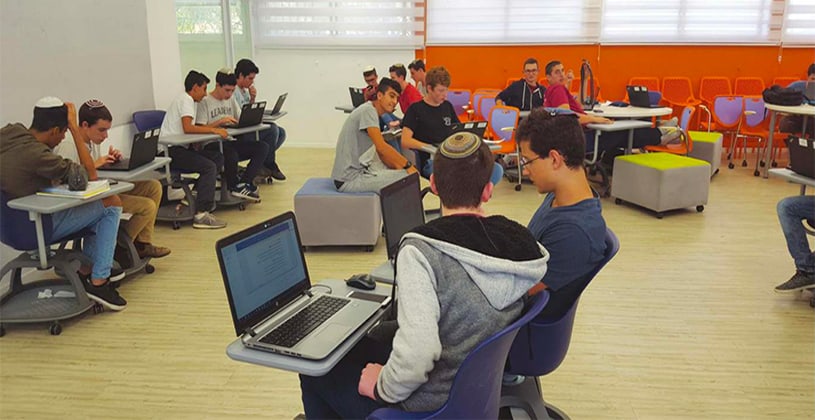
“Breaking Down the Walls” is being rolled out in schools across the country with the method of teaching changed from the core. Instead of more traditional regimented classroom teaching, the walls are literally taken down, with students learning in an open space rather than a classroom. And instead of 30 students (or thereabouts) being confined to one classroom and one teacher, 70 to 100 students will be in the open space with four teachers per age group.
Lessons are not confined to 45-minute blocs in an enclosed space, but rather whole-day learning units in open spaces, based on varied assignments related to each study material. The goal of such an educational approach is to turn the class (in fact, the entire age group) into a learning community. The goal is to enhance every student’s stronger points, while creating support to bolster areas in which they are weaker.
The effect imprints itself not only on the students, but also on the teachers, whose role will become more of a guide, rather than a transmitter of knowledge — a more beit midrash–style of learning. Rabbi Nitzan Berger, the head of the AMIT Kfar Ganim Yeshiva High School in Petah Tikva, is an advocate of the new approach.
“Today we all understand that we can no longer use the old system, where one teacher stands and speaks for 45 minutes in front of a 35-student classroom. We believe that the responsibility for study should be transferred to the students, making them want to study, giving them the tools to each find the way they study best.”
What are the benefits of such a learning environment, of turning the schools into studying educational communities? It provides more choice to students of whom to learn with, rather than someone sitting at the same table or cluster of tables. The emphasis is on the students — to choose their method of learning and go at a pace and a style that is compatible with them. This new method of breaking down the walls does not assume that students are homogeneous and learn best in the same style or absorb information at the same rate. This includes the physical furniture and its arrangement. The system allows for flexible and diverse study methods: personal study, group or pair study, large or small groups, a teacher tribune for large assemblies and more. In some instances, glass partitions can divide a special shared study space into sections, so that it retains the feeling of group work, but can made to feel more intimate.
At present, the schools will not offer this learning style for English and mathematics. However, Yael Nemeth, math teacher in the AMIT Amichai Yeshiva high school in Rehovot, says, “In the new learning space, the student is active. Using independent guided learning, I have seen how a student can reach better understanding and performance. They feel they are trusted and are allowed to train their special skills in a variety of methods, much more fascinating and challenging than staring at a teacher and blackboard.”
Options for study will be available for five full days of the school week. In each day, students will study only four subjects, with two or three hours devoted to each. Every student can choose the study method they favor out of a list of different methods. The teachers have all undergone special training and built a special website that will guide the learning in each course. One of the special learning methods is in groups — for example the jigsaw method — where every student in the group has a task; task groups work together and then reassemble in the basic groups to share knowledge, pair learning and project-based learning.
The AMlT educational network call this new approach “Gogya.” “We believe the change will occur from the bottom up, through teachers and not from directions they receive from the top,” says Dr. Amnon Eldar, AMIT’s director general.
Eldar is confident that the new system will be a success and will not detract from students’ ability to study for matriculation exams. He believes that it will better provide today’s students with many of the skills they will need to be successful in the 21st century.
This article was originally posted in the Jerusalem Post.