
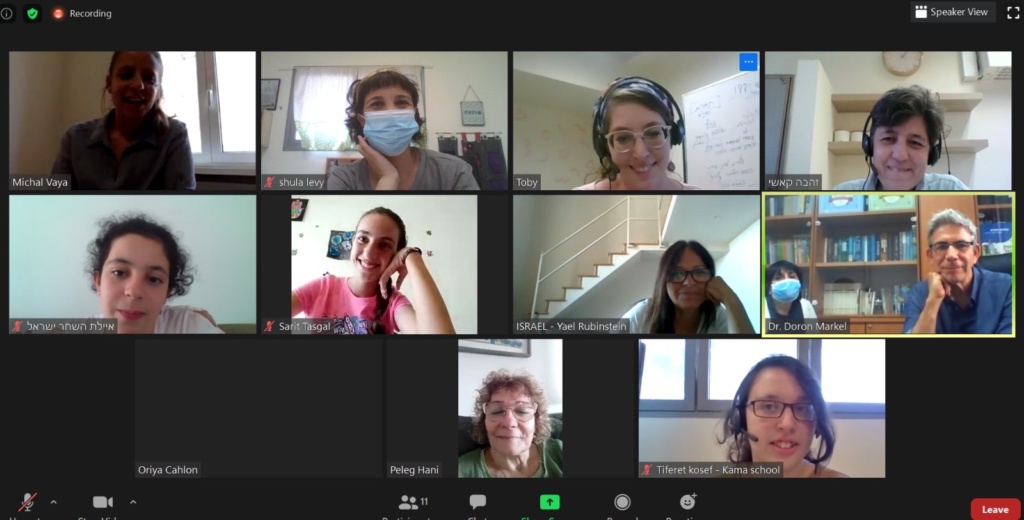
Four students from AMIT Kamah in Yerucham won first place in the Israel Sustainable Development Goals Program (ISDG) competition, a unique program that gives students the opportunity to create solutions for Third World countries.
The winning students will continue their research, and hopefully – global health conditions permitting – present the research to a panel of experts in Rome, provided that travel restrictions are eased.
The ISDG Program was created by the Ministry of Education, the Foreign Ministry and the Jewish National Fund with the goal of engaging student involvement in the international effort to achieve the United Nations Sustainable Development Goals (SDGs) for 2030. The ISDG program gives students an opportunity to participate in affecting, and ultimately providing a better future for the world.
Involvement in the ISDG program is very much in keeping with AMIT values, that is helping the community, in this case the worldwide community. The ISDG program allows students to understand developing parts of the world. Students grades 7 to 13 propose an initiative to help solve one or more of the 17 United Nations objectives in a developing country of their choice. Its goal is an integral part of the State of Israel’s objectives and values as Israel has the ability and seeks to serve as an example to other countries by sharing its knowledge, tools, and technologies.
The four students from AMIT Kamah in Yerucham who participated in the ISDG program are Sarit Nitzanya Tasgal, Ayelet Hashachar Israel, Tiferet Kosef, and Oriya Cahlon. Together with their mentors, Toby Tabak and Zehava Kashi, the students researched the drought periods in Ethiopia and its effects on the prolonged periods of hunger faced by residents. They have been working on producing a protein from locusts that can be helpful to developing countries.
(Locust breeding as an effective solution to the hunger problem is known to both business owners and the United Nations. Grasshoppers have significant nutritional, ecological, and economic benefits.)
“We have dealt with the way that the growth of the locusts can be assimilated as an agricultural industry in private farms, alongside traditional cattle until it can expand and possibly replace some of it,” the students explained. “Both the locust and the vegetation needed to grow it are local, familiar, and available, as are the conditions for making the locust into a grasshopper.
“We were thinking of developing a mobile growth cell of about ⅛ cubic meter, made of ventilated mesh walls. The structure can be folded into a flat shape and thus moved easily. Its shape is a hexagonal prism that allows structural stability, modular positioning, and volume maximization compared to the perimeter. The stiff bottom will be filled with soil for egg-laying and anchoring the plant roots used to feed the locusts. One cell will effectively contain dozens of grasshoppers. The mobile compartment allows control of light, heat, and humidity conditions by simply moving according to the micro-climate in the yard and also allows the addition of more growth cells according to the family’s ability.
“The first phase requires the support of a biological research team and a local marketing team, who knows to brand the idea to the residents as the key to local and sustainable economic nutrition independence,” the students said