
 AMIT: A vanguard of modern education
Interview with the president of the AMIT Network
By Jason Blackshaw
Audrey Axelrod Trachtman is the national president of AMIT, Israel’s premiere educational network. A professional businesswoman, she has been involved in voluntary philanthropic work for a long time, especially in promoting the well-being of AMIT. The organization has been in existence since 1925, and the current president is determined to continue its task of promoting excellence in educational opportunities for all Israeli youth.
In a talk with The Jerusalem Post, she describes this unique school system. “Our motto is ‘Building Israel. One Child at a Time.’ In practice, that means giving all our students, no matter what their socioeconomic background or geographic location, the best educational opportunities for the benefit of each one of them and for the benefit of the state. The concept of all our schools is to create innovative educational communities of learning throughout Israel to meet the country’s educational needs.”
In your opinion, what are AMIT’s most important achievements?
Our most important achievement throughout our 95 years is in maintaining our high level of education while adapting to the evolving needs of education. At its core, it is about encouraging children to dream and to help them reach the stars. Children from disadvantaged homes often don’t know how important it is to have dreams, whether it is to become a successful musician, architect, tennis player or venture capitalist. Disadvantaged kids also rarely have role models for success, so it’s not something they think about. And when it comes to girls, professional role models are even fewer, and their opportunities are even more limited. By giving them a good education, we enable our graduates to successfully integrate into society.
We are also very conscious of the constantly changing needs of our society and the great advances in technology. Therefore, we put an emphasis on teaching mathematics and physics. Our teachers are passionate in their task. The result is an 86% pass rate in the Education Ministry’s matriculation exams, and proudly, many of our students have earned impressive awards in academics on the national and international level.
The level of education in Israel seems to be dropping. The latest PISA [Program for International Student Assessment] results were problematic. Is there cause for concern, and how is AMIT coping?
We should constantly strive to improve educational standards. But with regard to PISA and exams in general, one should bear in mind that they are based largely on educational methods that are, to a certain extent, outdated.
Educational innovation is one of our strongest points. A system whereby students learn something by heart and then parrot what they learned on exams is no longer effective. We believe that modern education should be based on allowing the students to think for themselves, to make effective use of what they were taught at school in their everyday lives, and to use their education to promote their well-being. In short, to make the most effective use of the information they have in hand.
How do you implement that philosophy? Your schools have an 86% pass rate in matriculation exams compared to 70% nationwide, And exams, as you said, are outmoded.
We are a very innovative educational network, and these innovations are constantly practiced in our classrooms. We also place great importance on the future success in life of our graduates. We make sure our students achieve good matriculation grades because it opens many doors, such as entry into university and higher-level placement in the IDF. This doesn’t mean that we neglect our innovative educational system. We operate on the basis that the task of our teachers is not only to impart information but also to facilitate the students’ applying the information they receive.
So, we make full use of the newest technologies. We are aware that in the peripheral areas of the country it is more challenging to find a significant number of strong and innovative teachers, especially in mathematics and physics. To overcome this drawback, we use the Internet for learning purposes. Teachers give ‘remote control classes.’ They have proven very successful because we make sure that they are both instructive and interesting.
Very significantly, we have pioneered the Gogya educational system. It is AMIT’s innovative 21st century teaching and learning method and one of the most modern educational systems. Gogya is a philosophy and place derived from the word ‘pedagogy.’ It is AMIT’s state-of-the-art hub for educational innovation and professional training and development. It is where our teachers continue to learn how to give the best to our students.
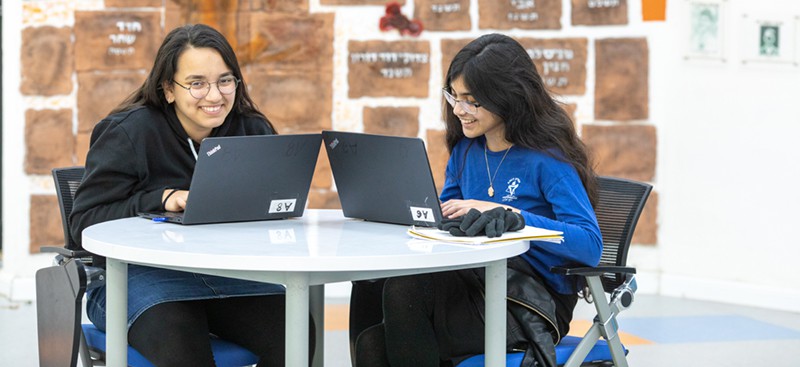
We have developed creative learning communities, redefined the role of teachers, and promote students teaching other students. And we ensure that it is done in a creative atmosphere with glass walls, modern furniture and optimal use of space. All the desks and chairs have wheels to create modular and flexible learning environments.
In addition, we use distance learnERN ing to bring university classes to our students. We want our students, especially those from underprivileged environments, to realize that they have the potential for a university education.
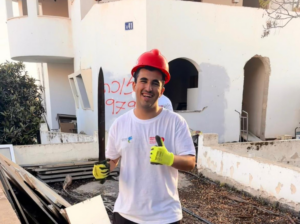
As we are constantly innovating our teaching methods and giving our students a 21st-century edge, we stay true to teaching our core Jewish values. We emphasize giving back to the community, taking care of one another, and doing good works in a wholistic approach so that our students not only contribute to the State’s growth and safety, but that they also become citizens with good values.
You operate under the jurisdiction and pedagogical guidelines of the Education Ministry, which is considered to be very conservative. Does that create problems with your advanced teaching methods?
No, it doesn’t. Our curriculum is based on the guidelines of the Education Ministry, and we have our innovative educational methods. The two work in concert, actually, and do not clash. The Education Ministry is very satisfied with our work primarily because it is holistic in nature. That is, it includes all sectors of society. In education, we act as a bridge. We have secular, religious and Haredi schools in our network. We embrace new immigrants and have helped integrate successive immigration waves into Israeli society. As such, we are an important element in helping bridge the socioeconomic gap.
Some 70% of our schools are located in peripheral underprivileged areas. The students finish school with excellent grades. Consequently, they are integrated into mainstream society in a way that might not have been possible without an AMIT education.
We are proud to work in partnership with the Education Ministry and are very proud of its recognition of AMIT as the number one system for the last three years in a row. The Ministry visits our Gogya center and learns from our methods. We are a role model for other schools and education systems in the State. We aim to serve as a reference as we are leading the educational revolution in Israel.
AMIT has a number of Pre-military junior colleges. Please elaborate.
These colleges are part of our effort to give opportunity to underprivileged and disadvantaged students to become active contributing members of Israeli society. The junior colleges give our students a chance to continue their studies, in grades 13 and 14, before they do their national military service. In essence, the junior colleges act as an extra step for them by giving them an opportunity to be buttressed by a curriculum that includes academic, technical, life skill classes, and Judaic studies to better prepare them for what is ahead. In these colleges, they can choose a technical subject such as electronics or mechanics and do two years of coursework and specialize in their subject of choice. Upon completion with a technological certification, they join the IDF with a meaningful position relating to their field of study. We are proud that many of our junior college graduates continue to climb the ranks of the IDF serving as officers and commanders in the field. Upon completion in the IDF, they are able to enter the workforce as productive members of society, utilizing the professional training they received at AMIT.
AMIT started out as a Jewish women’s organization. Do you have special educational programs for girls?
AMIT was founded by women who were affiliated with the Mizrachi movement in the US. The women decided that instead of raising money and giving it to the men in the movement, they would use the money to promote an organization of their own. That was 95 years ago, and a significant part of our history. Up until a year ago, the board was made up solely of women. Now five members of our 30-member board are men. We came to this decision because in modern society where women are an integral part of business, politics – in fact, everything – the day of the purely female organization is perhaps no longer relevant as it once was.
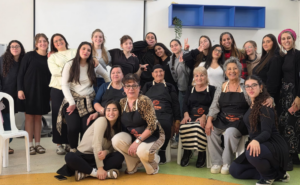
That being said, we continue to remain connected to our origin and strongly rooted to the ideals of women’s empowerment by providing opportunity to our female students throughout the AMIT network. We have programs that encourage our female students not only to dream, but to develop purpose, confidence, and skills to turn those dreams into reality. An example of this is special sessions with leading women in business, especially in the hi-tech industry, thereby creating role models for these girls. Education without motivation, role models, and confidence is a hard road to hoe. These special programs allow AMIT students see themselves as successful, we are giving them a giant leap forward into a dream-realized and meaningful accomplishments. Our female students have myriad opportunities where they learn leadership skills and we constantly bringing in inspiring and successful female role models in many fields to underscore the possibilities for their own lives.
How do you see AMIT in 10 years’ time?
We are in the midst of an educational revolution. I sincerely hope that in the coming years we will be able to complete it. AMIT, as a leader in educational innovation in Israel, will lead the country in this revolution. AMIT is also expanding: more schools, more students, and taking the lead on redefining the educational landscape in Israel. This expansion will continue unimpeded in the years to come.
 Gogya: A pedagogical breath of fresh air
By Jason Blackshaw
Over the past five years, the AMIT Educational Network, with guidance from experts at Harvard University, has developed an innovative educational philosophy referred to as Gogya. Derived from the word “pedagogy,” Gogya’s goal is to create an alternative learning experience and redefine the teacherstudent roles within the classroom. AMIT’s state-of-the-art Gogya Center in Ra’anana serves as a model center to educate thousands of teachers on how to teach differently, in a way that makes the learning relevant for the 21st century.
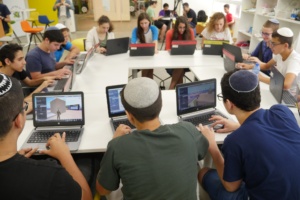
We live in the age of Google, in which a wealth of information is instantly accessible at everyone’s fingertips; traditional classrooms based on memorization of facts are no longer relevant. With this realization, AMIT has broken down walls, literally, to create open learning spaces and has developed modern teaching methods. Teachers serve as learning facilitators by setting goals for students to achieve at their own pace. Thanks to the open space and modular furniture, it is easy for the students to choose how they want to learn, be it working individually on a laptop, in small groups, class-wide discussions or project based learning. The Gogya-style space, with its comfortable, movable furniture, glass walls that you can write on, and dry-erase tables, creates a myriad of exciting learning opportunities.
A result of the Gogya concept is education communities where students and teachers alike enjoy the process of learning together and personalized learning experiences for every student according to individual desires and educational needs. In addition to gaining knowledge, the emphasis is on teaching students the skills, values and tools needed to navigate the 21st century world.
At the heart of this network-wide innovation are the teachers. The AMIT Educational Network is turning its 108 schools into educational communities in which teachers work together to create learning units that are meaningful, long-term and holistic. They identify the central idea they want to relay over the course of the unit and figure out the best method to teach specific skills and values, using relevant methods and meaningful assessment.
The Gogya methodology provides students with learning that is relevant for the 21st century, including concrete tools such as presenting in front of a crowd, research and information assessment, critical thinking, team work and creativity. Equally as important, Gogya’s purpose is to give students, especially those from Israel’s socioeconomic and geographic periphery, confidence in their abilities and their capability to succeed. To date, all of AMIT’s schools have innovative, open learning spaces with teachers supporting and utilizing the Gogya method, taking an active part in this educational change. AMIT is truly leading the educational revolution in Israel.
Reprinted with permission of The Jerusalem Post. Click here to see the original article.