
Rav Noam Krigman, the principal of Yeshivat AMIT Nachshon, in Mateh Yehuda, believes that his students must understand that Israeli society comprises different sectors and be tolerant of them. He also believes that his students should have access to the best teachers, which is why he hired a Muslim to teach conversational Arabic at his school.
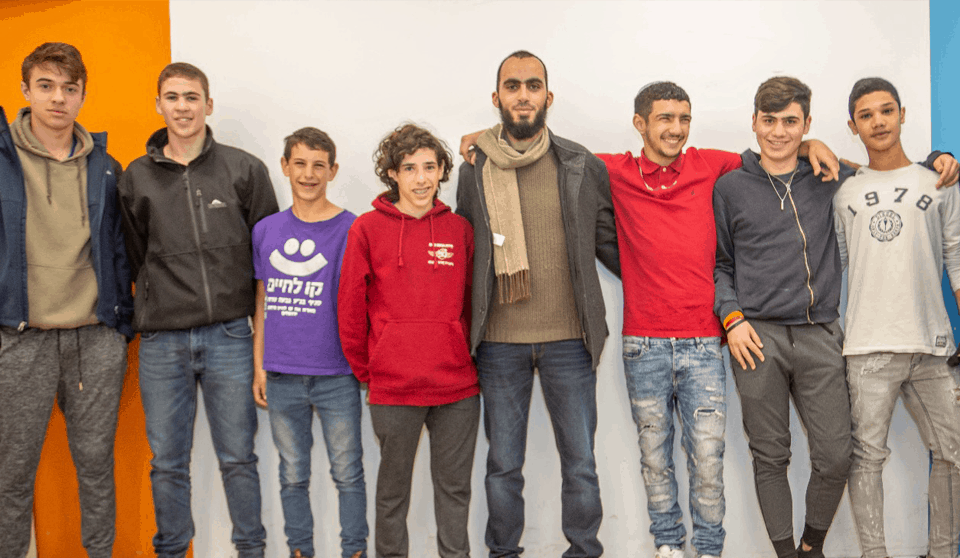
Yasin Barhom, a teacher from the Branco Weiss school in Ein Rafa (about six miles west of Jerusalem), recently became the first Muslim to teach at a yeshiva in Israel. His hiring made headlines across Israeli media—and while it is uncommon to see a bearded Muslim at a Jewish high school, for Krigman it was a natural decision. Some even saw it as a brave one in light of the fact that Krigman’s niece, Shlomit, was murdered in a stabbing attack in Beit Horon in 2016.
“From the moment I met Yasin, it was clear to me that it was right for him to teach at the yeshiva,” Krigman told Israel’s Channel 13. “Our goal is to break barriers, to inspire curiosity in our students, to get to know the other. When you have a conversational Arabic class, the most logical thing is to have someone who speaks Arabic at home, as his mother tongue, teach it.”
The students greeted Yasin with some trepidation on the first day of class, but his approach was to allow them to ask whatever questions they wanted—even tough ones or those based on preconceived notions of Arabs. He told Yedioth Ahronoth that he wanted to confront the elephant in the room off the bat.
Rav Krigman “feared that the students would embarrass me with questions about my religion and nationality. I told him, ‘I’ll handle it. What will they say about me? Terrorist? Murderer? I’ll cope and explain it to them,’” he told the paper.
Once everything was out in the open, he said, the students were surprised to learn that they were similar in many ways. “Today they understand that you can’t make generalizations and that not every Arab is a terrorist,” he said.
Krigman said that Yeshivat AMIT Nachshon teaches a Judaism that he described as bigger and broader. “Getting to know someone who is, theoretically, the most different from you is part of that learning experience. The main point is to collaborate on such a joint initiative.”
He also said that the school believes in encouraging students to pursue their interests, whatever they may be. “Studying Arabic is the right thing for those who choose it,” he said. “It is important for us that our students recognize and get to know different parts of Israeli society and to encourage tolerance.”