
“When everyone was in quarantine, we had a huge house with fields, swings, and a trampoline”
Picture Credit: Avishag Sha’ar-Yashuv
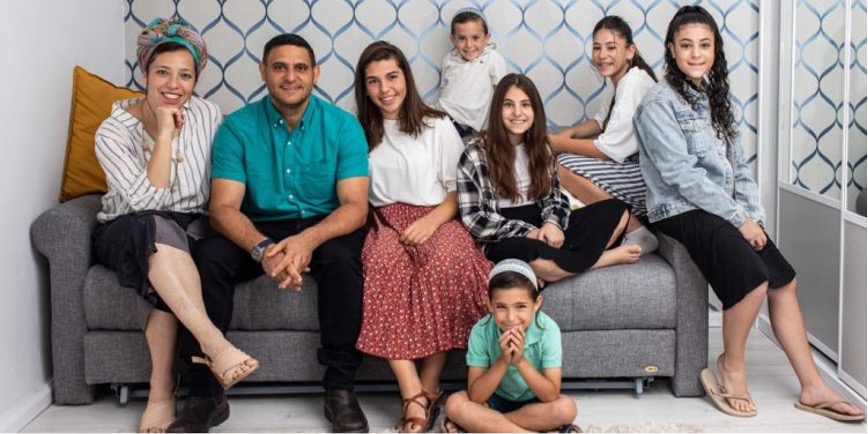
The Shaki family: mother Dina, 41, an educator at AMIT State Technological High School in Kiryat Menachem; father Evyatar, 44, director of the AMIT Frisch Beit Hayeled in Gilo; Ayala, 17, a student at Ulpanat Kochav Yaakov; Shira, 14, a graduate of Noam Girls School; Ruth, 13, a student at Ulpanat Tzvia; Avigayil, 10, student at AMIT Reishit; Avner, 7, student of Talmud Torah Eretz HaMoriah; Hillel, 7, student of Talmud Torah Eretz HaMoriah.
The House
Their living space is six rooms plus a courtyard and is on the lower level of AMIT Frisch Beit Hayeled Children’s Home. It has a separate entrance. “We really love the apartment and are attached to it even though it’s not really ours.” The apartment was recently renovated and the space expanded. “We moved the children between rooms. We came here when the girls were still in elementary school and now they are all in middle and high school, and the house should allow them to live comfortably.”
Good Morning
Evyatar gets up at 6:30 a.m. and goes to shul which is just across the road. Dina wakes the children and makes them sandwiches before they disperse to their respective educational institutions. “The morning is always crazy,” she says. “We are a family of night owls and usually go to bed late.”
Challenging Education
Dina teaches 11th and 12th grades at AMIT State Technological High School in Jerusalem’s Kiryat Menachem neighborhood. “This is a challenging job within education, working with amazing youth who did not manage well in other schools, and have amassed not a small number of negative experiences. At the foundation of this wonderful work is the personal connection, the smile and the belief in each and every one of them.”
Evyatar runs the AMIT Frisch Beit Hayeled Children’s Home in Gilo, a therapeutic residential facility supervised by the Ministry of Welfare. “The children who come here have been removed from their homes due to difficulties and complex situations. The mishpachtonim (family-style apartments) are led by married couples, along with two National Service girls and a professional support team that strives to help the children develop, strengthen their faith and confidence in themselves and the world, and allow them to dream and fulfill their dreams. My job, by and large, is to be the ‘big abba’ of this home, both of the staff and of the children, in the professional and logistical sense as well as in the emotional sense.”
Residence At Work
Living in Beit Hayeled itself allows Evyatar to strengthen ties with the children in the home. “On Shabbatot I make sure to play with them, be with them, and experience them. For our own children, there are quite a few benefits to raising children in a place like this, which has a music room. All summer their schedule is bursting with activities. There are outdoor games all the time, and all the kids play together. There is a feeling of a neighborhood, everyone knows everyone,” he says. “They grow up in a slightly different atmosphere and are exposed to the realities of life that most children their age are unfamiliar with. There are complexities in caring for the amazing children here. But it is an amazing privilege to give and receive from the children in Beit Hayeled, and we feel the help of G-d and divine providence.”
A Special Knock
Evyatar notes: “There are advantages and of course disadvantages to the fact that I live and work in the same building. Especially at family dinners when there are almost always knocks on the door. We organized a special knock with our neighbors so that our hearts won’t sink every time they come to borrow some eggs.”
Covid-19
During the closures our kids had to stay in the building with all the children in Beit Hayeled, without going on vacations or going to school. “It was crazy and a bit unreal, but when everyone was isolated in their apartment or house we had a huge house with playgrounds, swings, a trampoline, a table games floor, a music room with a studio, a computer games room and a library.”
Legacy
Dina grew up in Kiryat Ono, to immigrant parents from Poland and Slovakia who came to Israel because of pure Zionism. “My mother fled while it was still forbidden, and at the age of 18 she immigrated to Israel with one suitcase. My father did not know he was a Jew after the Holocaust and grew up as a non-religious communist until he found out and immigrated to Israel.” In later days in Israel, they both became religious. “They built themselves and their family on their own, without any help and without their parents. It was a house of simplicity, values of Zionism and giving, full of love. They are both educators at heart – Abba a teacher and Ema a kindergarten teacher.”
Evyatar is the son of Avner Shaki, Minister of Religious Services, Deputy Minister of Education and Member of the Knesset for 19 years. The elder Shaki came from the world of academia and was a law professor. He was widowed by his first wife and at the age of 42 met Evyatar’s mother, 22 years old at the time. Avner studied with his father in the Faculty of Law and was an instructor at the Achuzat Sarah dormitory, where the four children from his father’s first wife studied. In all there are seven brothers and sisters. “At home it was forbidden to behave badly. It was forbidden to embarrass ‘the firm.’ Abba was a man of the book living a spiritual life, and Ema was everything at home, including being the only one who had a driver’s license,” says Evyatar. “All technical matters were her sole responsibility, including those usually given to men. Over the years she became a Torah scholar who is also a sought-after lecturer throughout the country.”
Path
Dina was a group leader at the Bnei Akiva Kiryat Ono branch, served in the Maftan program (which helps youth who have disconnected from the system), and taught Judaism in secular schools. She later completed a bachelor’s degree in logistics and education.
Evyatar studied at Yeshivat Shavei Chevron and was a group leader in the Bnei Akiva youth group’s Rechovot branch before serving in the army. He studied in Yeshivat Eli, served in the Golani Brigade, and went on to become a platoon commander in the Givati Brigade. After the army he first studied for a bachelor’s and then for a master’s degree in law, ultimately adding a master’s degree in managing informal education systems.
The Meeting
“I went out with Dina’s girlfriend, but it didn’t work out,” says Evyatar. “One Shabbat, Dina and the girlfriend and I were being hosted for a meal by a friend, and then the girlfriend threw out the idea of a match between me and Dina. The hostess made inquiries, and already on Saturday night the offer came to meet. We later got to return the favor to the friend as a reward, and at our engagement party we introduced her to a friend — and later they got married.”
Parents
They lived in Eli, then moved to the AMIT Kfar Blatt Youth Village in Petach Tikva, where they lived for four years. Dina said, “We lived with 18 boys for three years, and another year with 18 girls. We were a very young father and mother to teenage boys who had a lot of stories and baggage. We were by their side 24 hours a day, taking care of their academics, their health, their social and emotional and personal needs.” Evyatar adds: “That’s why I left the field of law. I felt that nothing came close to the strength of the boys and girls we worked with as part of the AMIT Kfar Blatt Youth Village. Every child who finished 12th grade and called to talk to me moved me, and I could not go back to dealing with legal statements and courts. I felt that was not my calling.” They are still in touch with the students and are occasionally invited to weddings or other celebrations.
Homes
From Petach Tikva, they moved to the religious community in north Tel Aviv. Evyatar was both a cantor and community leader in the Tel Baruch North neighborhood and principal of the junior high school at AMIT Kfar Blatt in Petach Tikva. Dina worked as a kindergarten teacher. From there they moved to their home in Yad Binyamin and then to AMIT Beit Hayeled. “Next year we are going to break a record and we will begin, for the first time in 18 years of marriage, our sixth year in the same apartment.”