
By Carmit Birnbaum
March and April 2020 saw the early, chaotic days of Coronavirus in Israel. The country and especially medical staff experienced a dangerous shortage of protective equipment and masks. In the south, the AMIT B’Levav Shalem Robotics Team in Yeruham decided to partner with the Yeruham Science Center to help solve the problem—by producing masks themselves.
Amitai Algom, a member of the Robotics Team, was in Eleventh grade at the time. “It was a confusing period. No one really had a lot of information about the virus yet. Some didn’t believe it was important to wear masks, of course. But many people wanted them and there simply weren’t enough to go around.” People ended up having to fashion make-shift masks at home, which was an especially difficult problem for medical staff, who were on the front lines and needed proper protection.
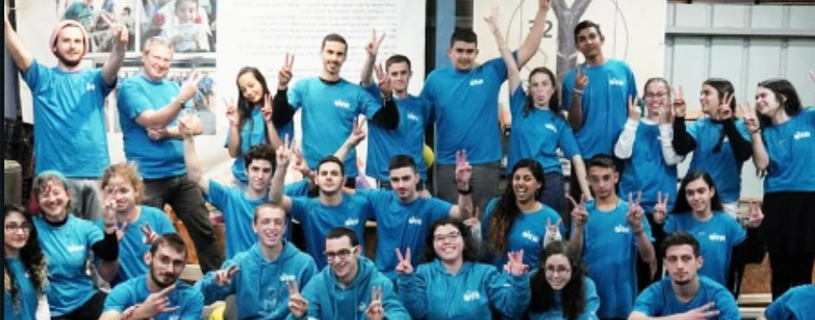
Enter the Robotics Team, which is made up of more than twenty students, including participants from AMIT B’Levav Shalem school, the local secular high school, and mentors who are teachers and upperclassmen. “During the mask crisis, we on the Robotics Team weren’t scared or worried for ourselves,” Algom said. “Rather, we were eager to help and mostly concerned for the medical staff, wondering: What can we do?”
Efforts unfolded at the nearby Yeruham Science Center, which aims to bring science to all kids. It offers courses, maker spaces, and a variety of mentorships and programming. The Team started with a Maker company prototype drawing of a mask base that could be built upon and put into a 3-D printer or laser modeling printer. The masks themselves were comprised of a surface covering the whole face made from plastic, with a tie fastening around the head.
“People started placing orders from different hospitals, clinics, and some nursing homes. We made the masks, boxed them up in crates, and delivered them to the facilities. Everyone was very happy to receive them.” Around 4000 masks were produced. First, they were funded by the Yeruham Science Center, and later the project was funded by other outside groups who supported the endeavor.
“Eventually, there was a lot more supply. Masks became more available; you could find them on every street corner. And we stopped getting orders. But we had done our part to get through that difficult period,” Algom said.
The Robotics Team was accomplished even before rising to the challenge of the mask crisis. It has participated and been awarded in various international competitions. The B’Levav Shalem school itself focuses in a myriad of ways on the complexities of Israeli society, from courses to volunteer work. Its mission also has a deep commitment to community service. It was one of five schools to win the Ministry of Education’s community volunteerism prize last year. And so, naturally, The Robotic’s Team’s interest in and strategy for problem solving is intertwined with finding ways to better the surrounding community and tackle issues within it.
The Robotics team worked on an innovative Bimba project to assist children with restricted mobility. Essentially, they created forms of transport, small vehicles, for children challenged by a range of issues. Each vehicle was tailored to a child’s individual needs.
And the team worked on another project that sought to create portable multisensory environments, a treatment invented in the Netherlands to soothe the senses of people with various disabilities or on the autistic spectrum. Since not everyone may actually be able to go to where one of these healing rooms is located, the team put together materials, lights, scents, and cushioning to bring them to various locations and replicate the experience for a wider group of people.
The Robotics Team also has an app in development which will make it possible to warn people about incidents that occur in the Yeruham area. These alerts will also be forwarded to the regional council so they can be addressed. “Usually when there is a problem,” Algom said, “people complain, and nothing happens. But this app will ensure that people are aware of what is going on—and that the issues will be put on the council’s agenda.” The app has not been released yet. But it was taken up by the council in Yeruham and then turned over to a project company that will build the app based on the team’s ideas.
Still, to date the B’Levav Shalem Robotics Team’s greatest accomplishment likely remains the masks they made during the emergency times of Coronavirus. “The situation in the country is much better now,” Algom reflects. “Still not perfect. I hope it will normalize though, and people will just take yearly vaccines for Coronavirus, like for the flu.”
Yet when it mattered most, this team of AMIT high schoolers rose to the challenge of a concrete societal need, with life and death implications on the line—and they managed to make a real contribution to the fate of Israel.