
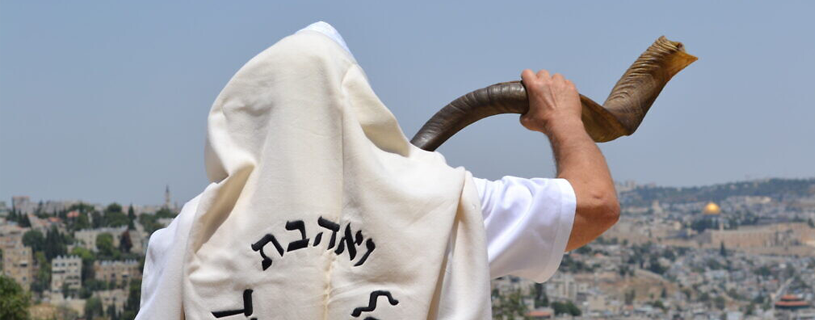
Despite Israel’s third coronavirus lockdown, the sounds of the shofar still echoed throughout the land. That’s thanks to an enterprising and dedicated group of young women organized by Hilma, a non-profit tech organization which focuses on social good and which is supported by AMIT.
Tech-savvy members of the voluntary national service program Carmel 6000 (also supported by AMIT) built a website that matched shofar blowers and those who requested to hear the resonate sounds. The website, named Yom T’ruah — the biblical name of Rosh Hashana that refers to the blast of the shofar—addressed the potential absence of the ancient shofar ritual they would otherwise miss since they could not attend synagogue for holiday services.
“Stuck at home?” the website homepage asks. “Shofar sounds—as close as possible.” Below these titles are two tabs to click and provide information. One tab says, “I want to hear the shofar,” and the other, “I want to blow the shofar.” Over 150 shofar blowers and 100 listeners (which included an audience of other family members and/or area neighbors) quickly signed up and were then geographically matched through a mapping system. Word of mouth, social media and traditional media (including newspapers and a network news broadcast) picked up the story, generating buzz and increasing response.
The Hilma staff got the idea for the website from other similar outreach the organization had previously done during the coronavirus lockdowns–such as for Memorial Day for those who could not visit the military cemetery–according to Michal Ophir, VP of Projects for Carmel 6000 and one of the founding members of Hilma.
The site was built in a relatively speedy two months and took the round-the-clock efforts of a full-time four-person team of Carmel 6000 members. The young web builders included Shani Keahti, a 19-year-old AMIT Renanim Science & Technology Junior and Senior High School Ra’anana graduate from Moshav Azriel, which is located near Ra’anana.
Keahti credits her AMIT education with opening the door to the world of tech. “AMIT always supported us in joining all kinds of classes, which helped me to graduate with a major in computer science. And thanks to Reshet AMIT (the AMIT network), I was connected to Carmel 6000,” she says.
Keahti emphasizes how deeply committed she and her co-workers were to the shofar project. “We put in extra effort, staying after hours and going over small things and additions, even during the weekend. It was very important not only for our team but for the heads of Hilma, who were very much aware of the project and its progress.”
“The shofar website taught me how to work with a team. We were together all the time working on the same project; we always knew what each other was doing. We needed to work closely together to make this website work, and we needed to put in all the effort we could. This gave me the feeling of setting my mind to something, and choach ratzon (strength of desire).” This experience will guide Keahti, as she has been designated a team leader for her second year in Carmel 6000.
Michal Ophir emphasizes the crucial support of AMIT in the efforts of both Hilma and Carmel 6000. “AMIT was the first to recognize how special this organization can be. They invested in Hilma and thanks to them as well, Carmel 6000. Without AMIT support, we wouldn’t be able to do any of this,” she says.
Both Ophir and Keahti point out that the shofar website and other such initiatives are especially unique in that they develop and support science and technology initiatives for religious girls, and train females in a field still dominated by males. Says Keahti, “The purpose and hope of Hilma is to change the number of women in high tech, in addition to helping the whole society.”
Michal Ophir was inspired by the humanity of the shofar website. “It was amazing that the shofar initiative made people feel they were not alone. Keahti’s reflection is equally strong, “It’s amazing how much impact one person working on one small site can have on people. It was the right thing to do at this time.”
The response to the shofar website confirmed the value of their efforts. “It was pivotal to work on this project knowing that a lot of people fulfilled such an important mitzvah during shofar blowing,’’ said Keahti. “The reaction was very warm. After the holiday, we got thank you messages about the amazing experience from both the blowers and the listeners. It was nice to hear that.”