
This article was published on September 10, 2020 in The Marker, Israel’s leading financial newspaper that is part of Haaretz.
How do we make the education system relevant to the 21st century, especially during the days of corona? At the AMIT Educational Network, which developed a new and innovative pedagogical language, education has focused on independent learning in digital environments for the past several years.
By Rona Mor, September 10th, 2020
Our world is becoming more and more digital, and information is more accessible than it has ever been before. The standard, old-fashioned learning methods – of a teacher standing in front of a class lecturing, and students absorbing information, spitting it back on a test, and typically forgetting it immediately afterwards – becomes less relevant, challenging and harms the students’ motivation to learn. The coronavirus has made the situation even more severe. Instead of capitalizing on the shift to digital learning as an opportunity to implement innovative learning methods, the same learning methods were simply transferred to Zoom. As such, the teacher still lectures, but there is no personal interaction with the students.
The current reality forces the education system to leave behind the old-fashioned learning methods and progress to more innovative methods, centered on the student’s individual abilities. This is what the AMIT Network does, with their innovative approach that encourages independent learning.
First and Foremost, Human Beings
At AMIT, the goal is for students to undergo a significant growth and empowerment process academically, professionally, and personally. As such, the network runs a program of individual support, with the goal of empowering and promoting feelings of belonging and experiences of success in each and every field, even if it is not necessarily taught at school. In the framework of this program, staff members and administrators acquire skills from the world of coaching and psychology.
Beyond developing independence, critical thinking and curiosity among students, an AMIT education also places an emphasis on dialogue, collaborative research, and brainstorming, hence creating a sense of community and observing and learning from one another. A strong emphasis is also placed on values, society, and humanity, which are much more important than grades. Dr. Amnon Eldar, Director General of AMIT explains that, “The importance of interpersonal relationships and social skills are felt even more so right now, during the corona pandemic. This time period has distanced some who were close, but also allowed for creating closeness in different ways. For example, teachers from various locations in Israel are teaching kids from other areas through online learning.”
It is clear that personal development, empowering, and the sense of belonging, community and success – these all help students develop traits and skills that are needed in the world of today and tomorrow, such as independent learning, entrepreneurship, creativity, critical thinking and self-expression.
Learning Journeys, Tax-Free (The Hebrew uses the word Ma’am, which means the VAT tax, but also for “Teacher Standing and Presenting to a Class” – Moreh Omed u’Medaber)
AMIT is the second largest educational network in Israel, with over 110 institutions throughout the country, and over 30,000 students in grades 7-12. The Network’s core approach is pedagogical innovation, ensuring that schools are made relevant to the 21st century. This process is called “Gogya” (from the world pedagogya: peda = child, gogya = leading). The approach promotes a new educational culture that shifts schools into educational learning communities. The teachers facilitate, initiate, accompany, guide, and inspire, and the students develop independent learning skills, increased motivation to learn, curiosity, and many other skills that are critical in our day and age.
Since the internet revolution, the teacher’s place as a transmitter of knowledge has been called into question. At AMIT, they internalized this years ago, and decided to change the existing structure of learning. The model of Ma’am (a teacher standing in front of a class and lecturing) is no longer relevant – but rather, a teacher facilitates, accompanies processes of learning, offers different angles and ways of thinking, and helps develop students who know how to learn independently and take responsibility for their learning. As such, the learning process is research-filled and active (not passive), modulated based on what the student wants to understand, individually adapted, and curiosity-fostering.
In this way, in addition to the ability to learn independently from a distance, as is necessary today, students develop a desire to learn and enrich their world, and also acquire tools and skills that will help them throughout their lives. In the future, both in times of routine and times of major unexpected changes, like we are going through right now, they will know how to identify information, collate, analyze, and process it and reach conclusions, remaining relevant in their chosen professions or with the option to independently learn a new profession or area of study.
The learning environment at AMIT is both physical and digital at once, and the ability to allow for distance learning has existed for some time. For this reason, the corona pandemic did not require major adaptations, as the teachers, students and educational content were primed and ready for a digital environment. The system that the educational network uses is called Teams – a collaborative program designed by Microsoft. In this way, teachers can view the digital notebooks of their students in live time, track their progress, accompany, and guide them. Meaning, they are present not just in the background, as takes place through Zoom, but are highly involved in the learning space of the students, even when learning takes place from a distance. Each child receives attention, and even when he’s involved with distance learning, the teacher is there to accompany him based on his needs.
This is essentially hybrid learning, independent, collaborative, frontal and internet based. Eldar explains, “Hybrid learning is a unique opportunity to change the approaches of teaching and learning for teacher and learner alike. This learning combines knowledge acquisition with practice and independent implementation of concepts learned, where acquisition can take place either with the help of a teacher, or through independent study online.” Eldar adds, “If we can design a course schedule where the majority of the time, a student studies independently and in-depth, we will free up the teacher’s time to accompany, facilitate, and teach small groups of students who get lost in a large classroom setting. Also, the teacher will have time to develop learning units that combine knowledge, values and skills.”
These learning units are known as “Me’ah Learning Journeys” (Me’ah being an acronym for Significant, Long and Holistic Learning Journeys). According to Reut (Tuti) Naor, Director of Gogya and Pedagogical Development at AMIT, “The teachers developed learning journeys all summer, out of choice and internal motivation, so that they would be ready for the challenging school year that just began. They want to leverage the complex situation in order to change methods of learning and create relevant learning journeys that are student-focused.”
She notes that, “The learning journeys can be learned in any scenario – they do not depend on physical location or time. Also, they allow students to delve further into specific areas of interest, independently, in pairs, or in small groups. In this way, teachers can have time to develop additional learning journeys and support each and every student based on their individual needs, both in terms of the learning content, and in terms of emotional, social, family-based issues, and other areas of development. The teacher is less of a lecturer and more of a facilitator of learning.”
It is important to note that each learning journey includes a full topic; for example, the quantum theory or human rights, and includes enough material for a month or two of learning; the journeys are structured based on independent learning at one’s own pace, and include explanations, enrichment films, digital tools and games, and assignments that the students must complete independently or in groups. Some of the journeys include interdisciplinary subjects, meaning two or more content areas are learned together. For example, a history class can be taught in English, or an English class can focus on historical content. In this way, students acquire a deeper and wider knowledge base, and the amount of time spent on a given topic is essentially doubled.
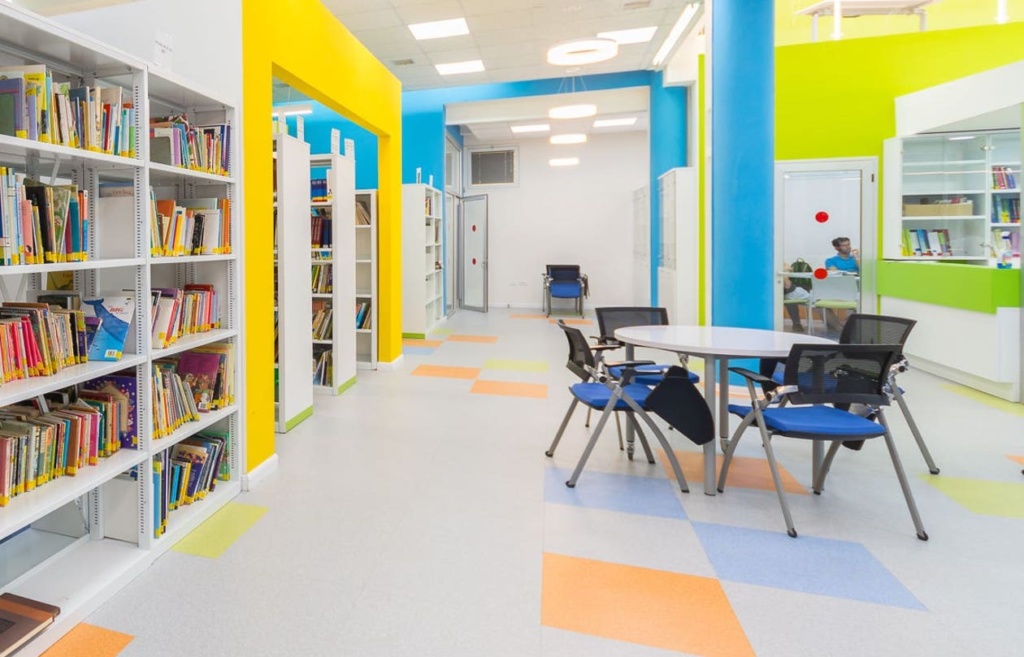
Physical time spent in school focuses on content that is more difficult to learn from a distance, such as values, social topics, and physical education classes. In recent years at AMIT schools, learning does not take place in old-fashioned classrooms, but rather in learning spaces where teachers circulate among students, allowing for an experience of a community that is constantly learning, researching, creative and enriching. In order to encourage learning that breaks down boundaries, teachers serve as a personal example by themselves taking part in learning communities of teachers, jointly creating, and developing.
As Eldar states, “The coronavirus pandemic, which has shaken reality as we know it, teaches us, above all else, about the importance of developing social and emotional skills, dealing with challenges, thinking creatively and being able to innovate.” He adds that, “At the AMIT Network we believe that especially at this time, we have a unique opportunity to make schools more and more relevant to the 21st century.”