
There are locales that have chosen to seize the opportunity provided by the corona guidelines – and take learning outside school to virtual and city-wide venues.
By: Lior Detel
August 23, 2020
Regional municipalities, directors of educational networks, and school principals are all trying to make the most of the Ministry of Education’s platform for the opening of the school year, and aim to implement a series of innovative steps, with the goal of improving the quality of education in the shadow of corona.
The conservative Ministry of Education platform enables only half of the students (grades 1-4) to come to school full time, with the rest of the student body (grades 5-12) coming to school only twice a week. Despite this, in the cities of Hadera, Herzliya and Tel Aviv, innovative programs have been developed to allow students to physically attend school much more frequently, sometimes even for a full week of school. Instead of using classrooms with up to 35 students per class, they are offering classes on the beach, in theaters, at museums, and learning journeys in the city.
The Ministry of Education is relying on distance learning via Zoom, which has been proven to be less effective, and are having difficulty solving the challenge of lack of computers amongst schools and students. In Herzliya, computers were distributed and cameras were affixed in classrooms in order to transmit classes in live time; in Tel Aviv, they are minimizing the use of Zoom and prefer independent learning; and the AMIT Educational Network, which operates throughout the country, put all materials in a virtual platform and changed classes into learning “journeys” for independent learning that is guided by teachers. All held training sessions in distance learning for teachers and additional staff members.
With all these initiatives, what stands out is the freedom and independence that has been given to school principals. They are all required to develop plans that work for their schools and their students. The challenge is that the Ministry of Education still demands many approvals from regional municipalities for every decision that deviates slightly from the Ministry’s proposed plan, and the freedom provided does not match the grand proclamations that have been made. In a large portion of schools and regional municipalities, they are still awaiting guidelines from the Ministry headquarters in Jerusalem.
“This can be done throughout Israel – it requires creativity, and primarily, the ability not to ask too many questions. To decide what you’re doing, and do it,” says the head of the Education Branch in the Tel Aviv Municipality, Shirley Rimon-Bracha. “It is critical to understand that the true educational leadership is found within the schools, and not up above in the Ministry’s headquarters. Those who led the change in the city are the school leaders. As soon as principals understand that they do not have to wait for answers, and that they have the answers within themselves – then we will see more changes in the education system. This is the time for the regional municipalities to shine. It is time for us to prove that education can be done differently, without leaving anyone behind”.
Tel Aviv
“Our principals were involved with creating new routines well before corona”
Over the past four years, the Tel Aviv municipality has been implementing a reform in schools throughout the city. In this reform, school principals received freedom of action in determining educational content, methods, and evaluation of students.
The municipality decided to rely on minimal distance learning. In order to enable this, each school received a list of nearby public structures and available rooms within, in order to enable splitting classes and allowing for social distancing the requisite size of capsules, and thus enabling the full student body to physically attend school. For example, some classes will learn in the Cameri Theater, while others will be in the Beit Lessin Theater. Some students will be in Beit Ariella, and other classes will learn in municipal office space. Simultaneously, the municipality is working with many other institutions to secure additional learning spaces through them.
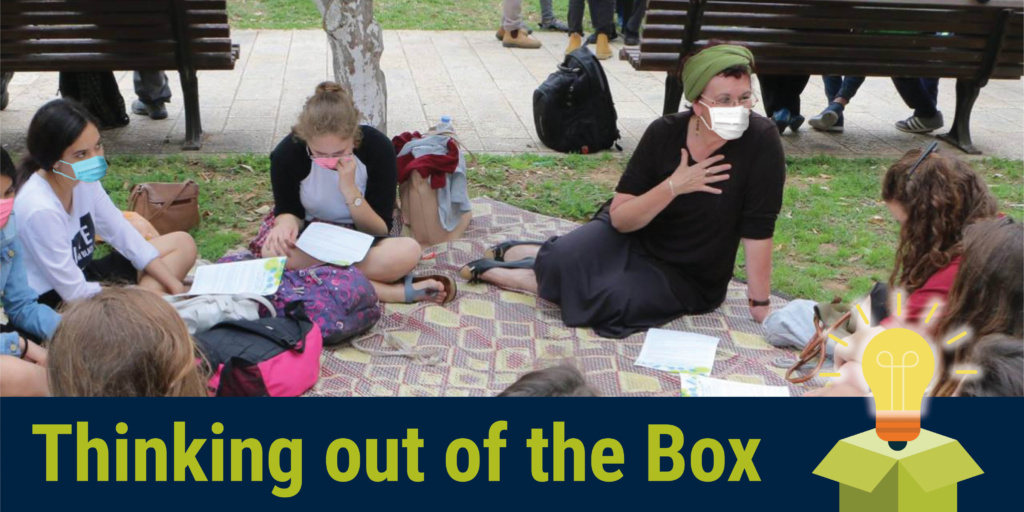
The municipality has also been promoting learning outside of schools, in parks, the port, and nearby streets. An app was developed that provides assignments at dozens of locations throughout the city and is available to teachers and students alike. “The city provides many opportunities for learning history, culture, nature, science, art and technology,” says Rimon-Bracha. “Kids can research the city from a historical or geographic perspective, the sea or the nature in the city”.
According to the Ministry of Education’s plan, high school students must physically attend school at least twice a week, but most of the middle and high schools in the city decided to have learning by shifts – enabling students to come to school every day of the week. One shift learns in the morning, with the other learning in the afternoon hours.
“Already before the corona pandemic, our principals were involved with building new routines and teaching in different ways, so for them the upcoming year is an opportunity,” says Rimon-Bracha. “Although students will learn for a total of less hours each week, they will be in smaller classes of up to 20 students. A teacher can play a much more significant role in knowledge and skill acquisition when students are in smaller groups. In the first wave of corona, stated that it was much easier to meet the individual needs to students when teaching in smaller groups.
“These changes fit with the pedagogical approach that our principals are leading, that sets a high standard for learning that focuses on dealing with challenges, independent and not group-based learning, and not for the sake of memorization. September will be dedicated to getting to know the students and seeing where they are at after a difficult six months, and based on this, we will determine a schedule that meets their needs.”
Despite the decision not to put a focus on distance learning, the municipality provided distance learning training for staff members at their schools, “in order to develop the independent learning skills of students, and improving the distance learning for cases of a full closure or quarantine,” and developed a uniform platform for distance learning for all of the city’s schools. According to Rimon-Bracha, the principals will determine how schools will run. “Each principal will develop a custom-made approach that best fits their needs. We do not believe in a uniform system. We have led processes that have helped with recruiting additional staff members for the schools, training the teams, and logistical components.
“The principals are leading the change. The only guideline I gave is that on September 1st, all students will begin the school year, to enable a sense of belonging. It will be a day of celebration that we all must take part in. Students will meet in schools, gardens, and nearby courtyards so they can see their teachers and peers.
Herzliya
“All of the city’s centers will become learning spaces. If need be, we will transport students”
While the Ministry of Education guidelines state that 5th and 6th graders will only attend school twice a week, the city of Herzliya developed a solution whereby they can attend class five days a week. Students will learn in classrooms at school, but also at the marina, parks, theaters, Cinematheque and museums.
Middle and high school students will come to school three days a week and will partake in distance learning for the rest of the week. The municipality installed cameras in the classrooms so classes can be broadcast to half the class that is at home, or to students who are high-risk and are concerned about physically attending school. The municipality purchased 1,000 computers that will be distributed to high school students who do not own computers.
“During corona, we sent a survey about distance learning to parents, students and teachers,” said Dr. Yaakov Nachum, the Head of the Department of Education in the city. “One of the conclusions we reached is that in elementary school, distance learning was less effective, and as a result, we decided to rely on it as little as possible. As such, we opened the entire city and made it into one big school. All the city centers are becoming learning spaces. Principals will teach in multiple open locations around the city, and students will meet their teachers every day. If need be, we will transport students to learning spaces that are far from their homes.
“In middle schools and high schools, we purchased and installed cameras in the classrooms, so a teacher can teach half the class in person, while the other half is at home – but everyone is learning in the same class. The teacher will see the students who are home on a large screen in class, and they can fully participate and ask questions. The following day, the two groups will swap, and in this way, everyone will have a full schedule.
“The Hila program for at-risk youth was at risk of being cancelled, but it seems like we have found a partial solution for the first few months of the year. As a municipality, we will not give up on these students, and we announced that we will continue the program even if the government cancels it”.
Hadera
“Corona was the trigger, but this will work for the day-after also”
In the city of Hadera, a model was developed that will allow students to learn in school most days of the week, in public spaces, museums, nature parks, the beach, and additional sites in the city. Principals can assign students to classes in all these different locations. In this way, there will be space for learning in capsules during most days of the week, for grades 5-12, instead of needing to rely heavily on distance learning.
“We said we wanted to make the city into one big school, with as much in-person learning and as little distance learning as possible,” says Dr. Osnat Sporta, the municipality’s deputy director. “the model includes opening all public spaces and nature sites in the city for the needs of the education system, and principals can assign students in advance based on an app they will use”.
The model is based on an inclusion of workshops in all the culture and science locations in the city, that will be run five days a week by professional guides in these areas, with municipal funding. This program will allow for classes to be split, to allow for more students to physically attend school. A principal can, for example, choose to send half of a class to learn in a different institution for a week, with the other half going there the following week.
“Students can spend a week in a museum, a week learning science on a nearby farm, a week in the school for theater arts to learn about acting, and space studies can be learned in the local planetarium,” says Sporta. “In this way, students will spend more time learning, and they will learn in a fascinating manner. There is a tremendous city-wide investment in education, where funding will also go towards the art and culture centers in the city.
“Principals have full autonomy to build their school’s work plan, as they see fit and based on the needs of their individual school. There will not be uniformity. A principal can decide that a class will have a workshop in a given locale, that the next week they will learn in open spaces throughout the city, and that the week after, they will engage in distance learning or a different workshop. The principles refer to individual contact with students and creating a structure for them”.
The municipality’s plan includes a four-day journey in Hadera called “Hadera Journey,” inspired by the Israeli Journey program. For the upper grades, the journey will also include camping.
School will take place from Sunday through Friday, but on Fridays, elementary schools will be led by the youth movements; and middle and high school students can participate in professional courses to be subsidized by the municipality. These will include, for example, courses in Spanish, Arabic, veterinary studies, dog training, photography, or municipal management.
“Corona was the trigger, but the model works for post-corona life as well,” says Sporta. “Education is the entire city’s responsibility, and each city has its own resources and path. Learning can take place anywhere, and significant learning takes place predominantly in the real world. Every crisis is an opportunity, and we have to capitalize on this”.
The AMIT Network
“Corona caused positive movement – it caused tremendous progress in independent learning”
The AMIT Network of schools transferred all subjects and content to a digital platform, in a manner that will enable students to progress in an independent manner, and for teachers to focus on helping students who are struggling most.
According to the Network, only 20% of distance learning will take place through online classes (similar to Zoom), and the rest of the time, students will learn independently or through group work, with teachers providing virtual help when needed. Because of the centrality of distance learning, the schools established lending libraries of laptops. Because distance learning will not rely predominantly on frontal virtual classes – students can learn during their free time, and there will not be such pressure in the event that households do not have a computer for each and every child.
At the same time, each principal throughout the network has been given freedom to determine their own school schedule during corona. Some principals chose to have learning take place in shifts, where half the class comes in the morning and the other half in the afternoon or evening, alongside learning in open spacing or communal structures located nearby the school.
The AMIT Network developed digital “learning journeys” – digital meaningful lesson plans developed by teachers. “A class is 45 minutes and revolves around specific content. A journey can be much longer – there are journeys that can last a month,” explains Naor. “We are talking about an independent learning journey of a student, accompanied by a teacher who is available to him. Students learn independently and in groups, and throughout the process, they also learn about themselves and how they learn best. They can continue on their journey no matter where they are physically located.”
“Corona has done something positive here. It has significantly advanced independent learning and helped everyone understand that it is time to let go and make the change – from a teacher who teaches to a teacher who guides, facilitates and mentors the process of learning”.
This article was published on Sunday, August 23 in The Marker, Israel’s leading financial newspaper that is part of Ha’aretz.