

It made headlines. It made history.
And it made an indelible impression on nearly everyone there, including Midreshet AMIT student Raquel Fusman, who was among the more than 3,300 participants at the first-ever women’s Siyum HaShas in Jerusalem marking the completion of the 7 ½-year cycle of daily study of the Babylonian Talmud.
“It was beyond amazing to see everyone united for one thing – for finishing Shas,” Raquel said, using the colloquial term to describe the Talmud.
The women – young girls accompanying their mothers, high school and seminary students, teachers and principals, middle-aged and older women, a veritable female panoply representing different ages and walks of life – joined together in pride and joy to celebrate their own participation in the global cycle of daily learning of the 2,711 pages of Talmud, which comprises the whole of Shas. Daf Yomi is the daily study of each page of the Babylonian Talmud.
Celebrations of completing Shas, a pursuit traditionally accomplished by men, were held worldwide. Among the biggest was the New Year’s Day gathering of 90,000 at MetLife Stadium in New Jersey. But this one in Israel on Jan. 5 celebrating women’s learning – the first of its kind in history – held by Hadran, an Israel-based organization devoted to fostering women’s Talmud study, highlighted a revolution in Jewish women’s Torah study, and, in particular, Talmud study. It also heralded a new precedent for the future of women and Talmud.
“It was so inspiring,” said Raquel, one of eight Midreshet AMIT students who “adopted a daf” (a double-sided page of Gemara) and learned it specifically for the women’s Siyum HaShas. Raquel, who studied Gemara in high school and now at Midreshet AMIT, wanted to learn not just one, but two dafim (Yevamot 48, Baba Basra 92) for the Siyum HaShas. “I really enjoyed it and felt very accomplished,” said Raquel, 18, of West Orange, N.J.
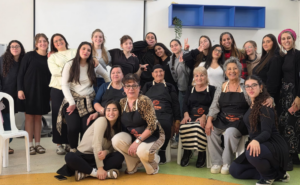
Raquel was among the more than 100 female students from AMIT schools throughout the country who participated in the women’s Siyum HaShas. During the event, they heard from some of the most highly regarded women Torah scholars who spoke to the overcapacity crowd at Jerusalem’s International Convention Center.
The AMIT schools in attendance included high schools, Dina and Moses Dyckman Ulpanat AMIT, Beer Sheva; Midreshet AMIT Arts and Sciences High School for Girls, Modiin; AMIT Renanim Science and Technology High School for Girls, Ra’anana; Midreshet AMIT Kamah High School for Girls, Yerucham; Ulpanat AMIT Givat Shmuel; and AMIT Bellows Ulpanat Noga High School, Beit Shemesh. The post-high school programs included Midreshet AMIT, Jerusalem; Midreshet AMIT Beer Yerucham; Midreshet Beer; Ashdod.
Dr. Amnon Eldar, director general of the AMIT educational network, congratulated the students. “Kol HaKavod to all our female students electively choosing to study Torah out of a desire to incorporate Torah values, gained at Reshet AMIT, into their daily lives.”
That pride in advanced study by the girls and young women was echoed by many education leaders at AMIT, which makes Jewish values and learning part of its core.
“It was incredible to be a part of this historic celebration of Torah learning and accomplishment,” said Ilana Gottlieb, director of Midreshet AMIT. “Our students were inspired by the women they heard from and reminded of the vast world of Torah and learning opportunities at their fingertips. They are even more motivated to spend the rest of their year at AMIT reaching their own goals and we are excited to be a part of that process.”
At the three-hour event, described as moving and exhilarating, speakers included Rabbanit Racheli Sprecher Frankel, who may be known to many as the mother of the teenager, Naftali, who was kidnapped and murdered by terrorists in 2014. Rabbanit Frankel, who emceed the program, is the director of the Advanced Halakha Program at the Matan Institute, one of the first institutions to teach women Talmud; Rabbanit Malke Bina, founder of Matan; Rabbanit Esti Rosenberg, head of the Migdal Oz seminary and daughter of Rav Aharon Lichtenstein, and others, perhaps lesser known but no less brilliant.
But the prime mover of the women’s Siyum HaShas was Rabbanit Michelle Cohen Farber, co-founder of Hadran, who reportedly is the first woman to lead a Daf Yomi. She is a graduate of the Yeshivah of Flatbush, an oleh, mother of five, and wife of Rabbi Seth Farber. Rabbanit Farber started teaching Talmud in her Ra’anana home more than seven years and a half years ago. She also recorded these classes, which are available as podcasts in English and Hebrew for women anywhere, anytime to learn Talmud.
At the event, Rabbanit Farber expressed hope that in some seven and a half years into the future when the next cycle of Shas is completed, the women will celebrate again, and fill a much bigger venue.
Noah HaCohen, principal of Dina and Moses Dyckman AMIT Ulpanat, Beer Sheva and leader of the newly launched Sayeret Gemara initiative for women at Reshet AMIT, noted the profundity of the event.
“Torat Chaim Jewish Studies is the beating heart of the AMIT Educational Network,” said HaCohen. “The Siyum HaShas connected our students with hundreds and thousands of female and male Torah-studying Jews around the world.”
Remarked Rabbi Erez Ohayon, Dina and Moses Dyckman Ulpanat AMIT Beer Sheva Middle School Principal, “Our students’ participation in the first-ever Siyum HaShas for women in Jerusalem was moving. The students were excited and enthused to be a part of this significant milestone.”
Miriam Coren of AMIT Bellows Ulpanat Noga High School for Girls in Beit Shemesh said that seeing women of all ages come together to complete the Talmud Bavli (Babylonian Talmud) was a very moving experience. She also expressed pride in AMIT students who continue to make learning a part of their lives.
“We are so proud of our students who continue to study after graduating our school onto Midrashot and Mechinot and make the choice even after they graduate high school to continue Judaic students at the highest level out of commitment to Torat Chaim,” said Coren.
Pesha Fischer, the senior educator and coordinator of experiential education at Midreshet AMIT, Jerusalem said that the women’s Siyum HaShas definitely ignited their students desire for learning. One student, she noted, even though she was exhausted following a daylong trip went straight into the Beit Midrash, pulled out her Tanach, and began to learn. The student aims to finish Navi (Prophets).
Upon reflection, Fischer said that she hopes that the powerful message of the women’s Siyum HaShas remains with the students long after the memory of the event recedes.
“I hope the takeaway is that they can see themselves committing to Torah learning and making Torah learning a part of their regular daily lives,” said Fischer. “I hope they see that not only can they learn, but that they themselves are part of the Torah world. We are the People of the Book, after all.”