
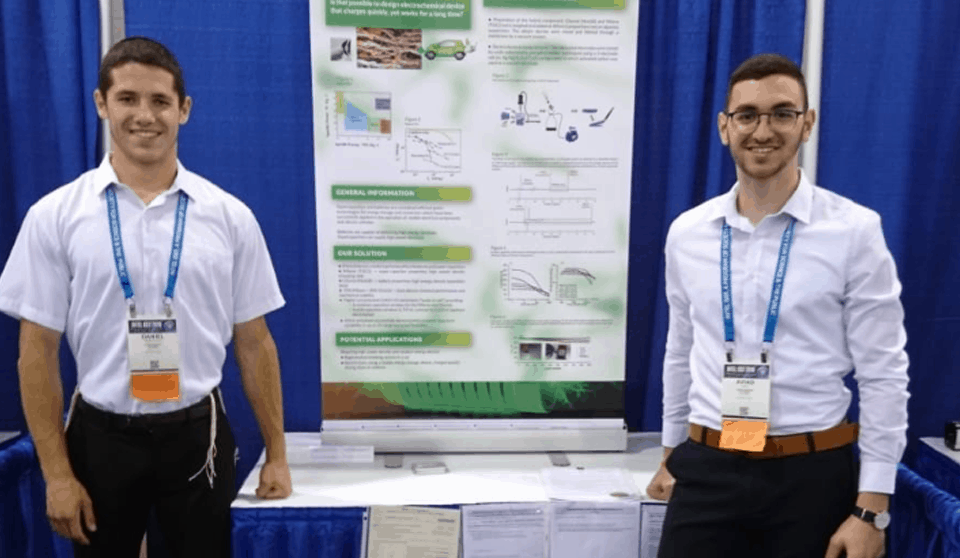
Is it possible to design an electrochemical device that charges quickly yet works for a long time? That question and the research that went into finding an answer recently earned AMIT student Aviad G. a ticket to the Intel International Science and Engineering Fair, the world’s largest pre-college science competition.
Aviad, a 12th-grader at AMIT Gwen Straus Jr. and Sr. Science High School for Boys, and his research partner, Daniel M. (who attends Tamar Ariel High School in Netanya), were among 1,800 teen researchers from more than 80 countries who attended the fair in Arizona. The budding scientists presented their ingenious STEM-related inventions that ranged from machine learning technology used to improve spinal surgery to a prototype that mimics how jellyfish move through water and may allow for greater exploration of the world’s oceans.
In Aviad and Daniel’s case, they invented a hybrid battery-capacitor that charges in seven seconds and lasts for six hours.
Aviad, who is from Netanya, chose to go to AMIT Gwen Straus starting in 7th grade because he had heard good things about the school. “I’m really pleased that I decided to go there,” he said. “I like the combination of advanced science studies and Torah learning that I didn’t find at schools in Netanya or the surrounding area. I really connected to that way of learning.”
He studies high-level physics and computers at AMIT Gwen Straus and began work on this project with Daniel about a year and a half ago. They were mentored throughout the process by Dr. Netanel Shpigel from Bar-Ilan University and Oskar Pelc of Intel. While Aviad’s research isn’t directly related to his academics at Gwen Straus, he said his teachers and principal there were incredibly encouraging and supportive of his endeavor, something not to be taken for granted.
“I heard that there was a competition where you present your research thesis, so I sent it in,” said Aviad. “I figured, what do we have to lose? Then I found out that there were 400 applicants and they started narrowing it down to 100, then 40, and then six were chosen to represent Israel at different international competitions.”
He, Daniel, and their mentors were at the Intel fair for nine days in May, an experience that Aviad describes as truly unforgettable. They got to know other young scientists from around the world, took part in various social activities, and then got down to the competition and presenting their work to a larger international audience.
“The experience at Intel, seeing people from all around the world who are my age and also developing and creating things, it really encouraged and inspired me to pursue research and development and science in the future—it really pushed me in that direction,” said Aviad.
“I was happy to have the privilege of representing Israel and gaining so much experience,” he went on, adding that, while they didn’t win, “the fact that we made it to the competition is a victory in itself.”
He and his partners are publishing an article on their hybrid device in a Royal Society of Chemistry journal and are already thinking about future applications for their invention, possibly in the smartphone or wearable technology industries.
First, though, Aviad plans to study at yeshiva before enlisting in the Israeli army.
“Aviad is an all-around outstanding student,” said his principal, Rav Sagi Rosenbaum. “He is principled, sociable, and is involved in the school in many ways. He strives for excellence but always in a pleasant manner and with a smile.”