

The Israeli Army’s Unit 8200—an elite intelligence corps responsible for cyber security and code decryption—has been called “Israel’s secret startup machine” because so many of its veterans have launched successful startups or gone on to work in Silicon Valley. Now, a new project aims to bring the prestige of that army unit to Israel’s national civilian service by harnessing the power of tech for social purposes.
Founded by high-tech entrepreneur Yossi Tsuria and run in partnership with AMIT, the new national civilian service program called Carmel 6000 is working on technology-based solutions to social problems, particularly in the fields of education, welfare, and healthcare. Tsuria, who helped develop the DVR and made several major exits, sees the project as his way of giving back to society—or, in other words, of combining tech and tikkun olam.
To launch the program, Tsuria first had to get the approval of the head of Israel’s National Civilian Service Administration, Sar-Shalom Jerbi. Within an hour during their first meeting, Jerbi not only took to the idea, he even suggested that Tsuria reach out to AMIT’s Director General Amnon Eldar to help recruit religious young women for the program.
Once all the relevant parties were on board, Carmel 6000 started small—with one young woman, Mary Arav, a graduate of AMIT Wasserman Junior and Senior High School in Beersheva, who studied in the school’s cyber track, but preferred national service over army enlistment.
She was the “pilot of the pilot,” sitting alone in a Jerusalem office last year and working on an application that would serve as a guide to some of Israel’s memorial sites, like Mount Herzl. Her app, called Zikaron Chai (“Living Memory” in Hebrew), would enable visitors to use their smartphones to get information about notable people buried at these sites.
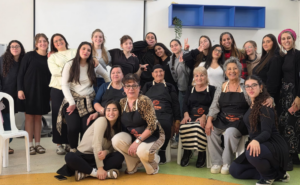
Today, Mary is in her second year of the program, and now she has company. Twenty-nine girls from across Israel, including seven other AMIT alumnae, were chosen to take part in the prestigious program this year after a highly selective process. Each of the girls had to have studied math and physics at the highest level and also have strong English skills. In addition to their bagrut scores, they were also judged on two entrance exams, a personal interview, and certain traits like entrepreneurship, their ability to learn independently, and their desire to achieve.
During their two-year national service stint, the young women will divide into groups and work on 20 projects with different “clients” (hospitals, nonprofits, and organizations dealing with everything from domestic violence to children with cancer). The volunteers are based in Cisco’s Har Hotzvim offices in Jerusalem, where each group will be mentored by a high-tech industry veteran who will provide expertise, training, and guidance.
They recently launched an app that allows users to automatically add Hebrew calendar dates to Google’s calendar—something that comes in handy for remembering loved ones’ yahrzeits, for example. Among the projects they are working on are an app that helps autistic children communicate with their parents, a sensor for wheelchairs that warns users when they are about to bump into something while going in reverse, and a ride-sharing app to help senior citizens or disabled people get to and from appointments.
“I believe that at the end of their service, the high-tech industry will be waiting for these young women,” Tsuria told Israel’s Makor Rishon newspaper. “I hope that the seed of social high-tech will be planted here, and that these girls will continue this dream in the future as well.”
Eldar sees the program as a worthy alternative for young women who want to realize their full potential, in keeping with AMIT’s mission, while also contributing to the country in a meaningful way.
“Young women today see enlistment in elite technology units like 8200 as a sign of success and of putting their talents to good use for the sake of the country,” he told Makor Rishon. “This project will offer them a very good alternative with significant added value.”
Education Minister Naftali Bennett concurred, telling the paper that Carmel 6000 is a groundbreaking and innovative program. “It takes one of the most important goals of the Jewish people—doing good—and combines it with the world of high-tech. It’s natural that this combination will bring about solutions that will benefit the entire world.”