
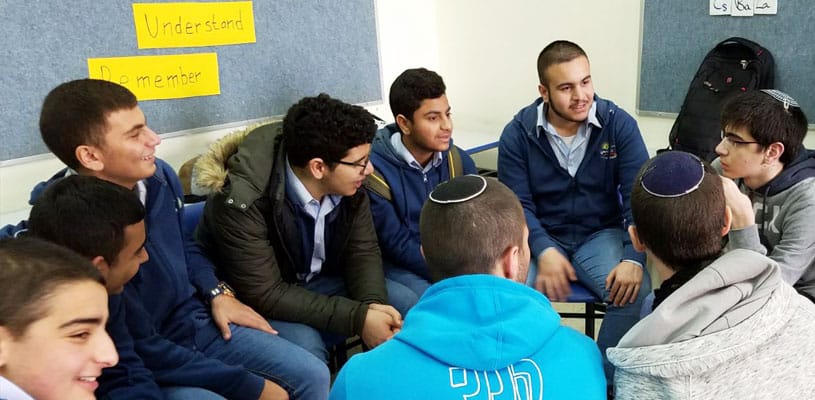
In June 2015, Israeli President Reuven Rivlin made a remarkable speech, in which he warned that Israeli society is divided into four “tribes”—ultra-Orthodox, national religious, secular, and Arab—that are increasingly growing apart.
“A child from Beth El, a child from Rahat, a child from Herzliya, and a child from Beitar Ilit—not only do they not meet each other, but they are educated toward a totally different outlook regarding the basic values and desired character of the State of Israel,” Rivlin said.
To combat this “new Israeli order” of mounting divisions, the president said, new partnerships would need to be created between the country’s various sectors. “We cannot do this unless we can learn to know each other, unless we gain an understanding of the most sensitive issues of each sector and learn how to respect and safeguard them—even when this is difficult or even frustrating,” Rivlin said.
That speech made waves in Israeli media, and it also left a deep impression on Gedalia Fensterheim, a rabbi and teacher at AMIT Ginsburg Bar Ilan Gush Dan Junior and Senior High School for Boys in Ramat Gan. About a year after that speech, Fensterheim attended a conference at Drew University’s Center on Religion, Culture & Conflict, which ignited the spark to launch a program on interfaith dialogue for his students.
Attending the conference at Drew gave Fensterheim a new perspective about himself and his faith within a wider religious context, and he wanted to do the same for his AMIT students. He reached out to a friend at the Interfaith Encounter Association in Israel to help match the school with a similar one in the Israeli Arab community.
Fensterheim brought the idea to the school’s management, led by Principal Tomer Shuper, who gave him the green light. “The school is quite open,” he said. “If a teacher proposes some initiative, they rarely say no.”
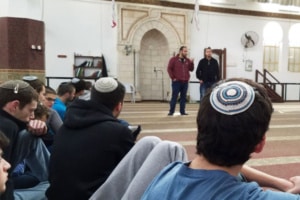 The program aims to find common ground between Judaism and Islam and turn those into a bridge that unites the students. It started small last year, with some 20 students from the 12th grade meeting three times with their peers from the Al-Qasemi school in the northern Israeli city of Baqa al-Gharbiya. The pilot was a success, and this year the same number of students from the 11th grade is participating in six sessions with Arab students.
“I believe that religious dialogue is an incredibly important tool for the future of Israeli society, which is becoming more religious across the board,” said Fensterheim.
The goal of the program, which aims to steer clear of politics and focus on religion, religious practice and customs, is to introduce the teenagers to diverse perspectives on faith, thereby strengthening their religious identity. It also aims to foster a sense of mutual responsibility among the students toward Israeli society.
“I don’t get to meet Arabs, and specifically Muslims, on a daily or regular basis,” Shoham, one of the AMIT students taking part, told Israel’s Channel 23, the educational network. “It was important for me to participate because they are also part of the state, just like we are, and it was important for me to learn about them.”
“I wanted to participate in this project to find out more about what Judaism is,” a Muslim student named Abed told Channel 23. “We live in Israel, Jews and Muslims, and for me as a Muslim, it’s important to know who are the Jews and what is the Jewish religion.”
The students have held four sessions thus far, including an ice-breaker in which they got introduced and two meetings focusing on prayer—held inside a synagogue and mosque—and a session before Passover about dietary laws and fasting. Each three-hour-long meeting includes a joint lesson on the given subject; then the group splits into a “Jewish circle” and a “Muslim circle,” after which they regroup for a workshop or discussion about that day’s theme.
Fensterheim described the recent visit to the mosque in Baqa al-Gharbiya as an incredible experience. “Jewish Israeli students learn a little about Islam in history class, and some have maybe visited a mosque during a trip, or at least looked in from outside, but to sit in a mosque and have the local imam talk to them in Arabic, with a Hebrew translation, about his mosque, was amazing.”
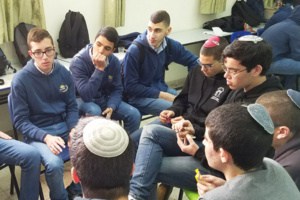 “Both religions believe in the Tanakh and I think that can unite between the two religions and bring about less anger and hatred and connect people,” Shoham said.
The most recent meeting, focusing on kashrut, took place in Givat Shmuel just ahead of Passover and included a visit to watch hagalah, or the process of koshering dishes and utensils for the holiday.
The students’ next meeting sounds particularly ambitious, and is what Fensterheim described as “putting the powder keg on the table”: He hopes to take them on a group tour in Jerusalem, focusing on the city’s holiness in a religious context, as opposed to its status in a political one.
The final session aims to bring together all of the students and their parents as well.
“It was important for me to introduce my students to a broader religious world, so that they could examine their own religious world more closely,” said Fensterheim.
It appears that his peers in Baqa feel the same way, as the school is looking to launch a similar program for girls.
President Rivlin spoke about creating shared spaces for Israel’s diverse populations to come together and try to gain a better understanding of one another, Fensterhein added. “Religion is an important shared space.”