
 In our fast-paced world, robots not only are becoming more life-like in how they walk and talk, they also are taking on increasingly larger roles: Amazon just patented its own sidewalk-rolling robot that will be able to deliver goods to people’s doorsteps; robots may soon be bringing room service to hotel rooms; and a robot named Erica will be debuting as a newscaster in Japan this year.
Henny Admoni, a roboticist at Carnegie Mellon University, recently told NBC News that robots will also be playing a greater role in children’s emotional, social, and cognitive development in the coming years.
“We really are at a transition point in human-robot interactions,” Admoni told NBC.
Research has shown that children, particularly those with special needs, such as children with autism or Down syndrome, can benefit from interaction with robots.
Robotics programs in schools make learning fun for children, encourage collaboration, creativity, and innovation, and prepare students for the changing workforce of the future.
Thanks to its supporters, the AMIT network is at the forefront of STEM (science, technology, engineering, and mathematics) education in Israel, and is well aware of the benefits of teaching robotics. In fact, it is already reaping the benefits from its robotics programming.
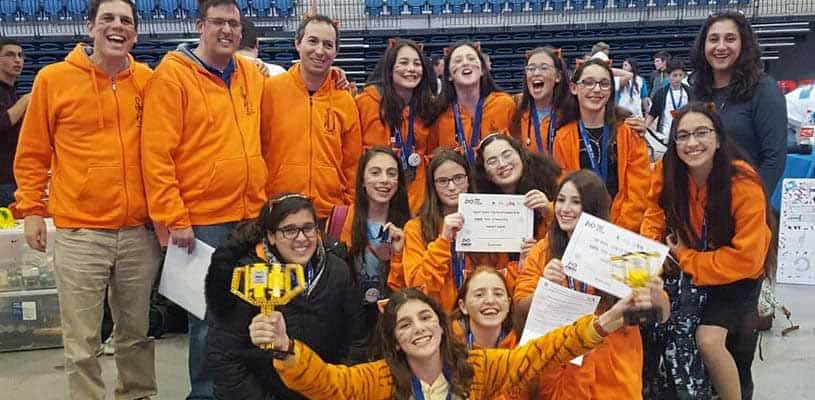
In just the first month of 2018, six AMIT schools won first or second place in various regional competitions of the FIRST LEGO League (FLL) robotics contest.
Three of those teams, the AMIT Modi’in High School for Girls, the Mr. and Mrs. Lester Sutker AMIT Modi’in School for Boys, and AMIT Yud Ashdod, have advanced to the national competition, with the Ashdod team also qualifying for the FIRST LEGO League Global Innovation Award international quarterfinals. There they will be competing among some 80 other teams from around the world.
This is the second year in a row that the AMIT Yud Ashdod robotics team made a strong showing at the competition. Last year, they beat 12 teams from across the country in the finals and represented Israel at the FIRST international competition.
The other schools whose teams won regional competitions are AMIT Hammer Jr. and Sr. High School for Boys and AMIT Hallel School for Girls, both in Rehovot, and AMIT Gwen Straus Jr. and Sr. Science High School for Boys, Ra’anana.
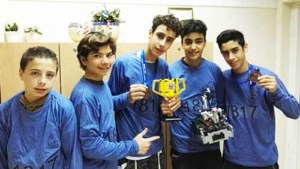
One of the Gwen Straus students, Nehorai Melamed, said he enjoys the experiential nature of learning robotics. “We acquired tools for life and learned new things, such as research processes, programming and strategies, robot functions—not to mention that values of cooperation and teamwork,” he said.
The theme for this year’s competition is “HYDRO DYNAMICS,” in which students learn all about water—how to find, transport, use, or dispose of it. Each team chooses and solves a real-world problem with their project, in which they will also build, test, and program an autonomous robot.
The Gwen Straus team invented a paddleboat that collects pollutants from lakes and rivers while those operating the boats take a leisurely cruise. The AMIT Modi’in students, who have made it to the nationals five years in a row, developed an innovative water-conservation device that uses excess water in air conditioning units to fill toilet tanks.
“The competition is a watershed moment after months in which the team worked on their collaboration, technical construction, and programming,” said Tzachi Green, principal of the Modi’in junior high school and coordinator of the robotics track. “The students benefit from a wide range of social and educational aspects of the program, and we are proud of them and wish them great success.”