
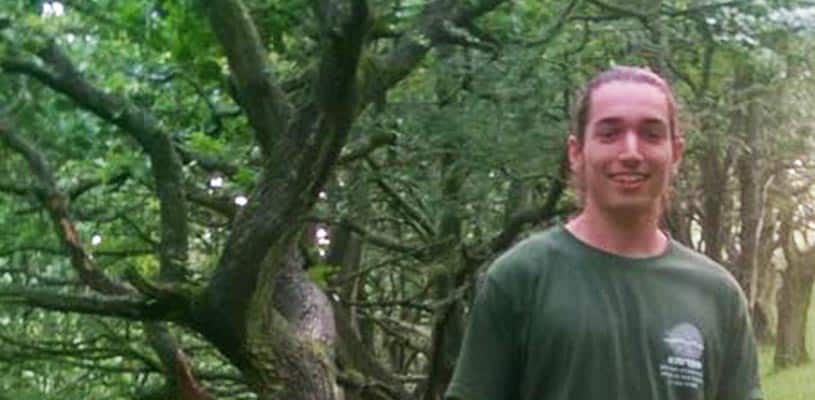
Last year, when Jonathan Lambert, a student at AMIT Bienenfeld Hevruta Yeshiva, was a junior, he had an unusual request for his teachers: He wanted their permission to go to China and study kung fu during the last two months of the school year. They said yes because the yeshiva, like Lambert’s request, is a little unusual, and because like kung fu, it views the spiritual growth of its students as a critical component of their education.
“The whole idea of the school is you give the kid the space, you give him whatever he needs to grow up and succeed in life, and he will do it,” said Lambert, who is now in 12th grade. “You’re trusting a kid to grow and learn and succeed in life, which is very honorable. It’s something very ancient, even, this way of thinking—teaching kids to learn by themselves, and just guiding them.”

AMIT Bienenfeld Hevruta Yeshiva is certainly unconventional by most Israeli standards. Rabbi Avinoam Almagor, who heads the school, said that it turns what are normally seen as extracurricular activities into the students’ daily curriculum. The program focuses on three courses of study—music, environmental studies, and nature and animal tracks—and it doesn’t require students to take the bagrut (matriculation) exams.
The religious education administration of the Education Ministry yeshiva recently awarded the school its 2018 national prize for outstanding education at a religious public school, which attests to the fact that the yeshiva’s uncommon approach has succeeded.
Hevruta’s boundary-breaking educational philosophy is based on Gardner’s theory of multiple intelligences. Dr. Howard Gardner, a Harvard professor, posited that there is a broad range of human potential in children (and adults), and that a person’s intelligence is greater than his IQ. In other words, individuals who “think outside the box” and exhibit ability and aptitude in fields such as art, music, and nature—not just math and English—deserve equal attention within the educational system. That’s why the school has a board with pictures of unique thinkers such as Harav Kook and Steve Jobs posted on it.
Hevruta aims to be a warm home for the boys, but it also teaches them that they are responsible for themselves and each other. As such, all decisions at the school are made with the students’ input during roundtable discussions, in which they talk about everything from which new students to accept to whether the school’s rules are being respected.
“The first thing is that I realized when I came to the school is that I can actually develop here,” said Lambert, who came to Hevruta in 9th grade after deciding he wanted to work with horses, which the yeshiva enables him to do. “You can really trust the teachers and talk to them and know that they’re really there for you. That’s important. And eventually it’s just understanding that if you want something, you can do it. The responsibility’s in my hand, which is how the school works.”
When Lambert got to Hevruta, he was quite shy and didn’t readily express his opinions. Now in his final year at the school, he organized a recent roundtable discussion (a “shulchan agol”in Hebrew) to address what he viewed as some students’ lackadaisical attitude about the school’s already laid-back rules. Some students were avoiding class, preferring to be on their phones, others were smoking outside of the designated smoking areas, while still others were ignoring rules about having earrings on.

“It was a very successful roundtable,” he said. “Kids were really talking about these issues, saying, ‘This is bothering me, this has to stop.’ Kids were saying, ‘We really have to make this kind of difference.’”
Lambert’s teacher told him afterward that he was a great moderator for the discussion, knowing when to allow the conversation to develop and how to stop the conversation if it was veering off course—skills he appeared to have picked up from his teachers at Hevruta.
“The teachers don’t have this attitude of ‘We’re better than you.’ They come down to your level and speak to you as a human being who just has more mileage than you and can help you,” said Lambert. “For me my teacher is like my friend. I talk to him like a human being and I will demand that he will talk to me like a human being, too.”
Lambert said that the teachers at the school understand that each student has fire growing inside him—a desire to learn something, to be someone, to follow his own path. “The school is trying to make that fire grow, but in a nice way, like putting it in a fireplace and feeding it there.”
Almagor, the principal, naturally wants his students to succeed, not just at school, but also in life after their senior year at Hevruta, a sentiment that Lambert echoed.
“We want to succeed,” he said. “We want to succeed in life and in order to succeed in life we need this school,” adding that, “even kung fu masters can come into my school and learn how to teach correctly. I really know how much the world needs more schools like mine.”