
By Michele Chabin
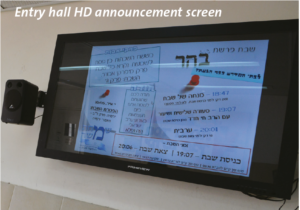
Rehovot, Israel – The large monitor that hangs in the entry hall of Yeshivat AMIT AMICHAI in this university town 12 miles south of Tel Aviv announces the time Shabbat will begin this week as well as the week’s Torah portion and the times for weekly afternoon prayers.
The flat-screen, which also informs students and faculty of other important school business, is a small but important symbol of the administration’s belief that when used correctly and in accordance with Jewish law, technology can be an important tool in and outside the classroom.
The embrace of technology is just one of the educational innovations Rabbi Avraham Rokach, the school’s affable Rosh Yeshiva and principal has introduced since assuming his post in 2009. Committed to making education more relevant to and enjoyable for the school’s 7th to 12th graders, he and his team have transformed the way subjects are taught, and empowered the students in the process.
The result is that AMIT Amichai which opened in 2007 and offers a rich program of Judaic and secular studies, has become synonymous with educational innovation in Israel, and is a model for educators both inside and outside the AMIT network.
 Instead of the frontal teaching that takes place in most Israeli classrooms, the school has embraced Project Based Learning, which is an alternative to rote memorization and teacher-only-led classrooms.
“My motivation is bringing our kids’ education into the 21st century,” Rokach said in his office, where a cookie jar sits on the large wooden table that dominates the room and signals that everyone is welcome. His desk stands in a corner.
“The kids need to think, to be creative, to develop a sense of responsibility,” Rokach concludes. “So we’ve created a ‘learning community.”
In the past, he said, teachers stood in front of the class and lectured. While the students learned a lot of information this way, and the method is still employed by teachers some of the time, students weren’t necessarily encouraged to come up with their own conclusions.
“The knowledge is everywhere – in the world outside the classroom and via Google,” the principal said. “Our students know much more than they think they know, simply by living in the world they live in, and, given the right framework, they come up with ideas and concepts they didn’t know they were capable of.”
But for this to happen, Rokach said, they need the proper educational tools, encouragement, and a sense of purpose.
Michal Jacobs, the vice-principal of Yeshivat AMIT Amichai and a math and science consultant to the AMIT network, said the goal is for students to learn more independently, with support from the faculty when needed.
“We want them to look up things online and to consult experts in the field. And, want them to take responsibility for their learning.”
To accomplish this, Jacobs said, administration and faculty had to change their concept of what classroom learning is all about.
The change has been incremental. The transition to participatory, student-centered learning needed to start with the faculty. Before AMIT could distribute tablets to the students, for example, the teachers needed to learn how to best utilize them in the classroom.
To accomplish this, AMIT sent Jacobs to a Project-Based Learning educators’ course in Napa Valley, California (see AMIT Magazine fall 2013, pg. 16). Upon her return, she taught what she learned to the school’s teachers, who were eager to master a new skill set.
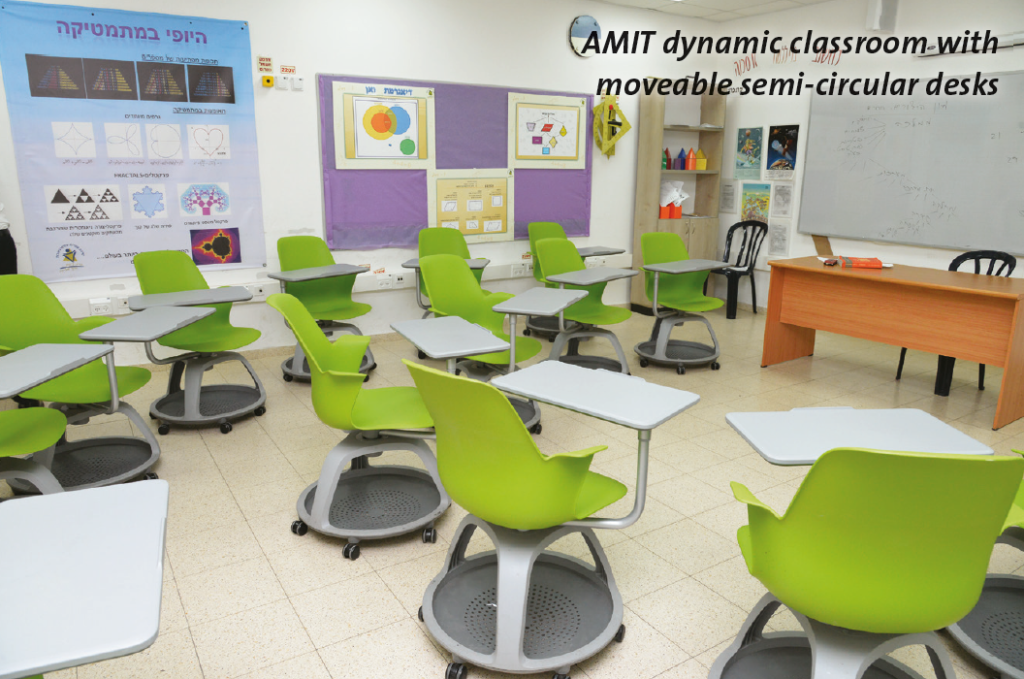
One of the first things Rokach did was reconfigure the structure of some of the classrooms. Rather than having conventional desks and chairs in neat rows standing before the board, some classrooms are now equipped with moveable semi-circular desks that encourage students to work together in small groups and not simply focus on the writing on the board.
Another innovation was providing some of the non-homeroom teachers with their own full-time classrooms – a novel concept in Israeli schools.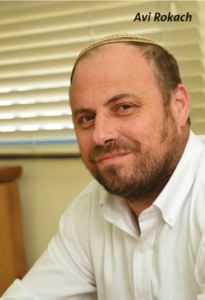
“In Israel, most subject teachers go to the students’ homeroom and not vice versa,” Jacobs explained. “In our school, the students usually go to the teachers, who have set up their rooms in the most functional way.”
The school also introduced forums in which students, parents, and teachers have become more involved in learning and decision-making. “The students in the forum tell the principal how the student body is doing and feeling and we present our ideas for a better learning experience,” Jacobs said.
Although face-to-face learning remains the most vital component of everyday life at the school – traditional Torah study, for example, is as vibrant as ever – Rokach has transformed the technology the students use every day into an educational tool, but with well-defined limits.
One teacher teaches Gemara by using Second Life, an on-line virtual world that is popular with many teens. In science and math classes students may be asked to use their Smart phones to look up a statistic or another type of information, but are prohibited from checking their e-mail or surfing the web in class.
mail or surfing the web in class. “Some things brought to us by technology aren’t appropriate for a halachic lifestyle,” Rokach emphasized. The students frequently attend lectures related to internet safety, and parents are also sent reminders about the dangers of unsupervised internet use.
“It’s clear that all our students have computers and use them,” Jacobs noted. “Rehovot is a very academic city, home to the Weizmann Institute of Science, and the parents tend to be employed in tech, math and the sciences. We use technology but with a halachic way of thinking.”
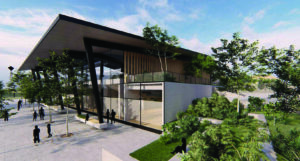
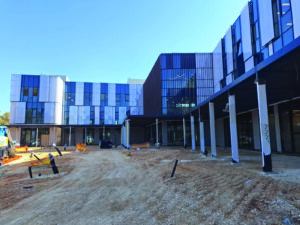
The educational innovations launched by Rokach’s team take place in a beautiful and modern school building where the hallways and classrooms are bright and airy. A large, grassy outdoor space with futuristic seating areas is a favorite place for informal lectures and just hanging out. There’s also plenty of comfortable seating in the spacious hallways.
The atmosphere is structured but relaxed and there is a feeling of innovation in the air.
In Aviva Taragin Hexter’s 9th grade English class, the students spent much of this year developing a plan to expand the English-language library, which lacks many of the books teens abroad read in high school.
Seated at their laptops in the library, the students cataloged the library’s existing books, set up an application whereby a student can locate a book by either author name or subject. In addition to the high-tech approach, the students also re-stacked the books on the shelves.
“We’re building an English library and learning English in the process,” said 14-year-old Ayden Rapstein, one of the seven students in the class. “We’ve investigated how other schools have built their libraries and met with our school’s executive director, who told us to write a grant proposal to fund the expansion. We’ve started writing the proposal and are cataloging the books with a program using Google Docs.”
“Instead of the teacher reading us chapters in a book and writing essays – although we’ve done that, too – we’ve visited other schools’ libraries in order to create something of our own,” chimed in 15-year-old Adam Revel, another English student.
Fourteen-year-old student Amitai Jacob noted that the school also entrusted the planning of the annual class trip to the students, which he called “a big job but worth it.”
“I feel the school gives us a lot more freedom than other schools and the trip is an example,” said 15-year-old Ziv Yeshayahu. “We feel that Rav Avi and the teachers trust us.”
In the math classroom, which was being used this day by an English for Hebrew speakers class, the students rolled around the room on the wheeled desk-chairs Rokach is experimenting with.
Seated in groups of twos and threes, the students spent the period deciding which foreign city they would most like to visit, as well as two venues in the city.
Their teacher, Rochelle Marcus, explained that her students would ultimately deliver both a written and an oral presentation, and also write a postcard ‘home’ to Israel.
“We can move and express ourselves better using these chairs,” 15-year-old Ofek Shaanan said as he moved his chair closer to his teammates. “It helps with learning during a long lesson.”
Dr. Amnon Eldar, director-general of the AMIT Network, said Rokach and his staff have had the “courage” to implement change.
“They’ve brainstormed together and asked themselves how to give their children the skills and values to face tomorrow, the future. They’ve created a kehila lomedet – a learning community – by inviting the teachers, the parents, and the professionals from the Rehovot educational system to learn together. And we, the AMIT network, have supported them in their efforts.”
Educators from several schools, including some from outside AMIT, as well as the Ministry of Education officials, have asked Rokach to share his hardwon knowledge, Eldar said.
“With enough funding, we could change the way children are taught in Israel. It’s a vital mission.”