
Interview by Robert E. Sutton
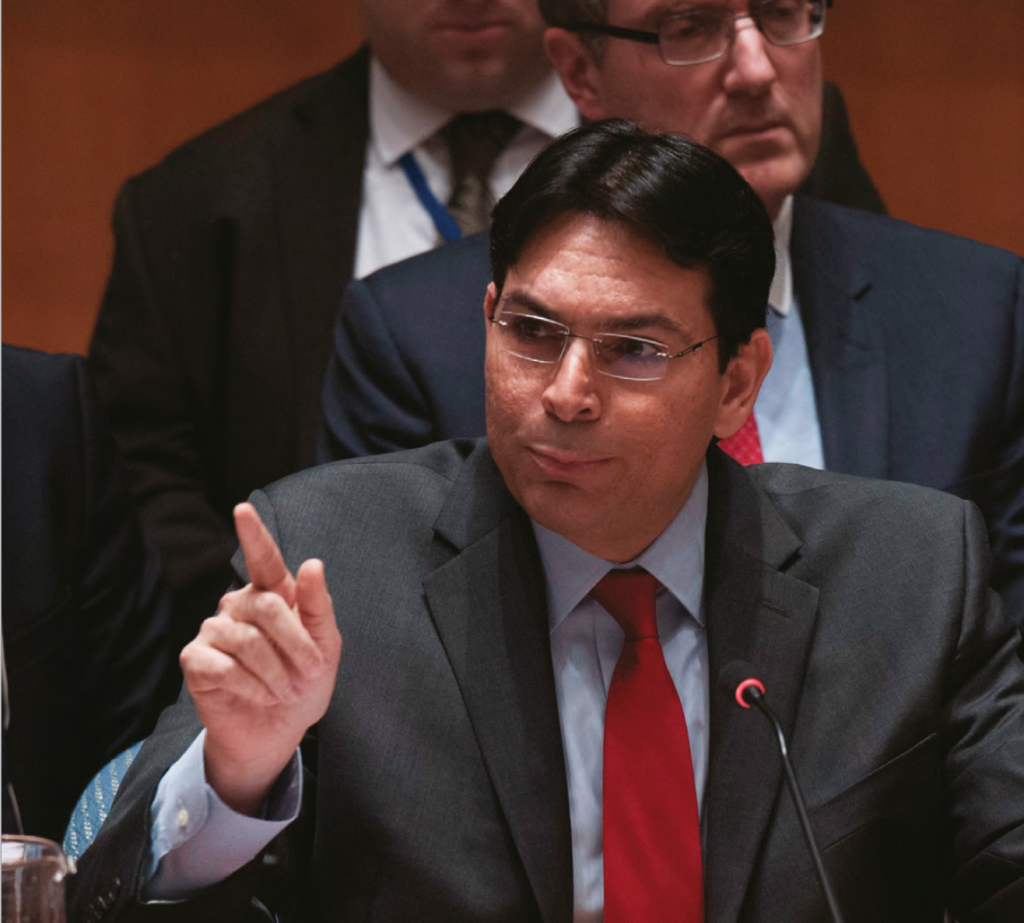
Danny Danon was a Member of the Knesset from February 2009 until August 2015. He served as Deputy Speaker of the 18th Knesset, as Chair of the Committee on the Rights of the Child, the Committee on the Status of Women and Gender Equality, and numerous other committees.
Danon served as Deputy Minister of Defense from – March 2013 until July 2014. In May 2015 he was appointed Minister of Science, Technology, and Space, serving until his appointment in August 2015 as Israel Ambassador to the United Nations.
You’ve been the Ambassador to the United Nations for eight months. Being on-site and mixing with other delegates, what are your impressions?
It is a great honor to serve as Israel’s permanent representative to the UN, but the challenges we face here are well known. It’s no secret that if a country proposed a resolution saying that the world is flat, and tacked on a condemnation of Israel – then it would pass in the General Assembly with a large majority. To me that just shows how far this institution has veered from the intentions of its founders.
Nevertheless, despite all the challenges, Israel has so much to offer the world, and when we’re given the chance we can share our innovations in agriculture, water, biomedical solutions, and, of course, anti-terror tactics. We’ve had amazing successes in all these areas. Thanks to our dedicated diplomats, we’re doing more and more of this every day at the UN, and it makes me extremely proud.
What surprised you about the UN?
I think what strikes me the most about the UN is that there is a “public UN” and a “private UN.” So many of the countries who automatically, and unfairly, condemn us in every possible forum – approach me privately saying how much they love Israel and proposing ways we can work together.
At the same time, too many publicly self-proclaimed allies of Israel abstain, or just disappear, when it’s time to stand by our side in key votes. I come from the Cabinet and the Knesset so I’m used to political maneuvering, but the UN takes it to a whole new level.
I view it as my job to merge these two UNs – to bring those who quietly support Israel out into the open, and to expose those who claim to support us but then disappear at critical times.
What are your strategies and goals at the UN?
When I started my new post, I gathered my staff and explained that we are no longer playing defense, we’re shifting to the offense. This means two things. First of all, no lie or slander against Israel goes unanswered. We don’t hesitate to speak out forcefully when needed and demand that either UN officials or member states not distort the truth when it comes to Israel. We recently spoke out very strongly when certain UN officials seemed to justify terrorism against innocent Israelis, and we regularly demand retractions and edits when Israel is treated in a hypocritical manner – and we are often successful.
Secondly, we push forward with positive initiatives in every possible forum. This means everything from increasing Israeli presence in peacekeeping to having Yom 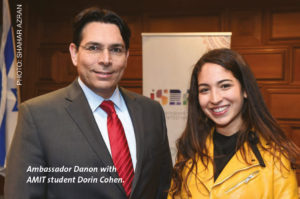 Kippur declared an official UN holiday. We are able to both show the true positive face of Israel and also make a positive change in the world. Both make me very proud.
How will you help combat the BDS movement at the UN and, have you been invited to universities to speak, specifically about refuting the BDS movement?
I have had the opportunity to speak at a number of campuses, and I have seen what students and professors who support Israel – or just those who refuse to tow the radical anti-Israeli line – have to deal with.
I know that there are those who advise ignoring these BDS activists. Some make the claim that the numbers of these activists are small and insignificant and that by speaking out against them we are giving them the very attention that they desire.
Our history has taught us, however, that we can never ignore those who seek to exclude the Jewish people from the family of nations. We can’t take it lightly when we are subjected to fines and sanctions merely for living according to our heritage and convictions.
At the UN we see a different, but familiar, type of BDS. They do this even when they are set to gain from the policy or change we are initiating.
And they do all of this simply because we are the Jewish state.
When you were young, you joined Betar, how did you come to join Betar? What spurred you?
Like many Israelis, I learned a lot from my youth movement. For me, it was a place to educate myself and immerse in the ideological values that I already had started to develop as a young man. I also appreciated the global reach of Betar. I was really proud to be associated with an organization that looked out for all Jews, wherever they may be in the world.
As you know, AMIT is an educational network throughout Israel composed of 110 schools with over 32,000 students. One of our newest initiatives is to advance education in the fields of science and technology – specifically educating AMIT students from the periphery in the subjects needed that will place them in positions as cybersecurity analysts and technologists. Your thoughts and comments?
I often say that one of the positions that prepared me most for my post at the UN was when I served in the Cabinet as Minister of Science, Technology, and Space. We are all aware that Israel is one of the foremost “start-upnations,” but during my time in the ministry, it became apparent to me that we can’t take this for granted. This is why I focused much of my efforts on ensuring that high-level education in the sciences and technology was available to all Israelis, and to communities throughout the country.
This is also why it’s so important that organizations like AMIT partner with Israel in giving our next generation every possible advantage, both so that they can succeed on an individual level, and so that Israel continues to grow as a technological powerhouse.
Two weeks ago, you attended the Women Engineers of Tomorrow Conference. One of the presentations was from an AMIT student, Dorin Cohen from Haifa. What were your impressions of the conference?
It was a real pleasure to host those young women at the UN. Not just because they were such bright and charming young women, but also because it tied together so nicely some of the things I mentioned earlier.
 Seeing the work that Dorin and her friends are doing validates my sense of hopefulness about the future. I know that through their hard work and tenacity Israel will not only retain its prominence as a start-up nation, but will reach new heights.
At the same time, hosting that group at the UN did a great service to the State of Israel. It gave the chance for diplomats from around the world to see the amazing things coming out of our country. I believe it shows them how much more we can contribute for the betterment of all mankind if we focus on these types of positive initiatives instead of wasting time and energy on condemning Israel unfairly.
What are your political aspirations?
My aspiration is to succeed at my position as Ambassador to the UN. I hope to stand up for the truth, and to be a successful emissary on behalf of my country and my people.