
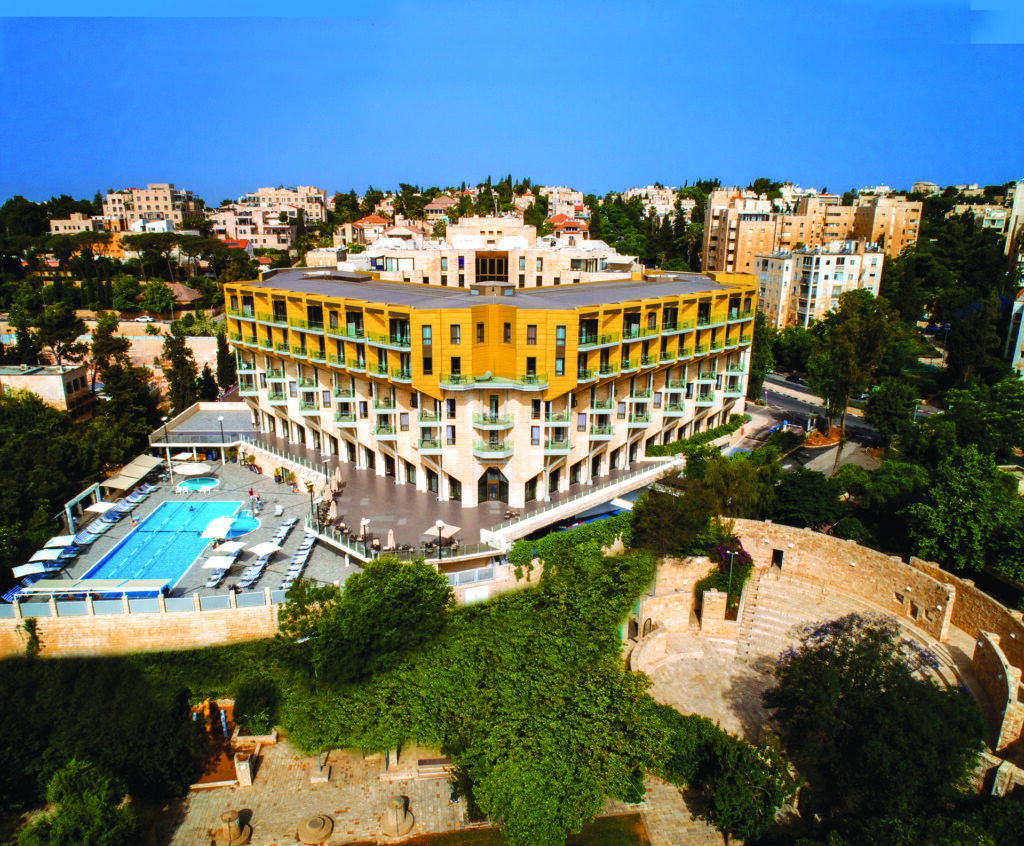
Simchat Torah 5784 was supposed to be one of the happiest days of the Jewish year. After almost a full month of back-to-back holidays, and following a week of living in makeshift sukkahs outside our homes, we once again completed the reading of the entire Torah and we were about to begin the readings of another yearly cycle.
And then came the horrific, shattering news.
“We had about 850 guests staying in The Inbal Hotel, mostly Americans,” recalls Rony Timsit, general manager of The Inbal Jerusalem Hotel. “I got to the hotel about five minutes after the sirens first sounded in Jerusalem. My staff and I immediately moved everyone from the outdoor sukkahs, where they were sitting for the holiday meals, to our halls on floor minus two. But there were many hotel guests who were caught outside the hotel because they had gone to synagogue for the holiday.”
Throughout the early hours of Saturday morning, everyone began to hear pieces of information as they trickled in, bit by bit. Sirens. Missiles. Attacks. South. Gaza. Infiltration. Together, they painted a brutal story: Thousands of Hamas terrorists had broken the border fence with Israel and invaded Southern communities and army bases, attacking, killing, and more.
In the following hours and days, most foreign guests caught whatever flights they could out of Israel, reluctantly leaving the Israel they love in a state of chaos and emergency, to return to their obligations back home.
“Within about four to five days, the hotel emptied, and my staff and I asked ourselves, ‘So, what are we going to do?’” recalls Rony.
The answer to that compelling question presented itself almost immediately. That first week or two, many Southern communities were evacuated, and following the threat of attacks in the North, many communities on the Israel-Lebanon border were also evacuated. Residents were only able to pick up and carry some basic belongings as they sought shelter in safer places.
Rony knew his hotel could be one of those safe refuges for individuals and families that had to leave almost everything behind. Ten days after the initial attacks, The Inbal made the decision to take in evacuees from the South.
Rony, along with his staff, prepared 40 rooms for evacuees from Kiryat Shmona.
“I was not going to let anyone sleep outside,” explains Rony. “I did not want anyone to feel that they were ‘refugees.’ I wanted them to feel like tourists. That’s the least they should have.”
He continues, “We decided to have only two people per room; any more would feel overcrowded. Families were given rooms with adjoining rooms for the children.”
With the 40 rooms quickly occupied, Rony and his staff began strategizing about making another 40 rooms available. Around this time, in a fortuitous twist, a Jerusalem contractor told Rony that he had just completed the construction of a building and he wanted to enable the evacuees to use the apartments, but he didn’t have any furniture. There was one floor in the hotel that was due for renovations, so a decision was made that this was the right time. The contractor took all the furniture from the rooms and moved them into the apartment building.
By Hanukkah, solidarity missions started arriving from New York, and the hotel was filling up again. The hotel services, swimming pool, gym, and dining rooms were available to the guest missions, as well as to the evacuees, to use.
Rony continues, “Many of our employees had been put on unpaid leave because there were no guests in the hotel. Some of the department heads were also volunteering, but they were gradually called back as the hotel filled up. Many five-star hotels were requested to take in evacuees, and some turned down the request, but we felt that we had to do our part in the national effort.”
This proved to be a wise decision, as ultimately Rony discovered that many solidarity missions that came to Israel asked if they had evacuees staying in the hotel, and when he said yes, they specifically chose to come and stay at The Inbal. “This was very touching. People understood the importance of what we were doing for the evacuees,” says Rony. And in turn, they wanted to support The Inbal.
People came on personal solidarity trips as well. They arrived in Israel with suitcases full of goodies for the soldiers, for children, and more. The hotel had to allocate several rooms just to store their suitcases.
Every story and every case was extremely emotional and uplifting.
There was a family of a lone soldier, where at any given time, one of the parents was in Israel. Even if they didn’t see their soldier regularly, at least one parent was in the country, ready to provide moral support. There were grandparents who came to Israel to stay with a granddaughter and her children while her husband was in Gaza.
Rony set up a WhatsApp group for the evacuees, he says, “so that they could inform us of any specific needs, allowing us to check what they were entitled to from the government, and make sure they were given appropriate assistance,” he explains. “We even coordinated laundry services, private companies that came and picked up the laundry from the evacuees and returned it clean a day later.”
“I was at The Inbal a few weeks into the war, when there were a small handful of guests and the evacuees,” says Andy Goldsmith, executive vice president of AMIT. “When I went for a walk one night, I passed many dark hotels. It turns out many luxury hotels chose to close their doors rather than open themselves up to housing evacuees. The Inbal welcomed them with all possible hospitality and with great sensitivity.”
Rony is modest about The Inbal’s contribution to the national effort. “This was a big project for us, but it is just a small part of everything that was done on behalf of Israel in her time of need,” he says. “Our reward is simply that we were able to give to those who needed it.”
“We always say that Israeli society is sometimes divided, because we’re individualists,” continues Rony, “but when the challenge arises, we are all there for each other.”