
By Arnie Draiman
When a high school student from Sderot, displaced by the October 7 war and deep in trauma, told her ad hoc therapy group, “I want my TATZAM group. That’s where I feel most comfortable talking about my experiences,” she wasn’t just describing a class, a classroom, or an after-school activity. She was identifying a lifeline.
In a country where students navigate not just adolescence but the very real challenges of conflict, inequality, and social upheaval, AMIT’s TATZAM program has emerged as a quietly radical response: a structured, nationwide mentoring and personal development process grounded in emotional intelligence, community belonging, and human connection.
What Is TATZAM?
Launched in September 2021, TATZAM is an acronym for Tahalaich Tz’micha Ishi Miktzo’i (Professional and Personal Growth Process). While the name may sound clinical, the results are anything but. At its core, TATZAM is about unlocking human potential—not just in the thousands of AMIT’s high school students, but in its teachers, principals, and entire school communities.
“There are six basic things every human being needs in order to thrive: belonging, security, communication, ability to act, autonomy, and an internal compass,” explained Shuli Yost, director of the TATZAM program. “These are simple needs—but if even one is missing, a person’s ability to grow and succeed is diminished.”
Based on the research of Professor Avi Assor of Ben-Gurion University and colleagues from the University of Rochester, the program rests on the now widely accepted understanding that emotional well-being isn’t a luxury—it’s a prerequisite for academic and personal success. TATZAM offers practical tools and mentoring processes to meet those needs with a focus on inclusion, equity, and human dignity.
Since its founding nearly 100 years ago, AMIT has worked to provide cutting-edge, values-based education to Israel’s diverse population. With 70% of its schools located in Israel’s socioeconomic and geographic periphery, AMIT’s mission is to level the educational playing field, empowering children from under-resourced communities with the same tools, mentorship, and academic opportunities as their peers elsewhere. TATZAM is a natural outgrowth of that mission.
“Academic achievement is essential, but it’s not enough,” Yost said. “We want our students to become the best versions of themselves so that they can fulfill their dreams and improve the world around them. That’s the heart of tikkun olam [repairing the world]. We’re not just teaching math, science, and civics—we’re shaping the people who will shape our future.”
Working together, the mentorship and deep personal work in TATZAM support success in the Learning Management System (see article on page 11), helping students identify the style of learning that suits them best. In turn, those personal and academic goals set in the LMS feed into the work students do in TATZAM as they build themselves up in social, emotional, and values-based areas. These two processes are part of the holistic framework that forms an AMIT education.
A Transformative Process
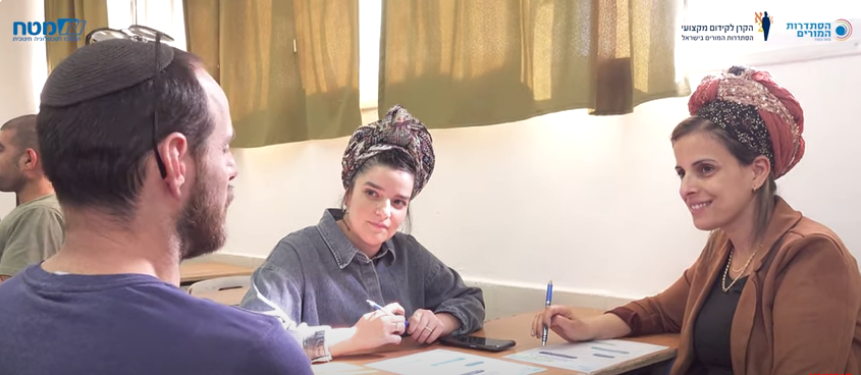
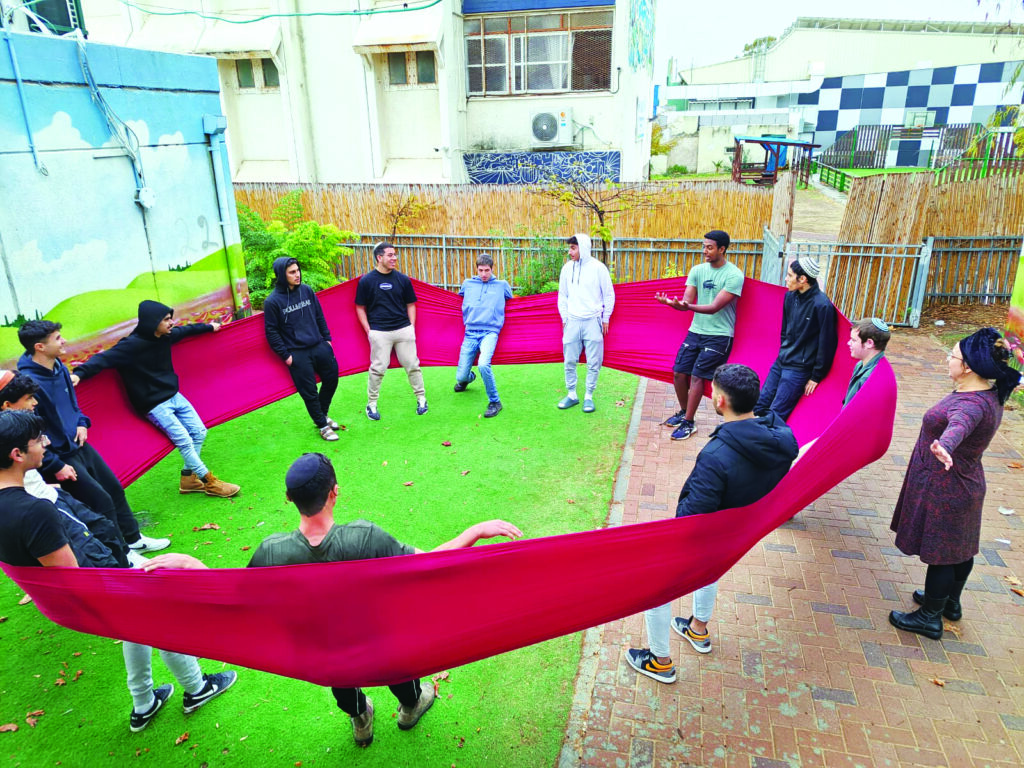
TATZAM functions on two levels: group and individual. Each week, students from grades seven through 12 meet in group sessions led by trained mentors—teachers and educators within the school who share in the daily lives of their students. And every six weeks, students receive one-on-one counseling from their mentor that is tailored to their unique emotional and developmental needs. Yosef, a student from the South, said, “It is crucial that there be a TATZAM program as part of the school day—it is important; it keeps us balanced. The mentor is someone you look up to, someone you want to emulate.”
“Each student has individual goals,” said Yost. “We adapt the syllabus for every grade and personalize the approach. Two students who are late for class might be dealing with completely different issues, so why respond to them in the same fashion: punishment, detention, extra assignments, the proverbial ‘go to the principal’s office’? In AMIT, we stop to ask, ‘What’s really going on here?’ And we work with each student as an individual.”
The results are transformative.
While the regular school classes are for 30 students, mentors work closely with subgroups of 15, fostering an environment of safety, openness, and shared responsibility. This past school year, 35 high schools were registered with the program, and an additional 30 have signed up for the coming year. The scale of the program is immense, with over 1,000 mentors on board this school year and more than 15,000 students enrolled in those schools. And TATZAM continues to grow.
Crucially, the TATZAM process doesn’t start with the students. It begins with the teachers.
“All of our mentors go through the program themselves,” Yost explained. “They experience it firsthand. That’s how they understand its power—and how to pass it on.”
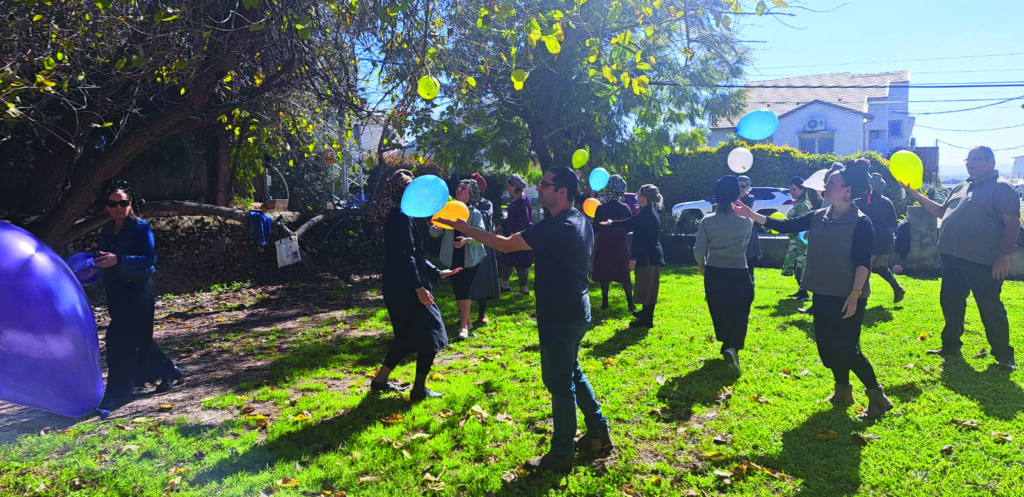
In practice, this means that the in-service training and professional development sessions aren’t just about pedagogy or classroom management, but about personal reflection, emotional growth, and authentic connection. In teacher lounges across the country, formative moments are unfolding. “We are always so busy in school,” expressed one of the teachers, “but now there is a time that is dedicated for me to grow. There is no doubt that TATZAM has made me a better teacher.”
Teachers are rediscovering their purpose, seeing their colleagues in a new light, and finding the support they need to thrive—not just as educators, but as human beings. “We don’t have in-service training days about how to be better teachers,” explained Tzuriel Rubens, principal of the AMIT Wasserman High School in Beersheva. “Rather, it is how to be our better selves.”
“There were moments where a teacher would say, ‘This is the first time I’ve felt like I’m at the center, like I really matter here,’” said Yost. “That’s not just heartwarming. That’s revolutionary.”
What makes TATZAM particularly notable is that it functions not just as a program, but as a cultural shift. Schools contribute part of their own Ministry of Education budget to fund the program, while AMIT covers the behind-the-scenes development, staff training, and materials required to implement it. The support system includes a detailed methodology, a shared language, and ongoing professional guidance to ensure conformity and adaptability across different environments—such as religious and secular schools, urban and rural settings, and affluent and underserved populations. “This is happening in our AMIT schools from the northernmost towns to the south,” Yost noted. “It doesn’t matter if it’s a wealthy school or one in a lower-income area. TATZAM belongs to everyone.”
The inclusivity at the heart of TATZAM reflects AMIT’s broader values. In a system where students often fall through the cracks due to lack of resources or emotional support, AMIT is modeling what an education system grounded in equity and care can look like.
The impact of TATZAM has been particularly visible in times of crisis. Following the devastating October 7, 2023, terror attacks and subsequent conflict, many AMIT students— especially those from southern cities like Sderot—were evacuated and relocated. Amid trauma and upheaval, their TATZAM groups became emotional anchors. “I remember that student from Sderot who insisted on having her TATZAM group,” Yost recalled. “That’s where she felt safe, comfortable. That’s where she felt seen.”
It’s this kind of grounded, sustained care that distinguishes the program from temporary interventions. Rather than offering short-term “resilience” workshops, TATZAM embeds emotional support into the daily rhythm of school life. It becomes a constant, not a crisis response.
From Resistance to Revolution
Of course, not everyone embraced TATZAM immediately. As with any major cultural change, there were skeptics—among teachers, parents, and even students.
“But we don’t see opposition as a problem,” said Yost. “We see it as a place to start a conversation. Why is this teacher resistant? What do they care about that’s making them hesitant? That’s how we engage—with respect, curiosity, and empathy.” In fact, many of the program’s strongest advocates were once its loudest critics. After experiencing the process themselves, they became believers—and champions.
“When a principal goes through it and sees the difference in their own life, they don’t just want TATZAM in their school—they demand it,” Yost laughed.
Looking ahead, AMIT has ambitious goals for TATZAM. The hope is that every AMIT student, teacher, and principal, regardless of background, will continue to benefit from the program’s deeply humanizing approach. “We’re aiming for full participation across our network,” said Yost. (AMIT runs 88 schools in 32 cities in Israel.) “But more than that, we want to share this model with the rest of Israel, and the world.”
To that end, AMIT continues to invest in training, curriculum development, and research partnerships to refine and expand the program. TATZAM is not static; it evolves in response to feedback, real-world needs, and the changing educational landscape.
Perhaps the most radical thing about TATZAM is its redefinition of success. In a world obsessed with grades, test scores, and measurable outcomes, AMIT is offering something different: an education that starts with the human being, not the data point. High school student Ofek (her name means “horizon” in Hebrew) made it clear: “The most important thing I have experienced with TATZAM is gaining self-confidence. I was a very shy girl, and now I have more confidence, and I have learned many new things about myself.”
“It’s not about turning students into robots who perform well on standardized tests,” Yost insisted. “It’s about turning them into human beings who know who they are, what they want, and how to get there— together.”
And that’s a lesson worth learning.