

By Robert E. Sutton
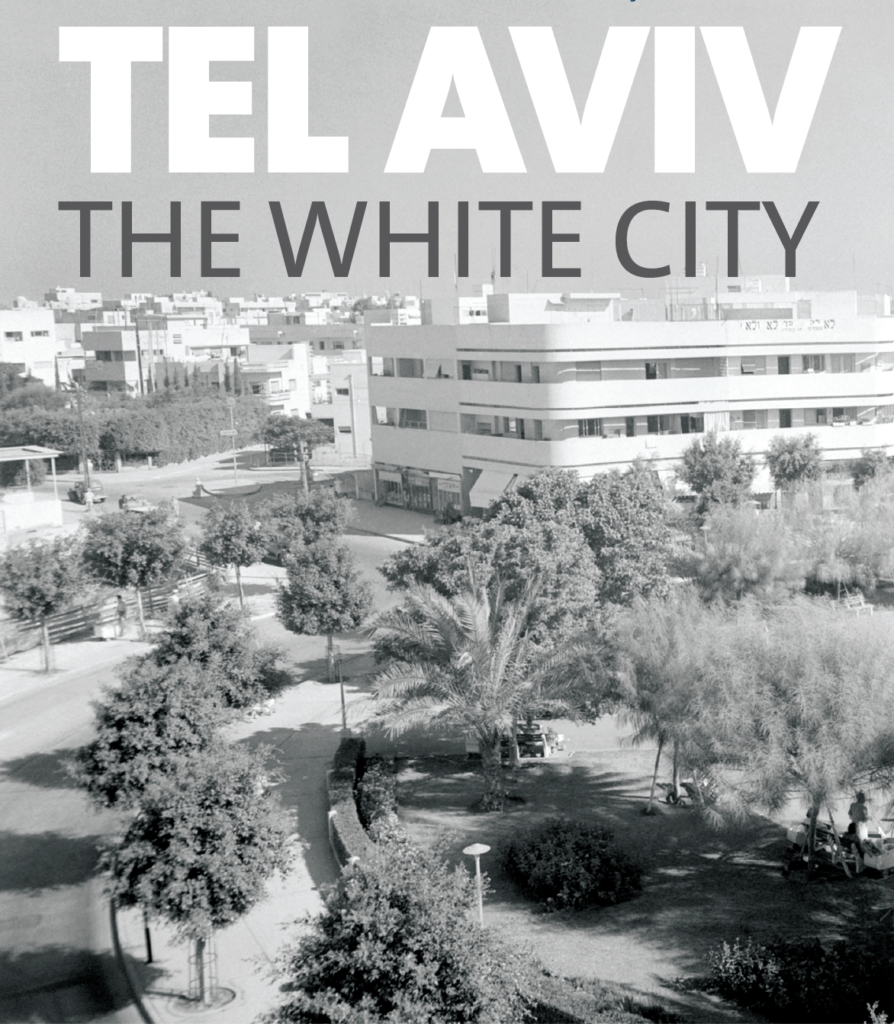
 Behind the facades and hidden in plain sight are the buildings that are the founding structures of Tel Aviv. These seemingly insignificant white houses, factories, hotels, and cinemas are part of one of the 20th century’s most important trends and esthetic styles: Bauhaus. And, Tel Aviv has nearly 2,000 white Bauhaus buildings, the highest concentration anywhere in the world.
THE ORIGINS OF TEL AVIV
Tel Aviv is the Hebrew title of the book Altneuland (“Old New Land”), in which Theodor Herzl outlined his Zionist vision. There is also a biblical component – the prophet Yechezkel [3:15] mentions a place in Babylonia called Tel Aviv. The name Tel Aviv is metaphorically very fitting. It embraces the idea of the renaissance of the ancient Jewish homeland – Tel an archaeological mound that reveals layers of ancient civilizations built one on top of the other and Aviv, Hebrew for “spring,” symbolizing renewal.
Tel Aviv’s origins go back to Ottoman Jaffa, a walled city in the midst of agricultural land in the early 19th century. Towards the end of the century, Jaffa developed into a commercial harbor, as well as the port for pilgrims to the Holy Land. A decree of 1856 allowed foreigners to acquire land, which led to the development of suburban areas. The first Jewish settlement north of Jaffa was Neve Zedek, founded in 1887-96. In 1908- 09, a group of affluent merchants established Achuzat Bayit as a garden suburb, later named Tel Aviv.
The early architecture of Tel Aviv was mostly Eclecticism Neo-Classical and Neo-Romantic with some Middle Eastern elements, such as arches, rounded balconies and wrought iron railings. This type of design and construction existed in Tel Aviv until the end of the 1920s, when the Bauhaus (or “International”) movement in architecture became popular, first in Germany, then abroad. The Bauhaus had a profound influence upon subsequent developments in art, architecture, graphic design, interior design, industrial design, and typography.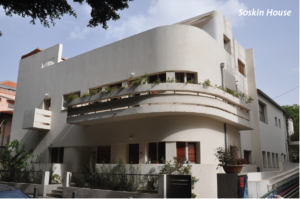
In the early 1920’s Jewish architects and planners brought the Bauhaus ideals and methods of “New Architecture” from Europe to Palestine, which had a lasting influence on the planning and design of Tel Aviv and many kibbutzim – “A new architecture for the new Israel, in a new land.”
Conversely, in the second half of the 1920s, upcoming architects from Palestine moved back to Europe in order to further their studies and learn the Bauhaus.
By 1933 many Jewish architects of the German Bauhaus school, which was closed down on the orders of the Nazi Party, fled to the British Mandate of Palestine. The residential and public buildings were designed by these architects, who took advantage of the absence of established architectural conventions to put the principles of modern architecture into practice. The Bauhaus principles, with their emphasis on functionality and inexpensive building materials, were perceived as ideal in Tel Aviv.
Arieh Sharon, Dov Carmi, Zeev Rechter, Pinchas Hueth, Josef Neufeld, Genia Averbuch, Richard Kauffmann and Erich Mendelsohn are just some of the architects who contributed to the local abundance of Bauhaus architecture. Sharon was known for his cooperative workers’ dwellings in Tel Aviv, work on many of the country’s hospitals and the early architecture in Kibbutz Gan Shmuel. In 1933, Rechter designed the Engel House, a large residential building that has become one of the symbols of Modernist architecture and the first building in Tel Aviv to be built on pillars (pilotis). Averbuch is well known because in 1934, at the age of 25, she won the competition to design Dizengoff Square, one of the landmarks of Tel Aviv’s historic Bauhaus White City. And, Averbuch planned some of the most important youth villages, including our very own Kfar Batya (1945).
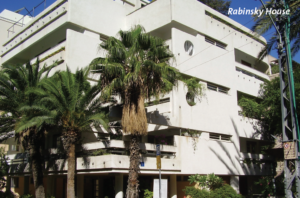 Though these Jewish Bauhaus architects didn’t build exclusively in Tel Aviv, it was Tel Aviv that gained the most from Bauhaus: In only about 12 years an astounding 1,500 Bauhaus styled structures were added to the town, mainly in the area known as the “White City.”
BAUHAUS – TEL AVIV ADAPTATIONS
With Tel Aviv situated on the shores of the Mediterranean the Bauhaus architecture had to be adapted to suit the hot and sunny climate. Some of the designs unique to Tel Aviv Bauhaus are:
• White and light colors that reflected the heat.
• Walls not only provided privacy but protected against the sun.
• Large areas of glass that let in the light, a key element of the Bauhaus style in Europe, were replaced with small recessed windows that limited the heat and glare.
• Long narrow balconies, each shaded by the balcony above it, allowed residents to catch the breeze blowing in from the sea to the west.
• Slanted roofs were replaced with flat ones, providing a common area where residents could socialize in the cool of the evening.
• Buildings were built on pillars to allow the wind to blow under and cool the apartments, as well as providing a play area for children.
Often flat and functional in other cities around the world, the simple, highly formalized Bauhaus style, free of decorations, is stunning in Tel Aviv because of the sheer number of Bauhaus buildings and constant sunshine reflected on the white plaster surfaces that emphasize the “White City.”
Tel Aviv hasn’t often had the luxury of looking back and appreciating the greatness of her architecture, though its presence has been celebrated in song and in the popular culture – the piece “White City” (“Ir Levenah” in Hebrew) by Naomi Shemer celebrates the beauty of Tel Aviv when its Bauhaus structures were still white from newness.
Over the years a kind of reactionary ‘anti-Bauhaus’ sentiment developed. Saving and restoring many of the city’s wonderful old buildings is fraught with legal and economic constraints that often make conservation less than desirable for the building’s owners. One can only hope that the coming years will bring solutions that will enable the preservation of more of Tel Aviv’s Bauhaus architecture.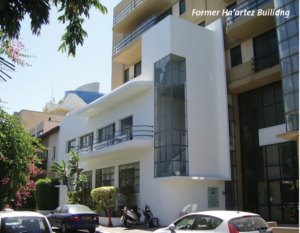
In 2003, the UN’s cultural and educational organization, UNESCO, declared the “White City” a World Heritage Site, based on the cultural value of such an amazing congregation of Bauhuas style buildings. UNESCO described the city as “a synthesis of outstanding significance of the various trends of the Modern Movement in architecture and town planning in the early part of the 20th century.”