

By Heidi Mae Bratt
Potential. When it’s untapped it remains like an unplanted seed or a bud with no flower.
Potential that is nurtured and given the right ingredients—encouragement, opportunity, nourishment, direction, love—can grow into the tallest, strongest tree, the most fecund blossom, or in the case of a young boy, a confident, successful, contributing young man serving his nation in a high-level IDF post with a wide vista of a bright future ahead.
Helping a young person realize his or her potential is one of the most gratifying things an educator can do, and AMIT teachers do that every day.
Haviv C., 26, had more than humble beginnings when he grew up in Be’er Sheva. His father, whose roots are Moroccan, had a full disability even before he was born. His mother, whose family originated in Tunis, was at home for many years. While there always was delicious Sephardic food at home, money was scarce, and there was very little for any extras.
But Haviv had vision and ambition to work hard. He also had AMIT.
He heard about AMIT Wasserman Jr. & Sr. High School—the school from which he graduated—from friends at his elementary school, and set his sights on going there qualifying through an entrance exam.
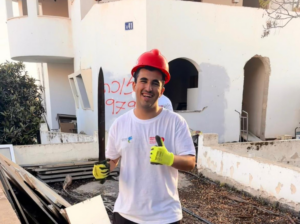
Today, Haviv is in the elite 8200 unit of the IDF, one of the nation’s top tiers of its armed services, is married, and is very grateful for how AMIT gave him the rungs on the ladder for his ascent into a life of limitless potential.
“Before I began studying at AMIT Wasserman, I heard that there was a math teacher named Gadi, who gave tons of homework,” Haviv recalled. “I was worried about it and discussed it with my mother. She said, ‘How much can it be? One hundred problems to solve? That’s not possible. Don’t worry, it will be fine.”
“I got to my first class with Gadi and was very impressed with him, his personality and teaching style. When I got home that day, I said to my mother, You won’t believe it. You said there is no way he would give us 100 problems for homework. Well, he gave us 450 problems to solve over the next three days!“
“I had no way of knowing at the time, but Gadi ended up being a very important influence on me,” Haviv said.
During his second year with Gadi, when he was in 8th grade, the math teacher challenged his students with “Skanavi Math Problems,” very difficult problems that were used on the entrance exams in the former U.S.S.R. Most other students hired tutors to pass the tests, but that wasn’t possible for Haviv’s family. He wound up failing two tests and thus would possibly have to drop to a lower-level math.
Gadi demonstrated his faith in Haviv.
At the end of the school year at a parent-teacher conference, Gadi told Haviv’s mother that while he liked him, and he was a good student, according to the rules he was supposed to drop him down a level in math for the coming year. Haviv asked for another chance to prove himself.
“I’ll never forget what he said, ‘Haviv, I believe in you, and there is no way I will drop you out of this math class.’…It was clear to me that I had been given an opportunity, and there was no way that I was going to pass it up. My teacher believed in me, and I wasn’t going to disappoint him,” said Haviv who sometimes spent six hours on one math problem.
“As the year went on, Gadi gave me a lot of extra help. He challenged me with extra questions and more difficult material. I ended up getting a 99 percent average in math in high school, and I did the 5-point math Bagrut. My ‘math muscle’ remains very strong and got me through my university studies. It is also because Gadi was such a great teacher, and most importantly, he believed in me, and that gave me the strength to believe in myself.”
Gadi wasn’t the only teacher who lifted Haviv up.
His 9th grade homeroom teacher, Nachama, took a very strong interest in Haviv. She was close to his family and when he would come into school early without breakfast, she would get a sandwich for him and made sure that he ate. She also knew what a strong academic student he was. While shy, she observed untapped potential in the social and activism sphere. She wanted to bolster those skills for Haviv so recommended him for Kav Hazinuk (The Starting Line), a national 10-year leadership program for people 15 to 25. He was one of 20 students in the south, a big deal.
“That program was very important to me and helped me develop a social consciousness,” Haviv said.
Through Kav Hazinuk he worked on an ecological project about the polluting effect of plastic bags, and AMIT Wasserman stood behind him in terms of support. They allowed him to lecture to the junior high school students and gave him time to pursue the projects.
“The school didn’t just recommend me for the program and say, ‘You’re on your own.’ Rather, it helped me succeed,” he said.
The school also emphasized volunteerism for students to earn their social Bagrut. Haviv volunteered with students on the autism spectrum at a neighboring school, Urim, and worked with a young boy who had trouble communicating. Trust was forged, as was a friendship. It wasn’t just Haviv who reached out to the school and the student. His math teacher, Gadi, taught that boy math. As a result, the boy was able to complete a Bagrut, something that was not seen as possible. Likewise, Haviv’s computer teacher, Ze’ev, created a class for Urim students to learn graphic design. What started as a club, is now a regular activity for the special needs students who have created exhibitions to display their work.
“Volunteerism is not just lip service that our school has us do for the social Bagrut,” Haviv said proudly. The school puts its money where its mouth is.
While in high school, there was much encouragement to push yourself to greater heights. “I ended up studying six majors for the Bagrut exams,” said Haviv, “including two computer majors, physics, a special project-based physics, chemistry, and literature.” Additionally, he did a level 5 in math and English.
To accelerate in physics, Haviv’s physics teacher, Victor, gave a summer course at the Ilan Ramon Center at Ben-Gurion University, which encouraged him to pursue high-level physics. In addition to extra learning with Victor, who introduced his students to advanced physics education, there were trips to the labs at Ben-Gurion University and the Weitzmann Institute.
Ambition, desire and hard work were paying off for Haviv, who took the opportunity in 11th grade to start his bachelor’s degree taking math courses at Ben-Gurion University in a special program introduced to him by Gadi.. The 100 Project was very intensive and required the maintenance of high grades in the program in addition to his high school work and exams. AMIT helped pay for the tuition, and Haviv decided to pursue another degree. He also studied computers and participated in the Olympiads.
The school also supported him financially, helping him out with the cost of schoolbooks and even finding funds for him to take the 12th grade Poland Heritage Trip with his classmates.
He also stays in touch with his 7th grade homeroom teacher, Yehudit, who gave him much support and understanding during the middle school years.
All the hard work and encouragement came to a fulcrum when Haviv was accepted into Technion, where he got his bachelor’s degree with honors in computer engineering.
“I am sure I was able to be successful there because I was so well prepared by my high school. Gadi’s pushing me, teaching me how to work very hard, all the extras I was given including university courses in high school and my informal education,” he said. At Technion he studied chemistry and physics.
Today, in addition to his high-level IDF service, Haviv is pursuing a master’s degree at Technion in computer programming.
“What I can say is that AMIT Wasserman really stressed the value of serving our country,” he said. “It was a familiar subject for conversation, and alumni who were serving in the IDF or National Service were always on campus, for holiday celebrations, ceremonies, and to talk to us about what the army was like.”
It seems natural for him to be of service—and proudly. “After receiving so much assistance from my school, it is a real honor for me to be able to serve my country in a significant position,” he said.
This is a true success story of realizing a student’s potential.