
Letters from AMIT founder to her friend and colleague
By Heidi Mae Bratt
They were bonded in their friendship and in their passion for pre-state Palestine. Two young women living in Seattle with the fire of Zion burning in their bellies. Yetta Ursditsky Strongin and Bessie Gotsfeld found friendship and communion with each other as they helped ignite the Jewish community with their vision of a future Israel.
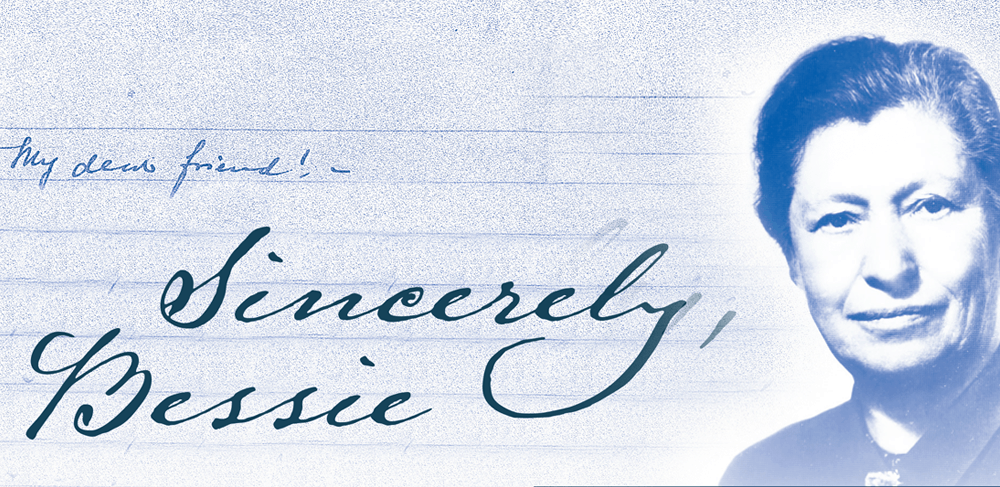
AMIT magazine has obtained letters written by Bessie Gotsfeld, the mother of Mizrachi Women’s Organization (now AMIT), to her friend and colleague, Yetta Strongin, who founded the organization’s San Francisco chapter in 1940.
The letters, typewritten on official letterhead stationery and handwritten on plain paper and postcards, span nearly three decades from 1933 to 1959, and offer a rare and historical glimpse of Mizrachi Women’s nascent days. They highlight some of the organization’s early challenges and successes, the warm, enduring friendship of these women, and the unflagging passion and determination of Gotsfeld.
Strongin and Gotsfeld had much in common. Both women were born in Europe: Strongin in Russia in 1890 and Gotsfeld in Poland in 1888. Both women moved and lived in Washington state. Strongin immigrated with her family in 1906 and married her husband, Harry, in 1913. Gotsfeld’s family immigrated to New York in 1905, and she and her husband of two years, Mendel, moved to Seattle in 1911.
It was sometime after 1911 when both were living in Seattle that they became friends, said Strongin’s relatives, who shared the letters with AMIT magazine. (Some of the letters were written by other Mizrachi leaders, but the majority are written by Gotsfeld.)
Both Strongin and Gotsfeld didn’t have any children of their own but that didn’t stop them from making the plight of children and immigrants central in their lives. “Mrs. Gotsfeld and her friend, Mrs. Yetta Strongin, were instrumental in founding this older group of Mizrachi women,” recalled Meta Buttnick whose historical account of the Seattle Jewish community is included in the University of Washington digital collection. “… they used to go down to the boat to meet the immigrants who were coming to Seattle via Harbin and the Oriental ports.”
That Strongin saved these letters, keeping them until her death in 1965, bespeaks how important Mizrachi Women was to her, her family said.
“The family is very proud of Yetta’s tireless involvement in AMIT” said Jonathan Frenkel, whose late mother, Sulamith, was Strongin’s niece.
“Yetta not only founded the San Francisco Chapter, but she was also a member of the National Board, and a lifelong member. Mizrachi Women was a large part of her life. Here was this widowed woman during the Great Depression, [Strongin’s husband died in 1930 and she moved to San Francisco in 1935] and she was a mover and shaker. She was close with a lot of important people who played a critical role in the history of Mizrachi. Her family took great pride in her life’s work for Jewish children and the future of the Jewish people.”
While these letters give only a one-sided account of the decades-long correspondences between Gotsfeld and Strongin (one wonders about Strongin’s responses) they paint a portrait of AMIT’s iconic founder as a strong woman ahead of her time, savvy in business and pragmatic in other matters, loyal to her friends, devout in her religious and Zionistic beliefs, always working to meet the needs of the religious young women of Palestine, and determined to find new ways to grow and strengthen Mizrachi Women in order to grow and strengthen Eretz Yisrael.
They also reveal her private side – i.e., Gotsfeld’s “anxiety” about Strongin’s request to bring a gown for her visit to San Francisco, (she told Strongin she did not own one), her distaste at seeing her own picture in the newspaper, her bouts with poor health (she had diabetes and had to take doctor-ordered rests), her longing to return to her husband during her protracted travels abroad, among other intimacies that one would share with a close friend.
The letters also are peppered with the names of now-famous world Mizrachi leaders who were the founders of the State of Israel, including Rabbi Zev Wolf Gold, a signatory of Israel’s Declaration of Independence, and Rabbi Meir Berlin (Rabbi Meir Bar-Ilan), for whom Bar-Ilan University was named.
Here is a glimpse of the letters:
Gotsfeld, who already had made Aliyah, came back to America to garner support for Mizrachi Women. Planning a trip across the country, including a stop to see Strongin in San Francisco, Gotsfeld in August 8, 1939 writes:
“My tour, although it is to take me first to your city, will nevertheless include stops in many other cities where Mizrachi Women’s Chapters already exist and where they may be opportunities for forming new ones. More than ever before it is necessary for us to maintain our position in Palestine. If a chance for this has ever been granted us it is at this time when there is an opportunity that out of the world chaos will come liberation of the Jew, and the definite granting to him of Palestine as his own home.”
Ever pragmatic, thinking about cost and quality, Gotsfeld writes to Strongin in October 11, 1939 asking for her help to send a shipment of food to Palestine and explains…
“…it would be to our advantage to ship the stuff from California where these goods are actually picked and packed…Naturally, my first thought was that you, who are in the business and undoubtedly have access to some of the large concerns in San Francisco, would best be able to help us. Besides, I am sure that you will not mind doing this, since it is for Palestine and since it will be a great savings for us.”
(The foods, incidentally, included prunes, seedless raisins, dried apricots, dried peaches, dried mixed fruit, stringless beans, crushed corn, tomatoes, fancy red salmon, white meat tuna rice, canned fruit and canned vegetables.)
“Most likely the prices that will be quoted you will be lower than those which we secured. We look forward to hearing from you regarding the above and would also appreciate it if you would find out for us the sailing dates of boats to Palestine, whether space is available on them for cargo, freight rates, insurance and war risk, and anything else which might be relevant to canned foods, and general foods from San Francisco to Palestine.”
As her goal was to enlist new Mizrachi Women members and raise money to help guide Strongin in the newly formed San Francisco Chapter, Gotsfeld had these words of encouragement and advice in a letter dated February 6, 1940:
“You can very well imagine how happy the contents of your letters regarding the progress of your chapter made me; but then this is all not a bit surprising to me, for I knew in advance that with you as the guiding power the group was destined for strong development and ultimate achievement.”
…“Two attractions for drawing in new members that have been utilized by our groups are the following: A member who brings in 3 new members, at $3.00 each, and adds $1.00 of her own, making a total of $10.00 may have her own name or a name of her own choice inscribed in the Book of Honor, in Palestine. Those who enroll as a $25.00 member, have the privilege of having their photograph and their name place in a Book for that particular purpose. I feel confident that your groups as well as a number of our other chapters did, can find this means an excellent one for the enlargement of your membership ranks.”
Following her return from America to Palestine, Gotsfeld gives an update and details important projects in this letter dated May 22, 1940:
“My arrival here coincided with the loveliest season of the year when everything is in bloom. I found a change here and a change to the better. The Yishuv has grown, settlements have increased in number and despite the blows dealt us, people are determined more than ever to carry on with the upbuilding of our Homeland…It is really a pity that in view of prevailing war conditions tourists cannot come over here and see for themselves everything that is being done.”
She talks about her visit to a young kibbutz “Arida” busy with heavy farming, gardening, poultry raising in the face of difficulties. On the kibbutz, there are graduates of the Jerusalem school.
….and here I saw that our training was bearing fruit, that our girls on leaving school find a niche for themselves and become useful members of the community.”
There was also a wedding there, she mentions, and since the kibbutz was poor, the bride was given a “dowry” of bedsteads, bed linens and towels, making sure that the physical needs of the girls are being taken care of.
In the same letter, Gotsfeld writes about these ambitious projects that will address the physical, educational, cultural, and spiritual needs of their girls and women:
“We are planning on opening Day Nurseries for children of working mothers. There is only a negligible percent of women in Palestine who do not work, and mostly those who cannot afford to take in help … Now with our Nurseries the mothers will be able to leave their children in good care and go off knowing their babies are well tended…”
Even beyond that:
“Attached to the Home will be an evening club for the benefit of ‘the newcomers’ fleeing from all the horrors of the war…working girls of the religious circles will come to spend their evenings. Thus, the girls will not be lonely, will find themselves in a congenial atmosphere will learn the language, which is so important for them and become assimilated to Palestinian life.”
In addition:
“We are also planning to open in the premises of Beth Zeirot in Tel Aviv, post graduate course for girls leaving school, who will get some practical training in the afternoon (cooking, sewing and general domestic science) which will also include evening classes for those girls who are forced to work, without being able to continue with their school studies.”
In early September 1940, Tel Aviv was attacked by Italian Axis forces in a bombing that killed 137 people. Gotsfeld writes to the Executive Board, giving them a firsthand view of the tragic events and the alacrity of recovery and the resilience of the Jewish people of Palestine.
“You would be surprised at the speed at which life resumed its normal course…. We suffered a terrible blow, but it was not a knock out one as the barbarous enemy intended it to be, life here goes on and people are only more strengthened in their determination to do all they can in helping the cause of democracy…An active collection is being carried – with excellent results – for a fighter plane, while on the other [hand Jewish] Palestinian youth is eagerly responding to the opportunity offered for enlistment in the army. The women on their part, ‘do their bit’ in the manifold branches of social services.
“As I already mentioned to you, our schools are a good deal more than merely educational institutions and through their medium we extend welcome hospitality to many guests. … There are many parents and relatives of the girls who come to Palestine with an entire lack of means and for the first few weeks, we extend to them our welcome and material assistance.
“The girls graduating our schools, mainly comers from distressed Europe have faced great adversity in their young lives – illness, unemployment and changing of vocations, etc. They miss their families greatly and the school is to them the family they left behind, guiding them by counsel, in many cases giving them food, sometimes even providing quarters and medical aid.”
Gotsfeld’s devotion to Mizrachi Women came at a high personal cost, but nevertheless she soldiered on as she describes in this letter dated March 2, 1950. She offers Strongin an apology for not writing in a timelier way, but offers this as a reason:
“We are always so much under pressure of our manifold duties and responsibilities that we have just time to take care of our business correspondence and our very dear friends are not by choice, but by necessity, neglected.”
When she faced disappointment, Gotsfeld was quite realistic. She would admit a shortcoming, but nevertheless would not let a setback stop her momentum. In this letter dated December 26, 1952, Gotsfeld is both philosophical and resolved:
“I fully appreciate the difficulties you are going through my dear. It is always the same and humanity is always the same.
“It must be that we are getting older and if we have not brought in any young people in the movement then it is our fault and we must suffer for it, but certainly we cannot afford to be quitters.”
“We cannot afford to be quitters” – the power of those six words that Gotsfeld wrote is what is still at the heart of AMIT today and why the organization is celebrating continued success after 95 years.
Indeed, it is a true result of Gotsfeld’s words.
To read a selection of the full letters, please click the links below: