
By Anat Rosenberg
Shalom D. admits that 9th grade wasn’t his most successful year. He was enrolled at an all-boys’ school in Jerusalem and was told he would have to redo the year if he wanted to stay at that school. With the help of a guidance counselor, he decided to look into other nearby schools, but none of them seemed to be the right fit.
Shalom, one of eight children in his family, grew up in an ultra-Orthodox neighborhood in Jerusalem. One of his older brothers had attended an AMIT school in Jerusalem and transferred to the Kfar Blatt Youth Village in Petach Tikva for vocational training, and he persuaded Shalom to try it as well. Kfar Blatt is one of AMIT’s surrogate family residences that cater to children from disadvantaged or dysfunctional homes and offers them a safe haven in which to learn and grow.
“My older brothers used to have conversations with me about why it’s important to invest in education and the future,” Shalom said.
 Today, after completing high school at Kfar Blatt with a full bagrut (matriculation) certificate and finishing his first year at the Lewis and Wolkoff Pre-Army Preparatory Program at the Gloria and Henry I. Zeisel and Family Junior College, Shalom agrees that investing in education is the best path to personal and professional success.
Shalom spent part of the summer after high school studying four additional units each in math and English and was determined to enlist in the IDF.
“After high school, I was thinking of going into the army, but my brother who was at the junior college tried to persuade me to go there, too. I said, ‘No, but I want to finish the army and start my life,’ but my brother persisted: ‘It builds you up—you have to try it.’”
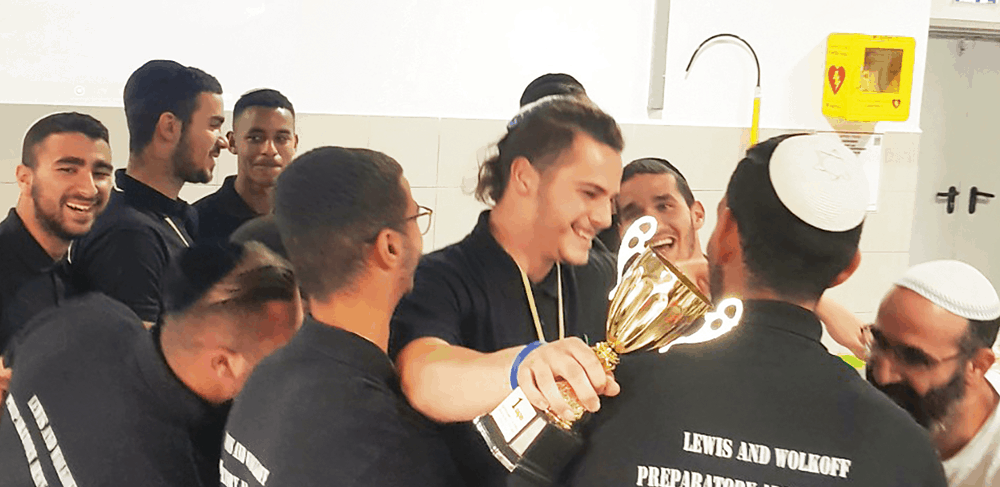
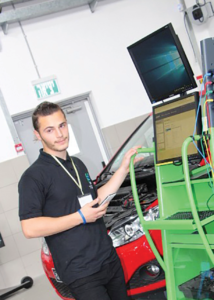
Despite not really having been interested in cars, he did try it—and he recently finished his first year at the junior college, which combines state-of-the-art automotive mechanical engineering studies with values-based leadership training. He also won the top spot at the school’s year-end competition for advanced car systems diagnostics, beating out 11 of his classmates, including one of his closest friends. (There were no hard feelings.)
“The week leading up to the competition was intense,” Shalom said, “and the dozen students who were participating studied together and supported one another in preparation for the big day.”
“At first, I admit, I didn’t have the energy to invest in studying, but we worked to help each other as a group, and I started seeing it as something that will help me for the future,” he said.
He also happens to like a good challenge and became more motivated to win. “Participating in something like this allows you to dream, and I thought it would help me advance academically,” he added.
The competition combined real-time auto diagnostics with a lightning round of general-knowledge questions about auto-tech and mechanical engineering. In the first stage, Shalom’s friend beat him by one point, but he triumphed in the second stage. “When you invest, you succeed,” he said.
That line neatly sums up the philosophy of the Lewis and Wolkoff Pre-Army Preparatory Program at the Zeisel junior college, where students devote two years to high-level training in auto-tech—learning computerized automobile diagnostics—or automotive mechanics, industrial management or legal administration, earning a valuable technological certificate and skills needed for meaningful military service and gainful future employment. During their time there, the students are enveloped in a warm, caring environment where they learn life skills that prepare them for significant service and fulfilling lives as productive members of Israeli society.
“Both the program and junior college gave me so many tools for the future — public speaking, responsibility, believing in myself, and believing that I’m capable,” said Shalom. “What gave me the main push to succeed was the combination of the two — the program taught me how to use the tools that the school gave me.”
He said that both the program and the school provide students with whatever support they need to succeed. “If, for example, my studies aren’t going well, the college immediately tries to figure out how to help, offers extra tutoring and teaching hours, and the teachers will stay late when they can. The program is teaching me how to use these tools — how to cultivate my personality, independence, and responsibility.”
According to Moshe Uziel, himself a graduate of Kfar Blatt and now the director of the Zeisel junior college, “the difference between graduates who succeed in realizing their goals in life and those who do not rests on their ability to embrace all the tools we give them and get the most out of them. Shalom and his brother are these kind of children — they welcomed the many tools they got here. In his everyday work, Shalom combines academic excellence and values, but, most importantly, he is always grateful to those around him.”
This fall, Shalom begins his second year at the junior college, where exciting things await him. He and the other finalists from the auto-tech competition will be attending a professional automotive seminar in Germany, and he will continue to build on the knowledge he has already acquired. He is still debating what he wants to do in the army — either serve in a combat unit or in the Technology and Maintenance Corps — but he knows that the future holds limitless possibilities.
“I was never really interested in cars,” he said, with a laugh. “I used to just look at cars and ask, ‘What model is it?’ But somehow at the junior college I fell in love with the field and really connected with it. I hope to continue with it — and my goal is to do something big.”