
By Rabbi Zev Reichman
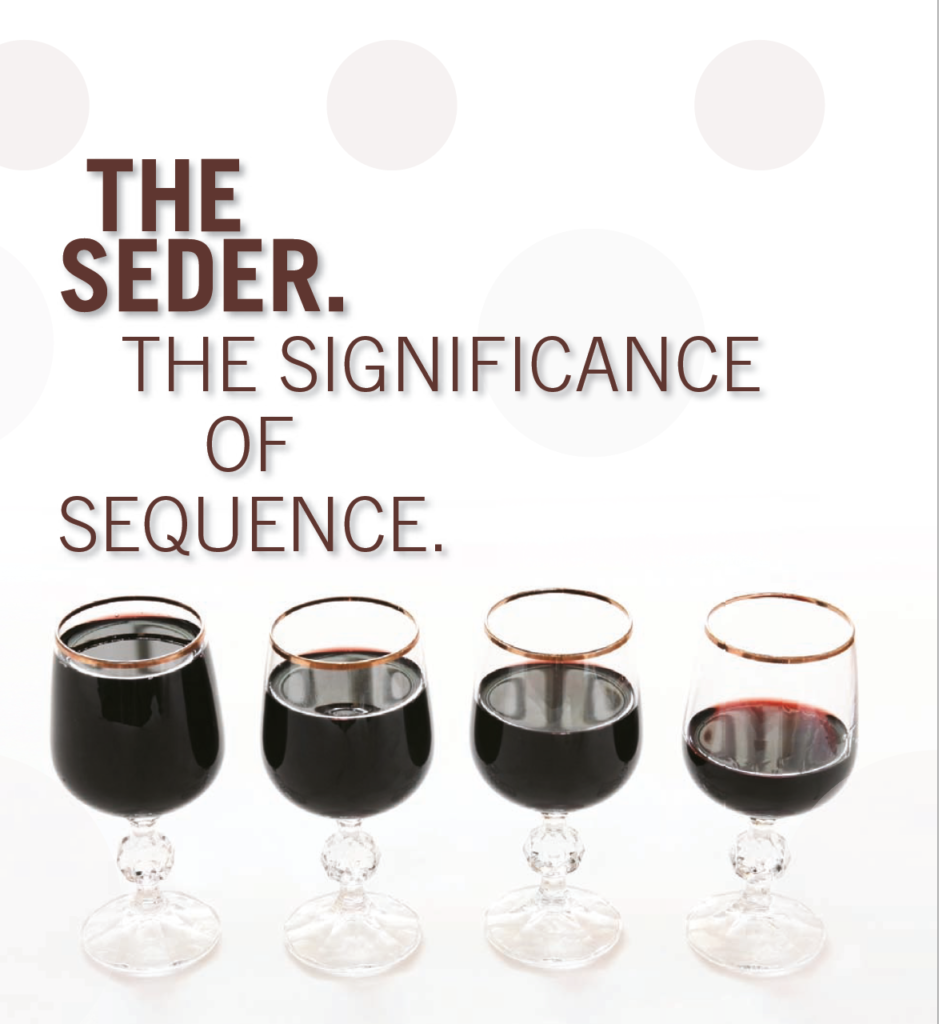
The Seder night is a time of order, the word seder means order, and on this night everything is ordered. We begin the night with the declaration of the stages of the meal, kadesh, urchatz, karpas, yachatz, etc., the focus being that each step has its own name and its own moment. Why is this night so regimented? Why so structured? Why didn’t our law allow for more subjective choice, why not give principles and allow for each of us to apply them differently?
The Maharal of Prague teaches that there is a deep lesson to the order of the Seder. Order as a prime feature of Exodus commemoration seems ironic. We actually left Egypt in a state of disorder. The verses in Shemot describe the chipazon, the hurried rush to get out of Egypt. In fact, the miracles of the ten plagues were themselves, in a certain measure, a reversal of normal order. Nature has its rules. The plagues broke those rules. The wild beasts entered civilized areas, the dust turned to lice, and the waters of river Nile became blood. The whole episode of leaving Egypt was disorder. It seems striking to focus Seder night on order.
The Maharal comments that leaving Egypt was not only a moment of liberation, it was a moment of internalizing faith and belief. The purpose of the Exodus was to teach us and the world that the Almighty is managing His creation and is continually watching and guiding all that occurs in our world. The lesson of leaving Egypt was that even where we perceive disorder, in truth there is a cosmic order. Everything has its place and He is managing all according to His plan.
Seder night is a night to sit with our children and impart to them the sense of trust, which comes from having a Father in Heaven who is running all affairs and managing all events. The stories of the Haggadah are all amplifications of the theme of faith. Telling ourselves and our children of exile and redemption is intended to strengthen our faith to the point that it becomes tangible so that we will feel tranquil and safe in His hands.
In light of this theme we can understand a very unsettling feature upon the conclusion of the Seder. The last song is Chad Gadyah, One Goat. In it a story is told of a goat that father purchased for two zuzim. it was bitten by the cat, the dog then bit the cat, the stick hit the dog, the fire burnt the stick, the water put out the fire, the ox drank the water, the shochet slaughtered the ox, the angel of death killed the slaughterer, and the Almighty killed the angel of death. The song seems very difficult to comprehend. The goat is seemingly the Jewish nation that the Almighty, our Father, acquired with two zuzim, the two Tablets of the Law. Yet if we follow this line of logic the song makes no sense at all. The goat is good, the cat who bites the goat would be an enemy of the Jews, a force for evil. Then the dog that bites the cat would be good. The stick who hits the dog bad, the fire that burns the stick good, the water that puts out the fire bad, the ox who drinks the water good, the slaughterer who kills the ox bad, but then the angel of death who kills the ox is good? And, what about G-d who kills the angel of death?
The answer to this question was suggested by Rav Moshe Wolfson. Since the Seder night taught us to have faith in the Almighty, we can live with questions. We now feel with all of our being that our Father in heaven is taking care and running affairs. Once we have faith we can live with questions.
Seder night is a time to renew our sense of trust in the Almighty. The AMIT Reshet (network) in Israel is imbuing Israel’s young with that faith. The sense that there is order in the chaos of life is the greatest gift one can give to children.
Rabbi Zev Reichman is spiritual leader of the East Hill Synagogue of Englewood, New Jersey and a teacher at Yeshiva University. He is the author of two books, “Remove Anger from Your Heart,” and “Flames of Faith: An Introduction to Chassidic Thought.”