

By Russell Jay Hendel
In this blog, we explore a key ingredient to AMIT’s pedagogic success: shared leadership, which refers to distributing leadership in a shared culture. AMIT accomplishes this shared leadership through the methods developed at its GOGYA teacher-training center.
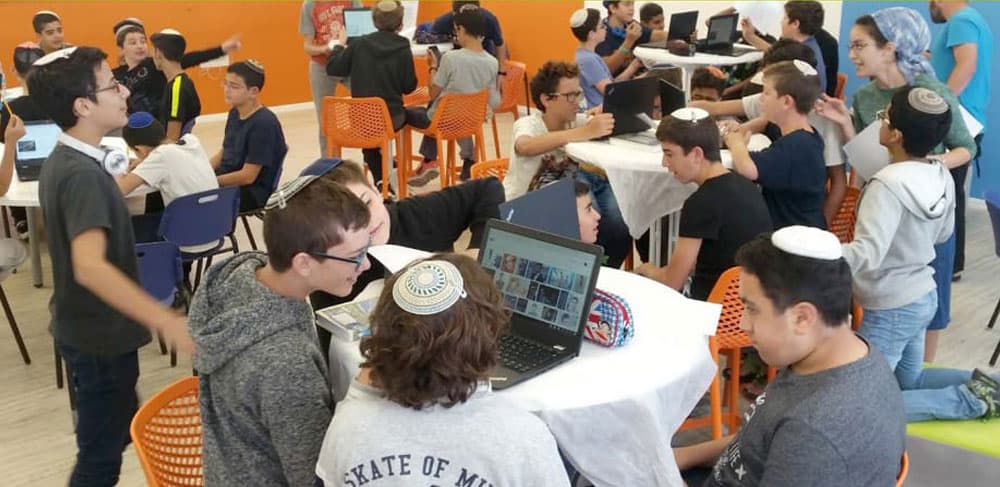
AMIT schools send research and development (R&D) teams, a group of seven teachers, to the GOGYA site once a month. Besides learning and listening to pedagogical lectures and methods, the teams exchange ideas and experiences with each other, then share them with fellow instructors in their own schools all across Israel.
GOGYA shifts the role of teachers, from deliverers of knowledge to facilitators of knowledge. It forces the students to seek out information; teachers merely equip them with the tools to interpret and assess the information they discovered. The students then take this information in exciting directions, as the Roboteens, AMIT Yud Ashdod’s 8th-grade robotics team, did with their invention which was chosen to represent Israel at a recent international competition, where they faced off against 80 other robotics teams. The assignment for the competition was aiding animals. The Roboteens took this in a fun direction, creating an innovative sensor to be installed on the backs of turtles to prevent them from swimming into fishing nets.
The idea of active student learning, active student questioning, student independence, and encouraged curiosity sounds modern and contrastive to the traditional way of learning. However, Judaism has always encouraged such behavior. The first GOGYA experiment was by Moses at Mount Sinai!
“How did Moses teach? He lectured to Aaron, then Aaron’s sons, then the Tribal Governors, and then to all of Israel. Moses then departed and first Aaron lectured to his sons; then Aaron departed and his sons lectured to the tribal governors; then Aaron’s sons left and the tribal governors lectured to their constituencies.” (Talmud Bavli, Eruvin, 54b)
In this way, all students also became active teachers. An example of the independence of students from Moses is found in Nu31-14,21:24. Because Moses lost his temper and was upset, Eliezer the son of Aaron, had to teach returning soldiers about the laws of Kelim, of immersion of newly acquired utensils.
There are many other examples of this Jewish approach to learning:
The Bible (Numbers 27) presents the inquiry exploration of Tzlafchad’s daughters. Rather than behaving in what was thought to be the traditional female student role of a passive listener, they actively inquired about the male-dominated inheritance laws, suggesting reform. G-d, in his response to Moses’ inquiry, besides answering their challenge question, explicitly stated, “These girls have properly asked: (Therefore) Give them an inheritance.”
The Vilna Gaon explains that the Hebrew language perpetuates biblical examples of curiosity, inquiry, or student independence, with the five Hebrew letters with unique end-word forms. Among the Hebrew letters that have one form in the middle of the word but a different form at the end of the word is Tzade, which is the first Hebrew letter of “Tzlafchad.” Similarly, among the letters with a unique end-word form is Caph, which is the first Hebrew letter of “Kelim,” utensils. Hence, Hebrew orthography also continually reminds students to be active, curious, inquiring, and independent.
The paradigm of Jewish learning, the Passover Seder ritual, is a rich advocate of student independence and inquiry. The Rambam describes requirements for the Passover Seder. “Make changes to provoke people into [lack of passivity and] actively asking: Distribute lots of candy and nuts, change the table settings, grab matzoh from each other,” all this so that children should not respectfully and passively sit, but actively ask.
Perhaps you will demur, “Well, they should be encouraged to ask, but they should ask respectfully.” Not so! The irreverent son (Rashah) who, according to the Bible, irreverently says, not asks, his question, “What is this Passover service to you?” is an integral part of the Seder. He is not banished, but receives an answer. He is part of the Jewish family, with his own unique, albeit irreverent, learning style.
These are just a few examples of the shared leadership in Judaism’s approach to learning that spans 4,000 years. Its focus on independence and inquiry lives on in AMIT’s GOGYA center.
Dr. Russell Jay Hendel teaches actuarial mathematics at Towson University’s Center for Actuarial Excellence. He also hosts a website, rashiyomi.com, devoted to explaining Rashi and teaching Rashi methods. He resides in Baltimore where he is co-president of the local AMIT chapter and is also a member of the AMIT President’s Circle.