

By Robert E. Sutton and Chana Shields
School House
This past April, eight of AMIT’s most outstanding principals came to the United States for an intellectual exchange of pedagogical thoughts and ideas and to tour a number of innovative and ahead-of-the-curve schools in the New York metro area and Washington, DC.
Led by Mor Deshen, AMIT deputy director of research and development, the AMIT educators wanted to experience first hand the way these schools educate their students. Each school utilized different innovative pedagogical programs.
The School in Queens
The School in Queens The first stop on the tour was the Metropolitan Expeditionary Learning School–“The School for A Sustainable City.” The school opened in September 2010 on a beautiful new campus in Forest Hills, Queens.
M.E.L.S. empowers students by helping them understand the impact of their daily actions as well as the actions of others. Through their authentic, project-based learning, students become critical thinkers who gather information, carefully weigh their options, and make informed, thoughtful choices that effect change.
The school follows the Expeditionary Learning model, in which students engage in learning expeditions and have multiple opportunities for hands-on learning, both inside and outside of the classroom. Students participate in fieldwork with civic leaders, industry figures, and environmental scientists to examine agriculture, architecture, city infrastructure, design, environmental policy, law, and planning.
A Gem on the Lower East Side
Located on Delancey Street, the Innovative Manhattan Charter School is a school where pedagogy, accountability, IT technology, administration, teachers’ resources, and school design were all integrated with one common purpose: to create a school centered on the recognition of each unique individual.
The school’s fundamental educational concept is that all children are different, learn in different ways and at different rates, and have the right to a personal challenge every day. The school offers its 6th-8th graders a coherent model for personalized education that is based on individual coaching, goals, and accountability combined with state-of-the-art learning technology and the international exchange of ideas and experiences.
Ingenuity in DC. Who Would Have Thought?
The next stop on the tour was Washington DC. The delegation visited Ingenuity Prep, an innovative charter school that prepares students to succeed in college and beyond as effective civic leaders. With more learning time and increased efficiency in its model, Ingenuity Prep offers an educational program that prepares students for mastery of rigorous core content and a broader set of 21st-century civic leadership competencies.
In a fascinating departure from the standard teacher model, Ingenuity Prep has resident, associate, lead, and master teacher positions. Ingenuity Prep’s teaching career ladder ensures that as teachers grow, so do their opportunities to leverage their leadership and increase their impact–all while remaining in the classroom. An experienced master teacher with exceptional content knowledge and strong instructional expertise anchors each classroom at Ingenuity Prep. As a result, early career teachers benefit from daily master teacher modeling and mentoring.
The AMIT principals came away with a deep understanding for the development and continued education of teachers in ways they never realized. They learned about unconventional teaching techniques, how one subject is taught through various courses, and, above all, the need for technology. The principals and teachers of the schools the delegation visited learned a lot about the AMIT network in the areas of teacher evaluations, classroom design, and educating students on ethics and values.
WHITE HOUSE
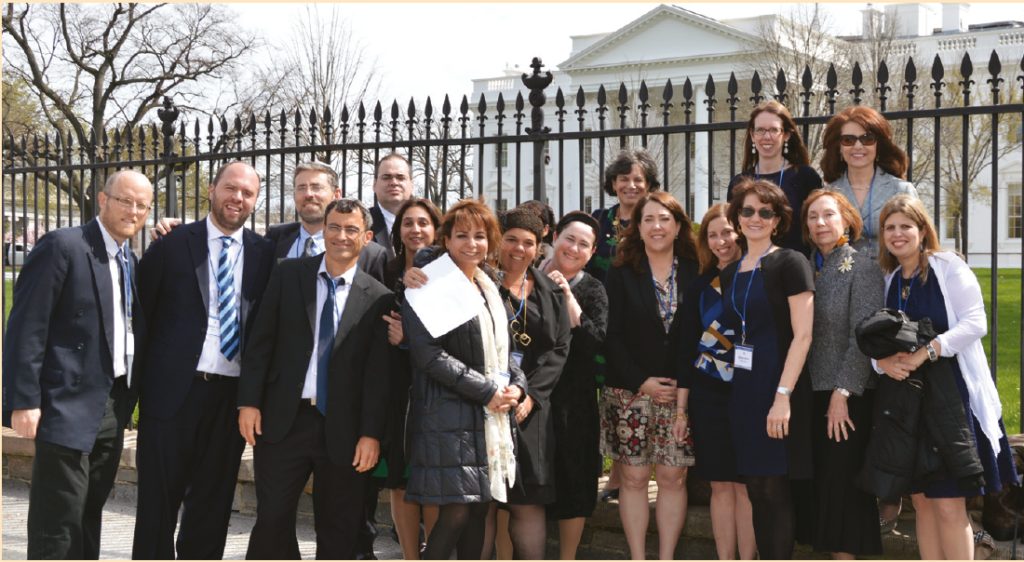
In addition to the school visits, the AMIT delegation from Israel along with AMIT leaders from New York and New Jersey were invited to the White House to explore innovative educational models that are being implemented in the United States.
The AMIT leadership met with high-level educational policymakers including Roberto Rodriguez, Special Assistant to the President for Education on the White House Domestic Policy Council, and Danielle Carnival, Senior Policy Advisor for STEM (Office of Science, Technology, Engineering, and Math). Matt Nosenchuk, Director for Outreach on the National Security Council, welcomed the delegation and mediated the discussions.
Debbie Isaac, President of AMIT, said that introducing our leadership and the principals to innovative educational methods in the U.S. is essential to advancing education in Israel. “You cannot teach a child who has a smartphone in his pocket in the same manner as you taught children 30, 20, or even 10 years ago. The educational system must reinvent itself in order to reach students and connect them to the future,” she said.
The officials examined the goals of the new U.S. education policy, which include raising the levels of reading and math; narrowing the gap between high-performing and low-performing schools; and identifying, training, and retaining outstanding teachers. The group learned about the administration’s “Race to the Top” initiative, as well as its approach to developing the STEM project.
Dr. Amnon Eldar, Director General of AMIT in Israel, said the challenges facing the education system in the U.S. are very similar to those in Israel as they are both “progressive modern countries.”
“We believe the most substantial challenge today is leading the innovation field in education. This tour is one step in a long path that our outstanding educators have taken in order to make Israeli education more relevant and meaningful,” he said.
Dr. Francine Stein, former AMIT President and a delegate to Washington indicated, “AMIT has always been on the forefront of educational innovation. What began as vocational training institutions has grown into one of the most successful and technologically advanced school systems in the country, educating tomorrow’s scientists, doctors, lawyers, political leaders and Nobel Prize winners.”
AMIT Executive Vice President Andrew Goldsmith remarked that “building relationships with White House policymakers for education is not just important for AMIT, but crucial to Israel’s future.”
The White House meetings concluded with a discussion about the current situation with Iran. Nitin Chadda, Director for Iran on the National Security Council, described the levels of financial sanctions imposed upon Iran by the U.S. government and assured the AMIT representatives that the administration’s foremost goal is ensuring that Iran does not attain nuclear weaponry.