

Alon Arbetz, 33, is an AMIT success story. In addition to being a married father of three, he is one of the founders of IntSights, a cyber company that sold in July 2021 to American cyber giant Rapid7 for an estimated $350 million. Arbetz grew up in Ra’anana, where he studied at the AMIT Gwen Straus Junior and Senior High School for Boys in Kfar Batya. He recently returned to Kfar Batya for a visit to AMIT’s educational innovation center, the Gogya Center. He met with AMIT Director General Dr. Amnon Eldar and shared his thoughts about educating the next generation of high-tech entrepreneurs like himself—students who will ensure that Israel expands its role as a technology leader in the future.
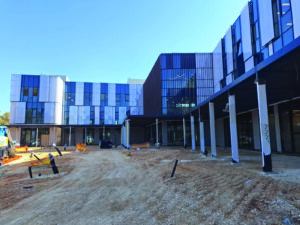
“I was so excited to come back and visit the Gogya Center,” says Arbetz. “It’s amazing to see the innovative education that AMIT is offering its students, making sure they’re prepared for the world of the future. I think it’s wonderful that AMIT is building a campus that will enable students to experience an environment that mirrors the work world, in a flexible, dynamic, beautiful building, creating a real community of learning and giving students a sense of pride and belonging.”
As a student, Arbetz was one of the founders of “Cyber School,” which offered workshops, courses, and summer camps to train youth in cybertechnology fields. He is also the founder of “Wings of Money,” a nonprofit that educates students for financial fluency and provides them with tools to pursue a successful career in the high-tech world, one of the most coveted professions in Israel. Arbetz runs a similar program for outstanding second and third grade students in the elementary school in Or Akiva, where his son Gilad studies. “I wanted him to be exposed to the world of high-tech programming and robotics at a young age, and I used that desire to promote a program for the benefit of the whole school,” says Arbetz.
He believes that AMIT’s Gogya educational philosophy is turning education on its head—in a good way.
In the past, school was very rigid, he explains: “The teacher comes and ‘feeds’ us the material for 45 minutes, and then you have to throw it back out on the test.” Today’s history lessons, on the other hand, may feature an analysis of the war between Russia and Ukraine, giving students the opportunity to use past insights to understand the current conflict and try to outline a solution or forecast. “It will help the student develop much more successfully,” says Arbetz. “There is an opinion today that many subjects will not exist in a decade, but the skills you give a student will always be with him.”
The goal isn’t for every student to one day work in high-tech, he says. But guiding students to high-tech professions, and especially encouraging entrepreneurial development, are, in his opinion, an important opportunity for growth and fulfillment.
“We as a society have a responsibility to encourage openness, understanding, and appreciation for every person who works and develops in his or her field,” says Arbetz. “If you become a successful entrepreneur in high-tech, you will probably make more money than a carpenter or an electrician, but both work to develop the country and the world.”
It’s important to him that every student be able to create his or her own dream. “The idea is to expose them to a rich and diverse world, and then let them choose,” he says.
His goal is aligned with AMIT’s: to make high-tech careers possible for students on the periphery who would never have dreamed of such options.
“Today, the range of places you will reach in employment is largely determined by the location and population in which you were raised,” says Arbetz. “For example, you don’t see high-tech experts in Beit She’an, so a student there will not aspire to such goals. In many cases it’s a psychological barrier, a belief that I cannot do it and do not have the skills for that.”
That’s where education plays such a critical role.
“Through AMIT’s ecosystem tracks, I see that when you expose boys and girls to the worlds of cyber and software, and other advanced content fields, they see it as cool. They have fun and realize they are capable,” he says.
In addition to career preparation, an education system’s mission is to “understand, educate, and work on moral values” and produce graduates who are productive and contribute to the world, he says. The teachers serve as role models, leading by personal example when it comes to demonstrating values such as Zionism and caring about others.
“Yinon Aviad, my high school principal, would constantly talk about excellence and caring,” recalls Arbetz. “If we didn’t raise our chairs onto the tables at the end of the school day so that the cleaner could wash the floors more easily, he regarded this as a case of uncaring, and he believed that it harmed excellence.”
Arbetz credits the school’s extracurricular events—such as producing a Purim event, running a kiosk, and managing projects within the school—with helping him develop entrepreneurial skills. “All these things sowed in me the power to lead ventures,” he says.