

Black, White, We’re All Human!
By Anat Rosenberg
This past summer witnessed the Ethiopian community in Israel explode with rage following the killing of unarmed 18-year-old Solomon Teka by an off-duty police officer, the second such case this year. Thousands of Ethiopian-Israeli youth protested for days after Teka’s death, blocking major junctions and roads in an effort to call attention to the racism and police brutality they face. They chanted a simple message: “Shachor, lavan, kulanu bnei adam”—Black, white, we’re all human.”
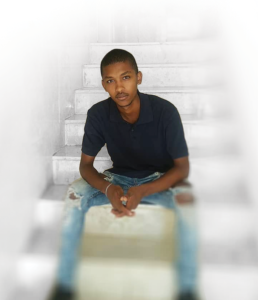
That anger isn’t new to Harel “Harry” Brown, an almost 18-year-old graduate of AMIT Elaine Silver Technological High School in Beersheva, one of the network’s vocational schools for students who haven’t found their place at more mainstream schools. Brown, an aspiring musician and rapper, has written songs about the police and other challenges of life as a teenager of Ethiopian descent in Israel. Today, he also mentors youth, helping them feel they are not alone and also helping them to develop their musical talents.
Brown is one of nine children to parents who immigrated to Israel from Ethiopia at ages 3 and 11. His parents met and married in Israel, settling in the southern Israeli city of Beersheva. Brown is soft-spoken and doesn’t talk much about his childhood, but by the time he was in high school, he had dropped out for about six months before arriving at AMIT Elaine Silver. Ethiopian children and youth often face discrimination within Israel’s education system as well, being placed in weaker schools or being told that they aren’t smart or capable enough (which Brown said has happened to him)—all of which leads to higher dropout rates or students not matriculating with a full bagrut, creating a cycle of limited opportunity for young Ethiopian-Israelis.
The AMIT network, which prides itself on the value of Klal Yisrael, educates some 30% of all Ethiopian youth in Israel, embracing them and equipping them with the tools they need to graduate and break that cycle. AMIT Elaine Silver—which offers three track options, including information technology, automotive technology and electronics, and design—has helped hundreds of teens from Israel’s socioeconomic and geographic periphery turn their lives around. It gives them the skills they need to enter the army with a vocation and find gainful employment afterward.
 “The educational framework at AMIT Elaine Silver Technological High School is a holistic approach,” explained Pincipal Tzipi Harpenes. “We look at each child from all angles, addressing all their needs, which allows for self-development and for them to flourish as individuals.”
At school, Brown tried all three tracks and said that Harpenes did her utmost to provide a supportive framework for him. She even encouraged him to audition for the first “Road to New York” competition for a chance at showcasing his talent for AMIT supporters in the United States.
He fondly remembers frequent chats he had with Harpenes: “I used to talk with the principal every week, and we would talk about fitting in and other things. She did everything she could for me, and I’m still grateful for that today.”
Brown said he would keep to himself during his schools years. But he would write down his feelings, “and then it would become a song in my head,” he said. That’s when he became more interested in music and slowly began developing his talent as a composer and rapper, something that the school encouraged.
“Slowly, I developed my skills,” he said. “I opened a studio, and a lot of that comes from my time at AMIT. I wouldn’t have this if it weren’t for AMIT. I used to be closed off, but AMIT helped me accept who I am and live with it in a positive way.”
During his time at Elaine Silver, Brown would visit different music studios and collaborate with different rappers and write rhymes with them. He spent time at Capit, a coffee shop and youth center in
Beersheva for teens aged 13–18 that encourages their creativity and allows them to talk openly with mentors and volunteers. He kept working on his own music, uploading videos of himself and his music to his YouTube channel.
“Harry joined our school in the beginning of 10th grade,” recalls Harpenes. “He came as a boy who struggled academically, had low self-esteem because he was surrounded by a toxic environment. We quickly realized he was musically gifted and enrolled him in Capit as an outlet to ensure he was getting the holistic solution he needed. By the time he graduated, he completed his basic learning requirements and through his music he found the tools to best deal with his challenging surroundings.”
Now that he’s completed high school, Brown continues to make music and he mentors youth through a program called Ma’agalim. Much like the AMIT network, the nonprofit Ma’agalim helps at-risk 11th and 12th-graders from the periphery undergo what they call a process of “personal growth.” It enables these teens to recognize their self-worth, envision goals for the future, and prepare for meaningful army or national service. Brown works with these teens and helps them express themselves through music.
He sees himself in the kids he works with, and understands that they need an outlet, that not all of them fit in to traditional or mainstream frameworks, and that they all have potential. They just need support and encouragement to bring that potential to the surface, just as AMIT Elaine Silver and its principal did for him.
“AMIT is a framework that gave me many paths toward the future,” he said. “Even today, every step I take, I think, ‘What would they tell me at AMIT?’ It gives me a lot of strength.”