
by Helga Abraham
A quiet revolution is taking place in the Haredi community of Israel. The huge growth in the Haredi population (estimated at nearly one million today), cuts in government support and pressure by centrist parties for Haredim to “share the burden” in terms of work and military service are creating fundamental changes in both the ethos and lifestyle of this community. The culture of a life devoted entirely to Torah study is slowly giving way to a more pragmatic approach and acceptance of the need to “work.” Forced by the new reality, more and more young Haredi men are entering or seeking to enter the job market. But after a traditional yeshiva education, which excludes secular subjects, and lacking in basic skills, they find themselves ill-equipped and at a considerable disadvantage. As a result, many Haredi parents are seeking a framework that offers both yeshiva studies and formal education in order to enable their children to enjoy the same job opportunities as others. AMIT Chedvat HaTorah in Jerusalem is one of the pioneering institutions that is helping to prepare Haredi youth for the demands of the 21st century.
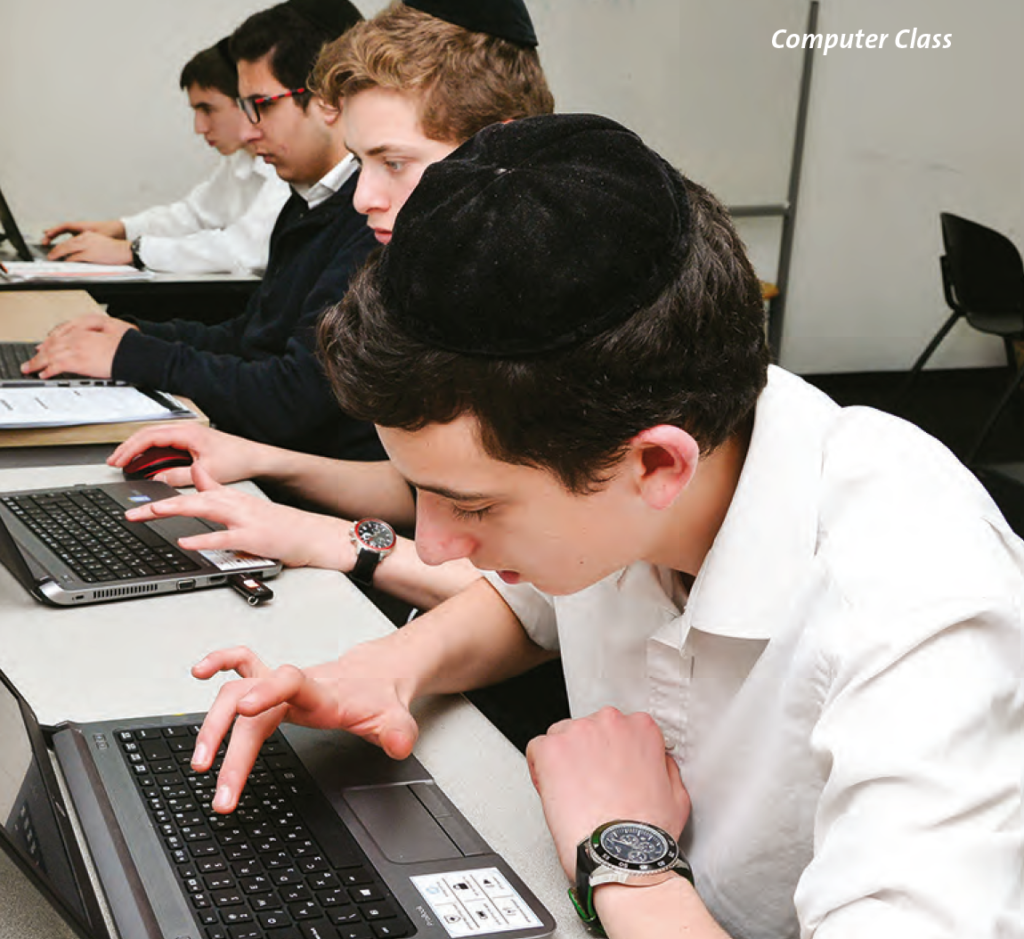
On the first floor of an office building in a commercial area of Jerusalem, Haredi boys are busy studying Gemara, the younger grades delving into the intricacies of Seder Nezikin, and the older grades immersed in Seder Nashim. For all intents and purposes, these students could belong to one of the countless yeshivas that have sprung up in Israel over the last decades. Their enthusiasm for Gemara and their commitment to the Haredi way of life are the same – but what makes these students different is that, once they finish their religious studies at 1:00 p.m., they will embark on a range of secular studies that include math, computer science, English, and Jewish philosophy, studying until 7:00 p.m. at night.
Rav Aharon Brandwein, the dynamic principle of AMIT Chedvat HaTorah says that his institution is unique in Jerusalem in being the first Haredi yeshiva high school to offer boys a broad secular education alongside religious studies. Like all Haredi principals, Rav Brandwein wants his students to become Torah scholars, but he also wants to give them a choice: “We tell our students – first learn everything, then you can choose whether to become a rabbi or a scientist. We want you to be able to decide what is good for you, rather than have circumstance decide for you.”
Visit the yeshiva, I heard the same refrain from teachers and parents: “the Haredi world is changing, it’s a different generation, it has different requirements.” Sheftel Weinberg, who grew up in the U.S. and has a son in the yeshiva, says that Chedvat HaTorah’s fusion of yeshiva and secular studies reflects a change in Haredi society as a whole: “The Haredim are much more involved today in every aspect of Israeli society than in the past when they lived totally separate lives.” To support his view, he points out that no mass demonstrations accompanied the opening of the yeshiva.
Mass demonstrations no, but opposition, yes. With a smile, Rav Brandwein points to a Haredi newsletter on his desk in which Chedvat HaTorah is denounced as “evil” by a group of rabbis. “The opposition,” he says, “comes from a fear that we will encourage Haredi children to leave their unique way of life. But this is not so. I always assure parents that we are a totally Haredi school, with the same books, morals, and high level of Talmud study as all yeshivas… but we also teach other subjects.”
AMIT Chedvat HaTorah was established in 2013 by a group of educators and parents, many of whom says Rav Brandwein, “were yeshiva graduates who regretted their own lack of education and wanted better opportunities for their children.” Motti Erenberg, who has two boys in the yeshiva, was one such parent: “I did not have any formal education and always felt I missed something,” he says, explaining that “It is very difficult for Haredim to catch up later in life, and that is why I want my children to acquire a broad education at a young age.”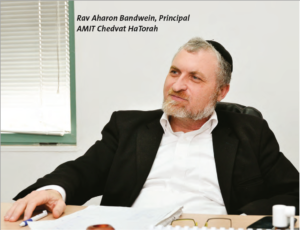
After helping to coalesce a core group of parents, Rav Brandwein turned to AMIT to help get the yeshiva off the ground. “We were told that AMIT is an institution that is always open to new ideas, and right away we won its support.” Despite a total lack of experience in formal education, Rav Brandwein was chosen to serve as principal. His strict yeshiva education, combined with a successful career in business running his own bus company, made him an ideal candidate for the new venture. As did a somewhat a-typical Haredi upbringing. “My father, who was a teacher and rabbi, educated me and my siblings to work, while all around us the ethos was: rak Torah (only Torah). And he also taught us to be Zionists – indeed, we were the only family in Bayit Vegan to hang a flag on Independence Day,” he recalls with a twinkle in his eye. Going against the stream is clearly innate in this businessman- the turned-school principal who is presently completing a BA in education and radiates an infectious love of youth and the teaching profession.
With Rav Brandwein at the helm, AMIT Chedvat HaTorah opened in an old Jerusalem building, with just seventeen students in one 9th grade class. Today, the yeshiva has 76 students and four grades. Next year it expects to receive 110, and its waiting list is constantly growing. In order to be accepted into the yeshiva, the students have to pass an entrance examination in Gemara, math, and English. If a student comes from a Haredi school where math and English were not taught or taught minimally, he has to excel in Gemara. While the religious studies teachers at the yeshiva are all Haredi, those in charge of secular studies are chosen for their competency, with the proviso of being religiously observant. The combined yeshiva/secular program of studies includes two hours of sport a week – soccer or basketball in an ad hoc playground-car park, plus table tennis during breaks and swimming once a week. To top it all, and rare for a yeshiva, the students are taken twice a year on a two-day trip to the south and north of the country.
The challenge of teaching high school students, many of whom lack basic knowledge of core subjects, means that the school has to organize many supplementary lessons, and the teachers often have to teach three levels in one class. “It’s like teaching three classes in one,” says English teacher Rav David Perlow. Whenever possible, Rav Perlow imparts to his class material that is relevant to the religious world. In his 9th grade class, he asked the students to write a project in English on how to enable youth to connect more to their Judaism. All the students I talked to concurred on the need to acquire a broad education. Seventh-grader Yossi Baider said it was important “in order to survive in life!” and 10th grader Matanel Gulevitz said he found it hard learning only Gemara in his previous school and wanted to acquire a range of knowledge, with the view to studying engineering.
Most popular of all is the two-hour-a week computer class, when 25 laptops, recently donated by AMIT, are given out to the joy of the students. Tenth grader Elia Baruch, who grew up in the U.S. and was used to combined programs, said his ambition was to work with computers or in industry, while 7th grader Shali Brandwein, exuding the same bubbly energy as his father, said he wanted to gain several degrees, in computer science and in business management, and then go on to do a doctorate!
Although the yeshiva is open to modernity, the Internet is forbidden, as are cell phones. “The students come here to learn,” says Rav Brandwein, “and if parents want to contact their child, they call the office.” In contrast, his attitude towards dress codes is more lenient, allowing younger grades to wear regular clothes and imposing the standard black-and-white yeshiva code of dress only on 9th graders and up. “I like colors,” he says “and do not see the need to force boys before Bar Mitzvah age to wear black.”
Looking to the future, Rav Brandwein acknowledges the need to find a more appealing location for the school. “We need our own building,” he says, “and an appropriate location.” But in spite of the changes which Haredi society is undergoing, finding such a location remains a thorny issue. “It would be difficult to locate the yeshiva in a Haredi neighborhood as we are still considered ‘threatening’, nor can we be based in a secular neighborhood because of fears of Haredization, so we have to remain on the seam.” Confident that these problems will eventually be surmounted, Rav Brandwein dreams of leading AMIT Chedvat HaTorah to great things: “My dream is that we will become a major institution – with a library, laboratories, gym room, music room, spacious classrooms – and that we will serve as model unto others.
Helga Abraham is a freelance journalist and translator based in Jerusalem. Before making “aliya” to Israel, she worked as a radio producer for CBC in London and Toronto.