
By Gloria Averbuch
“To be a physicist is to have an enormous potential to change the world.”
“Feynman’s Rainbow: A Search for Beauty in Physics and in Life” by Leonard Mlodinow
It was a Saturday evening phone call that changed life for Rafi Bistritzer. The voice on the end of the line informed him that he was a recipient of the Wolf Prize in Physics 2020, a prestigious international award often a precursor to the Nobel Prize. “It was a huge surprise to me,” he says with understatement. “I was extremely happy.”
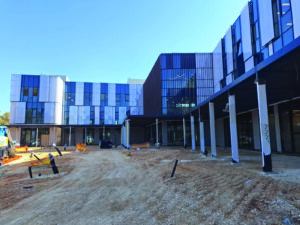
Perhaps it would not have been so surprising to the 10th grade boy who fell in love with physics as a student at AMIT Ginsburg Bar Ilan Gush Dan High School for Boys, where a passion was born that propelled Bistritzer to the top of his field.
Revolutionary Research
The Wolf Prize, currently in its 42nd year and given annually in Israel, is widely considered the most prestigious award in physics outside of the Nobel Prize. The Wolf Prize is given to top scientists and artists from around the world for “their significant contribution[s] to humankind.” The 2020 prize went to nine laureates from six countries.
The team of Bistritzer, Allan H. MacDonald and Pablo Jarillo-Herrero won the physics award “For pioneering theoretical and experimental work on twisted bilayer graphene.
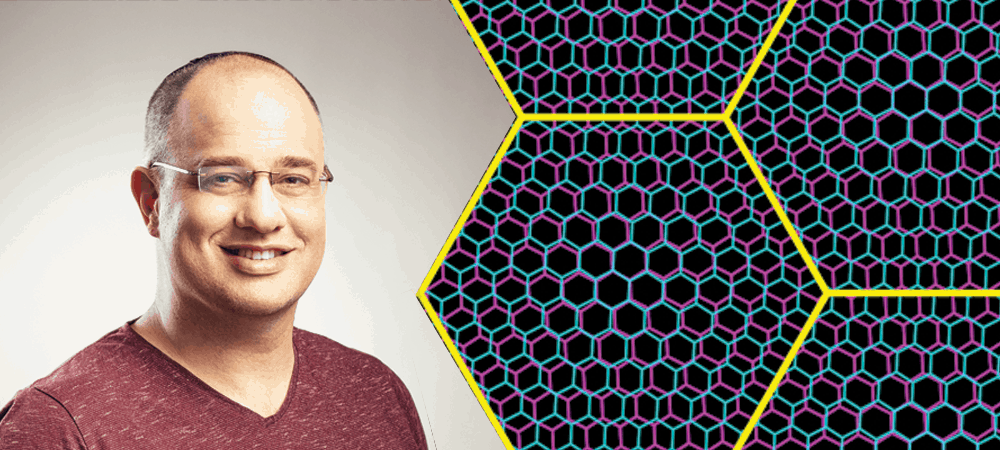
Graphene is a flat sheet of carbon atoms that form a lattice with a honeycomb pattern. Stacked at precisely 1.1 degrees, called “the magic angle”, the two-layer (bilayer) structure allows for remarkable phenomena—such as superconductivity. It was during Bistritzer’s postdoctoral research with Professor MacDonald at the University of Texas at Austin that they predicted this “magic angle” physics.
Bistritzer explains, “Strongly interacting electronic systems host some of the most fascinating physical phenomena. We found that by twisting two graphene sheets by precisely 1.1 degrees, the electrons are considerably slowed down, and the bilayer system enters a strongly interacting regime. Experiments done by Pablo Jarillo-Herrero and his group in MIT found that this system can superconduct. This relatively simple system will allow us to explore superconductivity and other strongly correlated phases of matter. The hope is that with a more profound understanding of the underlying mechanism behind these phenomena, we will be able to engineer room temperature superconductors—one of the “holy grails” of modern physics – a discovery that will change our daily lives.”
The prediction of Bistritzer and MacDonald, verified and expanded by the experimental research of Pablo Jarillo-Herrero of MIT, has led to a revolution in the advancing area of study now known as “twistronics.” In summary, their findings offer extraordinary promise to “lead to an energy revolution,” according to the Wolf Foundation.
Beginnings
Rafi Bistritzer comes from a family of physicians. This includes his father, brother, uncle, and three cousins. It seemed a foregone conclusion then that he would be one as well. “I even enrolled in medical school, so it was a surprise I became a physicist,” he says.
It was AMIT Ginsburg Bar Ilan Gush Dan High School that changed his mind—specifically, his first physics teacher there, Dr. Haim Danino. “He was excellent,” remembers Bistritzer. “He was strict but very professional. He didn’t just teach us physics; he showed us the beauty of it, the ability to predict elements of nature just by doing calculations.” At the 40th anniversary celebration of the school held two years ago, Bistritzer sought out Danino to thank him. “You changed my life,” he gratefully told his former teacher.
Bistritzer appreciates his overall AMIT experience. “The school was very good for me. I really enjoyed it. It was a very open-minded place with an informal atmosphere, but yet with a seriousness that comes from being located right within the university, which it was at the time.” Among the exceptional staff, he mentions the late computer teacher Moshe Ben Zion, and Gideon Sapir, a past candidate for the Israeli Supreme Court and currently a law professor at Bar-Ilan University. He also appreciates his counselor Tzipi Spiegel, whom he calls “exceptional, a very lively person with a contagious energy.”
A Push of the Button
The 2011 trip to Texas began with a series of emails. Bistritzer, a graduate of the University of Tel Aviv and the Weizmann Institute, was struggling against his doubts to pursue postdoctoral research under the tutelage of Professor MacDonald at the University of Texas in Austin. It didn’t seem wise. At the time, Bistritzer and his wife Anat, a computer scientist, already had their three children, the youngest of whom was a year old. “I very much hesitated. Postdoctoral salary is bad. My children were in Jewish schools,” he explains. Anat, whom Bistritzer calls “my most important influence,” encouraged him. “You have to do it,” she said.
The family ended up loving the entire experience in Texas, including the congregation they frequented. But mostly, Bistritzer effuses about the mentorship of MacDonald. He explains that the research life in physics is extremely competitive, but that MacDonald is different. “Aside from being a brilliant physicist, Allan is a true mensch. People all around the globe are eager to collaborate with him. The years with Allan gave me a lot, much beyond physics.”
A Complete Education
It wasn’t just academia that engaged Bistritzer at AMIT. “The volleyball team was the most unique experience I had in high school,” he says. His four years saw the team rise to Israel’s League A national team. He credits his dedicated coach, Yehuda Spitzer. “He put his life into the team,” he states. So much did Bistritzer love the sport, which he continued to play into adulthood, that it surpassed even what became his profession. When forced to choose between taking a university course in physics as a 10th grader and his five-day-a-week practice, he opted for volleyball.
Bistritzer’s sports experience illustrates the “complete education” he received at AMIT. Numerous studies document that in addition to physical health, youth sports promote academic success. Research has shown that youth athletes have 23 percent higher GPAs, and as the number of sports teams increases, so does the GPA. On that note, in addition to the volleyball team, Bistritzer’s basketball team also won the AMIT all-school championships in his junior and senior years.
Since 2016, Bistritzer has been an algorithm group manager at Applied Materials, working with machine learning and computer vision algorithms. While he expresses enjoyment of his job, since winning the Wolf Prize, he is also considering a return to part-time physics research at an Israeli university.
Today, his 21-year-old daughter, Nitzan, is serving in the Army, and his younger daughter, Topaz, recently finished high school (completing several academic physics courses while also playing basketball). And the legacy of AMIT lives on: Bistritzer’s youngest child, son Yotam, just completed the 8th grade at his father’s alma mater.