
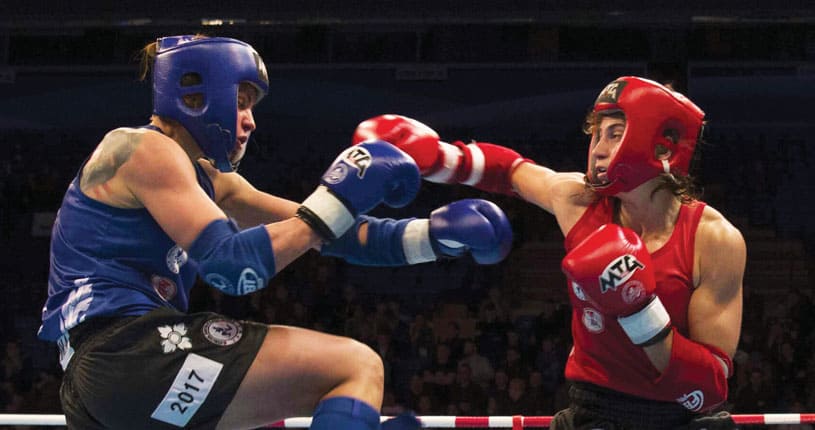
Israeli athlete Nili Block often says that her motto in life is something her late grandfather used to tell her repeatedly: “Don’t worry, be happy.” Block has plenty to be happy about: She kicked off 2017 by accepting the award for Israeli athlete of the previous year, in May she clocked her fourth career world championship in Thai boxing and in July, she won the bronze medal in the women’s 60-kilogram Muay Thai event at the World Games in Wroclaw, Poland, considered the equivalent of the Olympics for the sport.
“It feels amazing,” Block says of her achievements. “I devote my life to the sport, so it’s an amazing feeling to see the fruit of what I planted years before.”
Block is only 22 years old, but her journey into the world of Muay Thai, or Thai boxing, a combat sport like kickboxing, began when she was 10. Her mother, Rina, who was a volunteer in Israel’s Border Police at the time, took a Muay Thai class for self-defense and brought her daughter. “I went along with her, and it just stuck with me,” Nili says.
Born in Baltimore, Maryland, Block and her family immigrated to Israel when she was 2, and settled in Beit Shemesh. When Nili was 11, her parents divorced, and it was a challenging time for her. When she entered the seventh grade at AMIT Bellows Ulpanat Noga, Nili’s grades were low and she was on probation. Sports, especially flag football and Thai boxing, provided an outlet and a refuge.
“For the first two years, I was regressing in my schoolwork and I didn’t really care,” she says, adding that a turning point came when she decided she wanted to be on the national flag football team. “I had to prove myself…. The moment I worked through that, it went toward my schooling as well.”

While at the ulpana, Nili says her teachers were extremely encouraging of her involvement in sports, even if some in the Orthodox community saw it as an unusual choice for a religiously observant teenage girl. (Even today, Block brings cans of kosher tuna and bread to international competitions and is a member of an organization that aims to provide equal opportunities in sports for Shabbat-observant athletes.) The school, which didn’t really offer sports classes, sent her to a nearby secular school to pursue her passion. “They were very open-minded, and they let me go to a different school that was not religious—it took a lot of courage on their part,” she says.
Block began competing in Israel at age 12, and within a few years was already traveling around the world to take part in international Thai boxing and kickboxing competitions. As most Israeli teens do after high school, she enlisted in the Israel Defense Forces, which recognized her as an outstanding athlete and allowed her to continue training during her military service.
By the time Nili completed her army service in 2015, she already had two world championships under her belt, and would go on to win two more—the most recent of which she picked up May 11 at the International Federation of Muaythai Amateur (IFMA) games, in Minsk, Belarus. Just two days before her win, Belarus celebrated Victory Day, marking the defeat of Nazi Germany in World War II, a unique moment the significance of which was not lost on Block.
“For me, as an Israeli, to be in Belarus on that day, it was like coming full circle,” she told Israel’s Minister of Culture and Sport, Miri Regev, after defeating her Russian opponent.
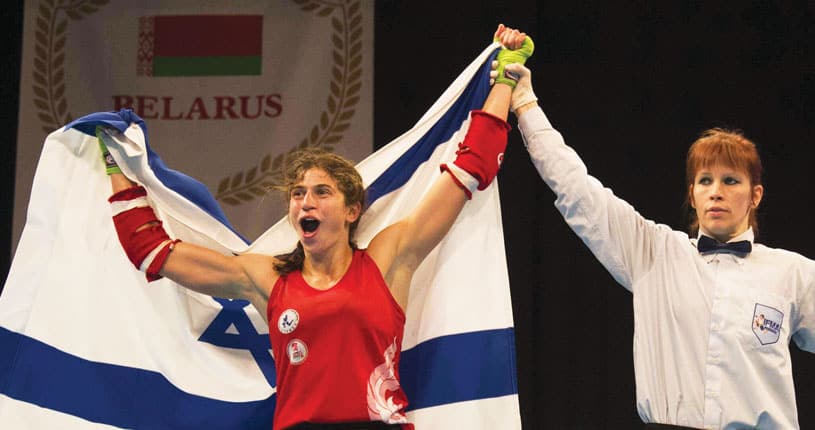
“You have brought respect and pride to the state of Israel and to Israeli sports,” Regev told Block, according to Israeli media. “Winning a championship is hard, and retaining that championship three times in a row is even harder…. Your victory symbolizes the Israeli spirit that is never broken, even when faced with opponents that on paper appear stronger.”
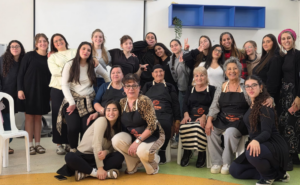
Block is working to instill that same fighting spirit in other Israeli teens, especially girls. She has returned to her AMIT alma mater and taught some of the girls there krav maga, the Israeli self-defense technique. She also hopes to convey to young women that models on magazine covers don’t have to be their only source of inspiration. As she wrote in a Facebook post, young girls today should aspire to be “beautiful, healthy, strong women,” who are assertive in life.
Ever determined to succeed, Nili’s next challenge will be combining her training in the ring with studies in the classroom this fall. She will be attending the Interdisciplinary Center (IDC) in Herzliya, focusing on getting a degree is sports psychology and ultimately becoming an international sports psychologist.
“Over the years, I learned that’s how it has to be done,” she says. “I just had to work very hard to achieve whatever it was, in school, in sports. If I wanted to buy something, I never asked my parents for the money. I always worked for it—I cleaned buildings on my street, I gave out newspapers and I sold cotton candy. I never ran straight to my parents. I don’t believe in that.” —AR