
By Robert E. Sutton
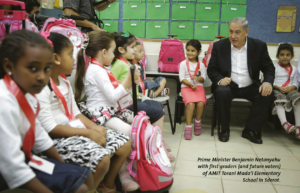
The start of school brought a sense of joy and excitement to rocket-scarred communities in southern Israel, and on Monday, September 1, AMIT opened its schools. Israeli Prime Minister Benjamin Netanyahu, along with Minister of Education Shai Piron, AMIT President Debbie Isaac, Amnon Eldar, Director General of the AMIT Network, and Sderot Mayor Alon Davidi inaugurated and celebrated the first day of school in Israel at AMIT Toranai Chadash Elementary School.
 The Prime Minister’s visit to the new AMIT religious elementary school included helping first-grade students with their very first lesson about the Hebrew alphabet.
“I know that you spent your vacation doing things not according to what you planned,” the Prime Minister said. “I hope that during the upcoming holidays you will have the chance to have some fun, to play and to be with your families and friends,” Prime Minister Netanyahu told the first graders.
“Be good friends with each other and hunger for knowledge. This is what distinguishes us and gives our people special strength,” he said. “We are the People of the Book and today the people of the tablet as well. We hold on to our heritage and also the future. Study the Bible, our heritage, math, computers, and science. Acquire knowledge for the sake of the nation of Israel, for the state of Israel, for the land of Israel, for yourselves and your families.”
Education Minister Shai Piron added that he was assigning a special assignment to the first graders this school year, which he noted wasn’t homework but classwork. “Look around you. See who may not have many friends and who may have had few visitors this summer. If a kid doesn’t come to school because he is sick, don’t forget to call him. Show respect to your teachers. Our greatest test is not how we acted during days of war, but how we will act in peacetime,” the Education Minister said.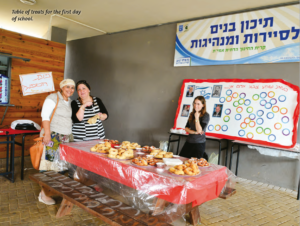
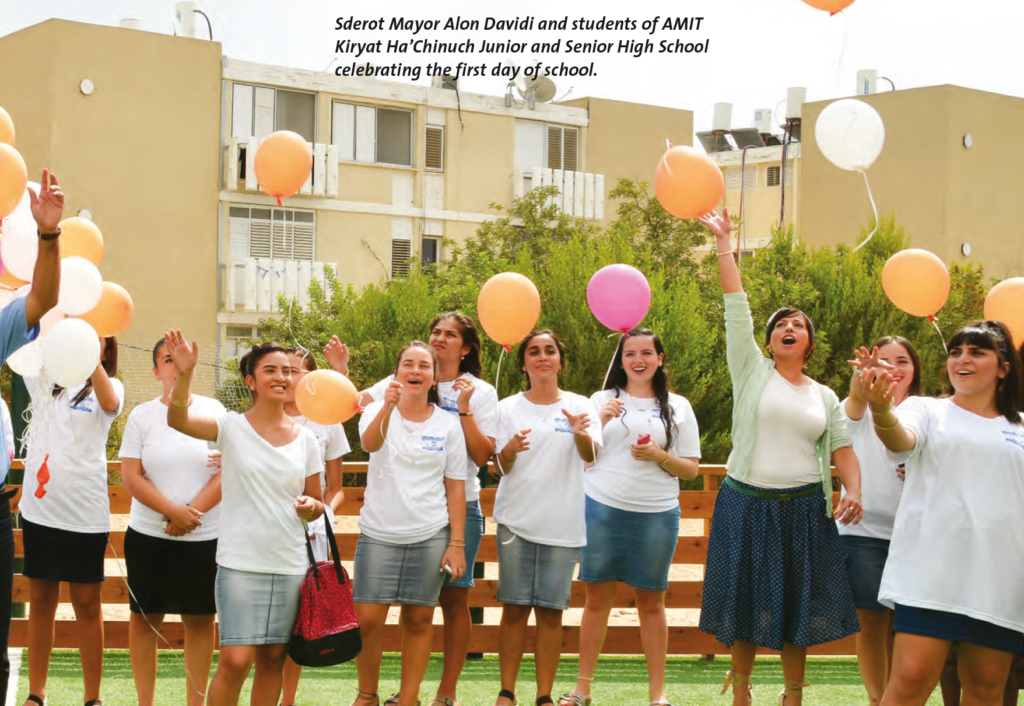
The AMIT delegation then visited the AMIT Kiryat Ha’Chinuch Junior and Senior High School. Decked with balloons, colorful posters, and a table of treats, the school opened in a welcome sign of familiarity after the war with Hamas.
But this was not an entirely normal first day for the students of AMIT Kiryat Ha’Chinuch. Though the return to school is always something of a national holiday, emotions were mixed this year, with the students showing signs of the anxiety of a violent and trapped summer. The regular curriculum was suspended for the beginning of the school year and security remained a concern, although a cease-fire seemed to be holding.
The day began with an assembly in the school gym that doubles as the auditorium. Principal Motti Arbel welcomed the students and told them that for the “first few weeks, we will slowly begin classes and take those weeks to reacquaint ourselves with the school and with each other. You are back in school. You are standing. You are breathing. Let’s continue.” Arbel stated, “AMIT Kiryat Ha’Chinuch provides meaningful educational experiences and opportunities for you, our students, with the goal of ensuring that all of you are prepared to become productive citizens of Israel, life-long learners and most important, remember that Torah is at the center of everything we do.”
Following Motti’s passionate welcome, The Director of Religious High School Education, Ram Zahavi, spoke of how our faith in Hashem gave Israel and in particular the population of Sderot the strength and determination to defeat the enemy. Taking from the book of Devarim (Deuteronomy), Mr. Zahavi recalled that in the portion Va’Etchanan, Moshe Rabbeinu beseeched Hashem, “Give me a chance to go into the Land of Israel. Let me enter the Land.” Moshe did not merit that request. “Every boy and girl who lives in Israel has earned that which Moshe was unable to receive,” said Zahavi.
 Debbie Isaac, President of AMIT, greeted the students and the faculty and said how pleased and excited she was to welcome them to school after such a horrific and lost summer. She reminded the students that “AMIT will assist you after the difficult summer and remember to ask for help from your principal, teachers, and guidance counselors.”
POST-WAR THERAPY FOR AMIT STUDENTS
After the war, the students are back at school with the feeling that the entire nation supported them and understood their distress, and that they were not alone. Specially trained therapists and social workers are reporting that the students are in a state of uncertainty. They don’t believe the war has ended and that a cease-fire will be long-lasting. The students—from elementary school to senior year students in high school— are extremely distressed after almost two months of survival in a routine of ongoing missile attacks and running to a shelter. Now expressions of anger, violence and aggression are appearing. The war shook up the family unit, and the pressure, the disruption of routine and the chaos have left the students in a situation of restlessness, tension, acting out, lack of concentration and problems with being attentive and functioning.
While the AMIT delegation was touring the schools, they were witness to some unique therapeutic treatments, two of which were especially interesting:
BEATING THE ODDS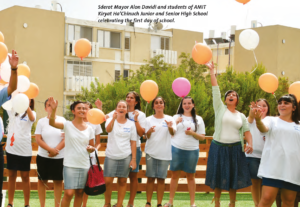
Seated in a circle, and led by a social worker, twenty-two students were pounding away on West African Djembe drums. Drumming Therapy is a method of utilizing the power of rhythm and pounding and applying it to a group for the purpose of healing. Group drumming breaks down barriers, promotes freedom of expression, non-verbal communication, unity and cooperation. And most important, drumming releases pent-up emotions, helping to significantly decrease depression, anxiety, anger and stress – all the emotions felt by the children of Sderot.
LAUGHTER IS THE BEST MEDICINE
In a roomful of bored and skeptical teenage boys, a teacher is trying to explain how laughing can help reduce a lot of the “tough feelings you are going through. We need to laugh and laugh together. Laugh at each other and with each other.” One at a time, the teacher approaches a boy and stares, makes a face or jiggles his body. At first the boys roll their eyes and seem embarrassed to be part of this tipshut (stupidity). After a few minutes, one student smiles and begins to giggle at the ridiculous behavior of his teacher. The giggle turns to a chuckle, which swells to all-out laughter. It’s contagious. The entire group begins to laugh out loud, some even hysterically. Let the healing process begin.