

By Carmit Birnbaum
Love is in the air—at least when it comes to AMIT Kfar Blatt’s new partnership with the Fischer Behar Chen Well Orion & Co. (FBC) law firm.
AMIT Kfar Blatt is no ordinary school. Rather, it is a unique and multi-dimensional environment, a youth village for at-risk teens from Petach Tikva. It includes residences called mishpachtonim—from the Hebrew word for family—for students who live with surrogate families. Kfar Blatt has a junior high school and a senior high school that offers a technology diploma track in addition to the regular full bagrut (matriculation) track. Its community center has a rich array of extracurricular activities to teach life skills and build student feelings of self-confidence and accomplishment. Students can receive a wide range of therapy and emotional support, which helps them overcome traumas they may have experienced due to their challenging backgrounds. And, there is also the AMIT Gloria & Henry I. Zeisel and Family Junior College, which runs the Lewis and Wolkoff Preparatory Army Program.
The FBC law firm is also an exceptional place. Based in Tel Aviv, it specializes in commercial law and was awarded the 2015 Israeli Law Firm of the Year by IFLR 1000. It has represented the State of Israel, Bank Hapoalim, J.P. Morgan, and many more well-known names. But it is also driven by community service. It operates the Senior Citizen Support and Social Facilitation Clinic in collaboration with the Interdisciplinary Center college in Herzliya, allowing law students to gain practical experience while assisting senior citizens and Holocaust survivors in realizing their rights. The firm also encourages pro bono projects and supports interesting nonprofit organizations.
Given their respective tracks, it is no surprise that the two places have a history together—FBC firm partners are longtime donors to AMIT Kfar Blatt. But one day, a firm partner came to Kfar Blatt to visit the school. Spending time at the school and meeting its people was an eye-opening experience for this partner, prompting her to want greater involvement by the law firm. What evolved from that day was an even more extensive partnership prioritizing mentorship, investment and experiential learning.
Both Kfar Blatt and FBC are community driven environments with a focus on deep and complex work, so the organic relationship currently blossoming is potentially vast.
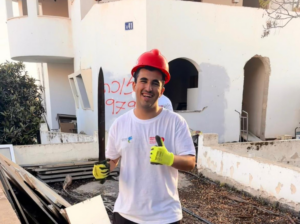
For example, firm employees contribute in a meaningful way to Kfar Blatt, both financially and, perhaps with even greater value, on the ground. They regularly contribute money and food to the families of students in need, especially on holidays like Rosh Hashanah and Passover. And once a year for the last four years, staff from the firm have upgraded a mishpachton apartment at a cost of tens of thousands of shekels. In this full-day, festive event, staff shop at IKEA and then arrive at the Youth Village, working together with the students to paint, design and furnish a mishpachton.
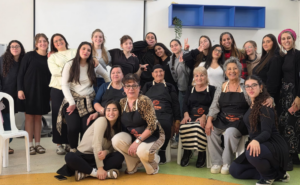
 Additionally, female students enrolled in the Zeisel Junior College, where they study Legal Administration, can now connect with lawyers at the firm thanks to the new partnership. During an annual “Ecosystem” day, the young women visit the firm’s office for positive, inspirational and experiential learning. They sit in the conference rooms and engage in conversations with the lawyers and the firm’s director, hearing motivational stories from female lawyers. The model of those powerful women in their professional space provides a great example for the students and allows them a vision to aspire toward. The students see that they can be just like them or anything they want to be.
According to Moshe Uziel, director of the Zeisel Junior College and an AMIT Kfar Blatt alum himself, this model is relatively unique. “Schools in Israel typically don’t emphasize industry experience and time in the workspace. But the Kfar Blatt/FBC program recognizes that it’s crucial for students to see and experience it so that it can truly feel concrete and accessible.” He adds: “I personally am a big believer in the real-world component and experiential learning, even early on in school. It instills in students an element of love and pride for the profession. It also helps a lot in developing a history, relevance and set of tools for actual industry needs.”
The added bonus to having this experience early on in their learning is that after their army or national service, the young women have an opportunity to circle back to this professional environment where they already have an established connection. Any graduate who has learned about the profession and is interested in the work there, can reconnect with one of the firm managers to discuss possible placement. The partnership provides an element of employment security and options, as even after some passage of time, the firm wants to stay connected with the Kfar Blatt alumnae and help them.
It is a known but often downplayed truth that the ladder to success often builds upon prior connections to established people and institutions. “Lucky breaks” and first jobs are usually about having a network, more than pure happenstance. This is one of the reasons why children of successful, connected parents often grow up to become successful, connected adults themselves. And, why those without such connections often struggle to change their life circumstances. This AMIT Kfar Blatt/FBC partnership creates the foundation of such connections for young women who may otherwise never have had them.
Shira Bakala is a recent success story who has emerged from this path and is now working at the law firm. She came to AMIT’s Kfar Blatt Youth Village in 10th grade and progressed through the high school. While enrolled in grade 13 at the Zeisel Junior College’s Legal Administration program, she experienced a life-changing day of “Ecosystem” learning at the FBC firm offices. “It was fascinating,” she says. “To hear about what they do. To see the courthouses. I realized I really wanted to work in law. And even then, I think I knew I would want to work with them if I could.”
After graduating, Shira did her national service. When that started to wind down, she reached out to the office manager at FBC, whom she had connected with on her visit there. “I told her I was starting to search for employment and that I would love to work there. They weren’t looking to bring on new people at the time, especially because of Corona.” So, after her service ended, Shira took a temporary job at a grocery store while planning her next steps. Bolstered by the confidence gained from her connection with the firm, Shira persisted in reaching out to its offices. And eventually her persistence paid off: they found a role for her in one of the departments as a legal secretary, where she handles projects and is gaining exposure to the world of law.
“I love meeting new people there, learning about what they do. It’s a fun place to be,” she explains. “It suits me. I don’t like to stay put. I like learning new things. And people are invested in what they do there, making a difference. They come in smiling, with good energy. It makes you realize that work doesn’t have to be just about money. It can be meaningful, too. I definitely want to stay in the world of law.”
Shira credits this opportunity and all her clarity to AMIT. “At the school I went to before AMIT, I never found my place. No one really noticed me. It was hard. And then, sheer luck brought me to AMIT. Suddenly teachers were paying attention to me, working with me one-on-one in the afternoon. Suddenly I was getting all these tools to learn and to succeed.” She pauses, searching for the words to capture how AMIT, FBC and their partnership has impacted her. Then she clinches it. “It all feels like a dream come true.”