
BY ANAT ROSENBERG
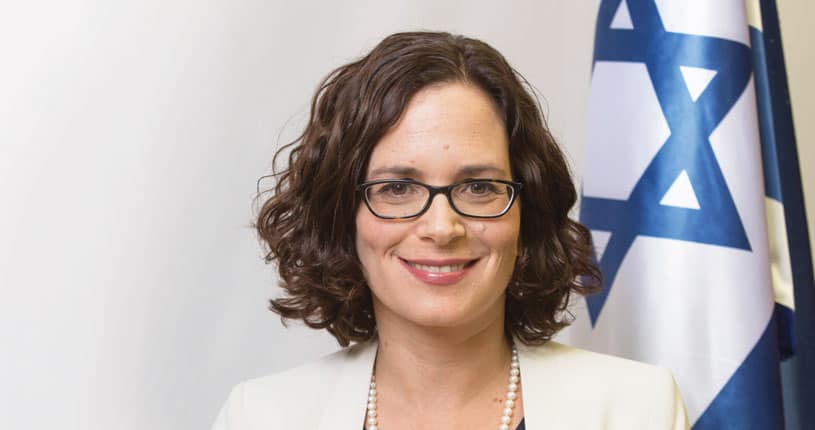
Born in Jerusalem and still living there with her husband and four children, Knesset member Rachel Azaria, 39, entered politics because she wanted to improve life for the city’s residents. She established the Yerushalmim political party in 2008, and in the nearly ten years since then has fought to make Israel a more pluralistic, equitable and affordable country. An alumna of the AMIT Gould Jr. and Sr. High School for Girls in Rehovot, Azaria spoke with us about her work as an MK, the challenges facing Israel and the tough high school teachers who inspired her.
AMIT: You got into politics to have an impact on social issues in Israel. Do you feel that much has changed in the almost ten years since you entered politics, or local politics, in Jerusalem?
Rachel Azaria: I went into politics because I cared for Jerusalem. Jerusalem is changing rapidly, and not for the better. Then I joined the Kulanu party because I was very active in social issues that were important to me. One of the main issues I was addressing is the fact that, in Israel, over the past 20 years, the percentage of mothers of young children that work has jumped from 55% to 75%. The labor market and the school system are organized as if there is someone at home with the children. There is no one at home with the children anymore. Over the past two years, I have accomplished a lot and it also became an issue that many people are working on.
AMIT: You’ve also worked to promote pluralism in Israel, but at the same time have said that the country’s divergent groups have yet to establish a cohesive Israeli identity. How do you see that coming about, and do you feel the divisions are growing deeper or is it getting closer to that goal of defining an ‘Israeliness’ within the population?
RA: I think that both are happening at the same time. The world is becoming more and more divided, but there are more people that are worried by that fact, and more people are trying to see how to create this cohesiveness. We don’t yet know how to make it happen, but I think this is part of the challenge. In the state of Israel, since it was born, every generation has had a challenge. Now the challenge we’re dealing with is the economic gaps. Every time we have one of these challenges, it looks impossible, and somehow, we make it happen. I’m hoping the same thing will happen here.
AMIT: Do you mean developing the identity?
RA: When I think about this issue of developing the identity, I think of what has happened every time we have had a state. In the first temple period, there were big gaps between the groups, and then there was exile for 70 years, then we came back. Again, we started working together and again, there were gaps, and again, we went through 2,000 years of exile. Every exile was because of infighting. It’s happened twice in history, and I think that it’s very important that we make sure it won’t happen again.
AMIT: You also said that socioeconomic issues are a challenge the Zionist effort has to overcome today. Can you talk a little bit about what Kulanu is doing to improve day-to-day life for Israelis?
RA: Oh, so much. There is a special program for people who are buying their first apartment, and it gives them an opportunity to buy at much lower prices. There is a program for families that subsidizes after-school activities, and there are also tax breaks for parents that work, which adds some income to every family. Then there’s a lot of work on breaking up monopolies. Israel is still a pretty monopolistic economy. The fourth is strengthening the Israeli economy by changing the tax breaks for high-tech companies to create more job opportunities.
AMIT: You were born in Jerusalem, and we just celebrated the 50th anniversary of the city’s reunification. What was that experience like for you, and what do you say to people who say that Jerusalem isn’t really a unified city?
RA: I’d say that, first of all, they should come to Jerusalem. Jerusalem has the rhythm of a city. It’s a very dynamic, very exciting, vibrant city. It’s not that I don’t think we’re unified. I don’t think that all the neighborhoods are the same, but we live in the same city. We love the city, and no one owns the city. The city owns us. There are different neighborhoods—there’s a lot of work that has to be done in east Jerusalem, but I’ve never met a city that has a wall going down it that’s a happy city. I think that Jerusalem has to stay one city.
AMIT: You’ve also been working to improve conditions in the periphery, and as you know, AMIT has many schools in the periphery. Can you talk a little bit about how Israel can make the peripheral areas feel more included and level the playing field for them?
RA: I think it’s happening in many ways. This week I was in Afula. There’s a lot of building of high-tech everywhere. The big army base from the center of Tel Aviv is moving to the south, and that is a big game-changer. For years, there was this concept that no one wanted to live in the periphery, and now everyone realizes that we’re building thousands of apartments in the periphery and people want to live there. People will feel less and less ‘periphery’ over the next few years.
AMIT: You’ve also long fought for women’s rights within Judaism and Israeli society and have been called an Orthodox feminist. How can we get more women and more Orthodox women involved in Israeli politics?
RA: I often go to Orthodox young girls’ schools and I talk about it. I think it’s important for young Orthodox women to be in politics, because at the end of the day, everyone sees the world through their eyes. If you don’t have decision-makers that have similar experiences to yours, so often issues that are important to you are ignored. I think that sometimes Orthodox young women have it hard because you’re taught many times to be modest. You can be modest and still have your voice heard.
AMIT: You obviously studied at an AMIT school. What was that like for you?
RA: We had very strong women teachers. I liked them. They had very high expectations. We studied very seriously. You knew you had to work hard.
AMIT: Do you feel that those tough women shaped who you are today?
RA: Yes, they taught us to be very determined, that nothing comes easy. One time we went to Givat Hatachmoshet [Ammunition Hill], and it was very hard. It was when we were in Lebanon. We were in 12th grade. Every other day, there were a few soldiers killed in Lebanon. That day, there were some soldiers killed, so a lot of us got very emotional. Then, the teacher said, ‘You have to remember that the only choice we have is between this and Auschwitz.’ She said, ‘Get yourself together, let’s continue, this is what we need to do and deal with and that’s it.’ That was very strong.
AMIT: What do you see as the biggest challenges for Israel in the years ahead?
RA: I think the major issue that’s awaiting us is forming an identity. External challenges are always there. It’s part of our life, unfortunately.
AMIT: How can we bring the American-Jewish community closer to Israel? Studies are showing that the younger generation here is detached from Israel—how do you think Israel can reach out to them more?
RA: I think, first of all, we need to start talking about brotherhood and sisterhood. I realize that there’s criticism about what’s happening in Israel. I think something that’s a challenge that we need to deal with is how Israelis perceive the American-Jewish community. Unfortunately, there’s a lot of work that has to be done there. I can’t stress how important the American-Jewish community is to Israel. I feel that sometimes Israelis don’t realize how important it is for our security, for our economy, for our relationship with the defense that the United States gives us, like security issues with the United Nations, and that’s huge. Often, people take relationships for granted or what they have for granted, and I think this is something we need to work on.
AMIT: Finally, do you see yourself aspiring to become prime minster one day? Have you thought about it?
RA: I’d be happy to be a minster—there’s still a lot of work that I want to do.
This interview has been edited for length and clarity.