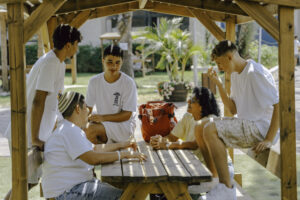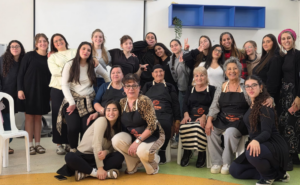

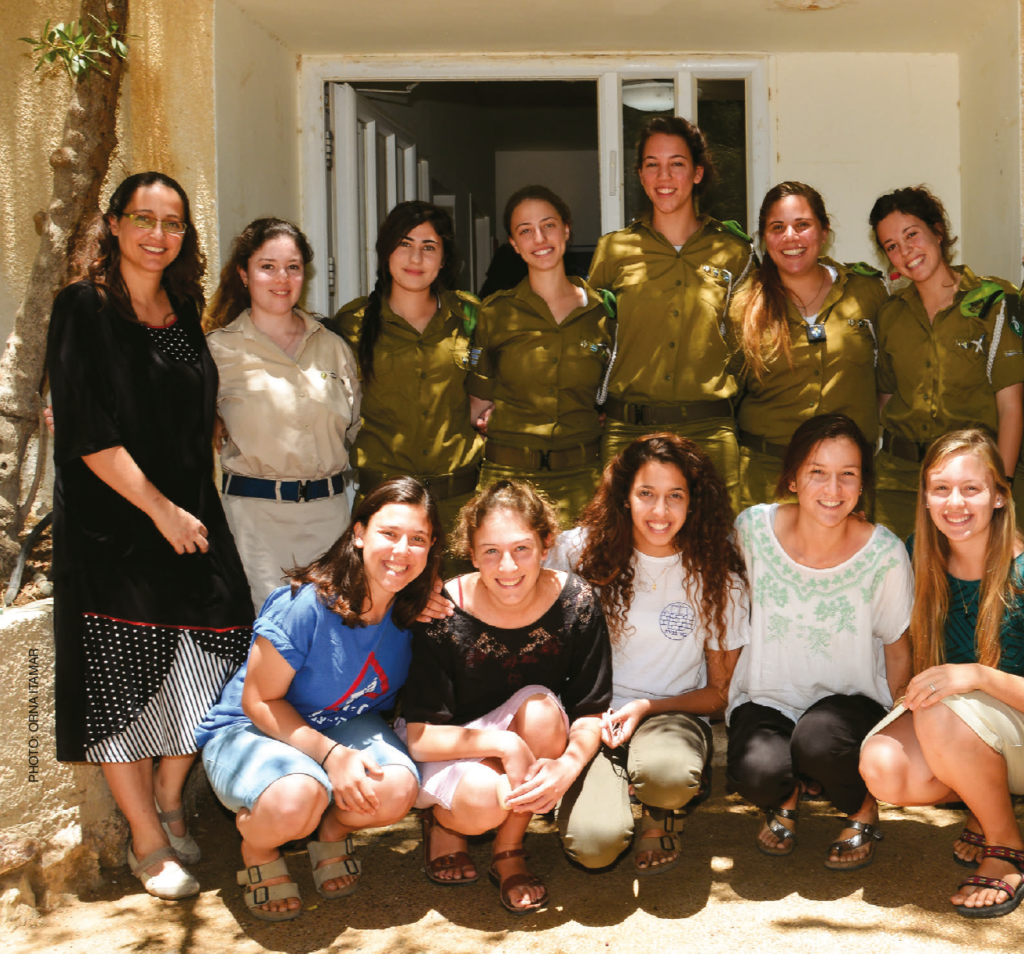
In the desert town of Yerucham, a group of girls are completing a year of Torah study and community service, while preparing to enter the army for a two–year hitch, the last six months of which will be spent in yet another round of community service. Midreshet AMIT Be’er is a new type of educational institution. While the hesder yeshiva for boys (a five-year program combining Torah studies with military service) has existed for decades, the hesder yeshiva for girls is new. Midreshet AMIT Be’er is one of just four institutions in the country offering this type of program. But what makes this midrasha unique is its emphasis on community service.
Like so many groundbreaking projects in Israel, the midrasha came to life under the most rudimentary conditions – in one room in Yerucham, with no staff and no budget, propelled solely by the vision of a few enterprising girls. Tami Biton, present principal of the midrasha, recalls how it all began: “I was a teacher in Yerucham, and I heard about a class of girls from the Pelech School in Jerusalem who were discussing what to do after high school. Half the class wanted to study Torah, the other half wanted to perform community service. So the girls came up with the idea of establishing a midrasha that combined the two. I met them and was very impressed; I told them I could give them two classes a week, and they would have to find their own community projects.”
And so Midreshet Be’er took was launched in 2001 with a small group of fifteen girls who were determined to build from the ground up. Once the army entered the picture, the midrasha was able to expand its staff and institute a full-time program of Torah studies and community work.
 In 2009, when AMIT took over Yerucham’s Kamah School for girls, co-founded by Ms. Biton, it also agreed to take over Midreshet Be’er, with one stipulation. “We were told we were too small to be viable, and we had to have a minimum of 30 students,” recalls Biton. But after launching an extensive outreach program, the target was quickly reached; and today the midrasha receives many applications, far more than the number of available slots. The facilities are still small. Biton sits in a cramped office, which she shares with her secretary; and there is a single large classroom where all classes take place.
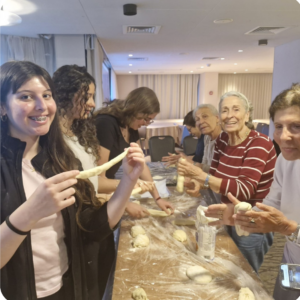
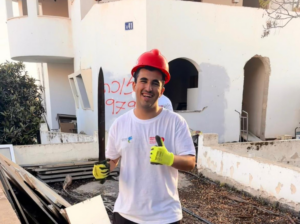
The midrasha may be undersized, but its program is intensive. Mornings are devoted to formal studies: Tanach, Gemara, the Mishna, halachah, Jewish philosophy, Hasidism, literature and social issues. The afternoon is dedicated to community service, which includes working in schools, nursing homes and centers for women at risk, and the evenings to more studies. As a development town, with a low socio-economic population consisting of immigrants from North Africa, Iran, Russia and India, Yerucham has few of the wide-ranging social services that are available in the large cities, and the need for volunteer help is enormous. The midrasha students are known and appreciated by the locals. “We’re known throughout Yerucham as the Be’er girls,” exclaimed Adi Eliran. Adi, a nineteen-year-old student, spent a year tutoring eighth-graders and assisting the staff at a nursing home.
In addition to the community’s specific requests for assistance, Midreshet AMIT Be’er has launched many of its own initiatives. Since 2010, it has been offering a twice-weekly ulpan, conducted by five girls, for recently arrived immigrants and even for the local Bedouin population. Salima, a mother of seven who lives in a tent outside Yerucham, has been attending the ulpan since its inception. “She wants to learn how to read and write, and her dream is to study Hebrew literature at Ben Gurion University,” says Biton smiling.
Another project initiated by the midrasha is an art workshop for local artists, which doubles as an art gallery. This year, as part of the gallery’s program of activities, the midrasha girls organized a citywide art competition for artists of all ages.
It takes a special type of girl to leave the attractive hub of modern Israel to go and live at the far end of the country, in a desert town with no theater or movie house. “The girls who come here,” says Biton, “have to be very committed and have lots of motivation.” Shoshana Moskowitz, from Bet Shemesh, specifically chose Yerucham because of its location: “The desert makes the place more spiritual and gives it a different atmosphere. I like Yerucham because it is small and intimate.” Like many of her fellow students, Efrat David, from Ramat Gan, radiates with enthusiasm. “Yerucham is terrific. It’s different from anywhere else…there’s not much to do here, so you have to build your own community. This is why I like it.”
Surprisingly, while most of the girls are dressed in skirts and modest tops, a number also wear trousers. When asked about this, Biton answers: “We allow our girls to wear what they want as long as they adhere to halacha. We try to be modern and observe religious law at the same time.”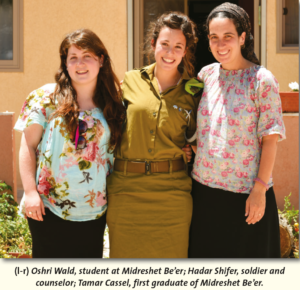
The midrasha’s open approach is reflected in the group of soldiers who have returned to Yerucham for six months of community work. Some wear IDF skirts, others trousers. All are religiously observant and spent their army service primarily in the education corps helping soldiers finish their high school studies or teaching Judaism to soldiers undergoing conversion. Two girls served in the air force, one in intelligence and the other preparing navigational maps. The girls enter the army as a group and remain in contact with each other and with the midrasha throughout their service. Ayelet Levy, who taught Jewish studies to immigrant soldiers, likes the midrasha’s program because, “We begin with Torah and community and, after the army, we return to the same area and same community, thus closing the circle.”
With insufficient facilities, the midrasha has drawn up plans and is raising funds for a modern building with a capacity for 80 students. Explains Biton, “We were offered a lot outside the city with a beautiful view but we chose a piece of land in an old, disadvantaged area, with an Indian synagogue on one side and a Persian on the other. We feel that we can contribute more to the city in this way.” The design of the new building, round-shaped with terraced gardens, was also given much thought. “We wanted a fusion of indoors with outdoors,” says Biton, “to reflect the essence of the midrasha, which fuses Torah studies and community work.”