


By Greg Vitiello
When Marty Glickman awoke in Berlin’s Olympic Village on the morning of August 8, 1936, he thought ahead to the race he’d be running that day in front of more than 100,000 spectators… He imagined taking the baton from his teammate Sam Stoller and sprinting down the backstretch, running clear of the competition, and handing the baton cleanly to Foy Draper. A dominant victory for the U.S. in the semi-final 4×100-meter relay would be a prelude to their gold medal run in the finals a day later.
Marty Glickman’s dream ended abruptly when the U.S. track and field coaches called the team together for an unscheduled meeting. The U.S. head coach, Lawson Robertson, said that Glickman and Sam Stoller, the only other Jew on the U.S. track and field team, were being replaced on the relay team by Jesse Owens and Ralph Metcalfe. Robertson claimed the reason for the change was that the Germans had been holding back, hiding their best sprinters until now. The German’s aim was to humiliate the U.S. relay. The coach said nothing about the fact that baton passing is decisive in the short relay – and Marty and Sam had perfected passing the baton with two other relay teammates for weeks, while Jesse Owens and Ralph Metcalfe never practiced baton passing.
 Only Glickman and Owens protested the decision. According to those present at the meeting, Glickman said, “Coach, there’s no reason to believe the Germans are any kind of threat in the relay. To be a worldclass sprinter, you have to compete in world-class competition.” And, earlier that year, Marty had already beaten Germany’s best sprinter, Erich Borchmeyer. Then Jesse Owens spoke up, “Coach, let Marty and Sam run, they deserve it. I’ve already won three gold medals.” Assistant coach Dean Cromwell harshly told Owens in a condescending tone, “You’ll do as you’re told.”
The U.S. team did win the Gold medal with Owens and Metcalfe. But what was the “real” reason for replacing Glickman and Stoller? Obviously not because of the Germans’ new-found power; the Germans finished fifteen yards back, in fourth place (they eventually moved up to third when the Dutch team was disqualified).
Following the Olympics, Marty and others became increasingly certain that anti-Semitism had motivated the decision to pull him and Stoller from the relay team. He felt the culprits were Avery Brundage, head of the U.S. Olympic Committee and a supporter of Hitler’s Germany, and Cromwell, both of whom later became members of the isolationist America First Committee. After Black Americans had dominated the track and field competition in Berlin, the success of two Jewish athletes would have been humiliating to Brundage, a friend of Nazi Germany.
Prior to the Olympics, when public pressure mounted for the United States to boycott rather than compete in Hitler’s Germany, it was Brundage who had cast the deciding vote in favor of the U.S. team’s presence.
At that time, Marty had been clear about his desire to compete in Berlin. As he expressed half a century later in an interview for the U.S. Holocaust Memorial Museum, “I wanted to go because it was the goal of any young athlete to make the team. And I wanted to show the world that a Jew could compete and do just as well as anyone else, and perhaps better.”
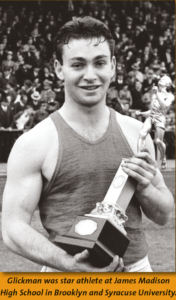
Marty’s Olympic dream had begun early in life. Growing up in New York City as the son of Romanian immigrants, he had always prided himself on being “the fastest kid on the block.” Later, he became a football star and record-setting sprinter at James Madison High School in Brooklyn.
Upon graduation, he went on to Syracuse University, thanks to five Jewish alumni who agreed to pay his tuition at the school. As Marty later wrote, “They said they wanted to get a Jewish athlete into Syracuse to help make it easier for other Jewish athletes to be admitted. There were quotas then.”
After a year of starring in football and track and field at Syracuse, Marty was an Olympian. Brushing off his disappointment at being pulled from the relay team, he returned to Syracuse for three more years of athletic stardom. He believed that the 1940 Olympic Games in Tokyo would be his year to win Olympic gold. But the onset of World War II forced the cancellation of the 1940 Olympics. Glickman enlisted and became an officer in the U.S. Marines.
Following the war, he ventured into sports broadcasting. He had already had a brief exposure to the profession while at Syracuse when his success at football prompted a local haberdasher to pay him to broadcast an event that would advertise the merchant’s business.
Marty trained his voice for broadcasting by reciting poetry, and warmed up for broadcast or speaking engagement by reciting Poe, Chaucer (yes, Chaucer!) and the Four Questions from the Passover Seder. Growing up in a Jewish home, Marty had gone to Hebrew school and had a Bar Mitzvah.
Marty emerged as a pioneering radio — and later, television — broadcaster. He particularly excelled at basketball, developing a vernacular and geography for the game. As a child growing up in the New York area, I vividly recall Marty’s skill at creating word pictures of the ball’s movement from player to player, and from one part of a court to another. He coined words like “swish,” describing a ball going cleanly through the net; and “Good like Nedick’s,” which instantly entered basketball’s vernacular – and boosted the broadcast’s sponsor.
In 1956, Glickman lost the announcer’s job for the National Basketball Association Game of the Week just when pro basketball was finally gaining a national audience. Years later, he learned that he was a victim of reverse anti-Semitism. As Marty recalled, “Maurice Podoloff was the commissioner of basketball and Haskell Cohen was director of public relations, and apparently they felt they shouldn’t have a third Jew in a prominent position.”
Though he was constantly in demand in the Greater New York area, he lost a chance to develop a national audience. Glickman was the announcer for the New York Giants for 23 years and later, the New York Jets for an additional eleven years.
Over more than fifty years as a broadcaster, his range of announcing skills extended from harness racing to boxing. He even announced a performance of the Big Apple Circus for blind children, making them aware of the actual texture of the animals they couldn’t see.
Marty felt a close connection to children of all ages and, for many years, broadcast the high school football game of the week. Bill Travers wrote in The New York Times: “He was a true friend of the high school athlete, especially the Public School Athletic League, as he was a product of the PSAL, having been a star athlete at James Madison High School. Until his death at the age of 83, Glickman remained a good friend to the high school athlete, dedicating much of his time to helping them achieve.” When he died, his wife Marge and his family asked that contributions be made to the PSAL.
Marty Glickman also had strong ties to his Jewish heritage. Peter Levine wrote of Marty in his 1993 book Ellis Island to Ebbets Field, “Although he hasn’t been to the temple in years, he is a strong supporter of Israel, a symbol for him of Jewish peoplehood and survival, and he gives generously of his time and money in its behalf. When he talks before ORT clubs, B’nai B’rith, the UJA, the Jewish National Fund fundraisers, or American Jewish Committee meetings, he speaks of what he knows best – his own Olympic experience and the importance of recognizing the accomplishments of Jewish athletes as an acknowledgement of their ability to maintain themselves both as Americans and as Jews.”
Marty demonstrated this tie in many ways. During the early 1990s, he had discussions with Mayor Teddy Kollek about the feasibility of an international marathon in Jerusalem.
And as chairman of the Jewish Sports Congress, he helped to raise funds for a memorial to the eleven Israeli athletes massacred at the 1972 Munich Games that would be housed at the Olympic Museum in Lausanne, Switzerland.
His disappointment about Berlin in 1936 continued to haunt him. He recalled returning to Olympic Stadium in Berlin in 1985 as part of a tribute to Jesse Owens. Glickman was surprised by his reactions. He told historian Peter Levine, “As I walked into the stadium, I began to get so angry. I began to get so mad. It shocked the hell out of me that this thing of 49 years ago could still evoke this anger…I was cussing…I was really amazed at myself, at this feeling of anger. Not about the Nazis… that was a given. But it was the anger at Avery Brundage and the coach, Dean Cromwell, for not allowing an eighteen-year-old kid to compete in the Olympic Games just because he was Jewish.”
He returned once more to the Olympic Stadium, in 1994, for a preseason game involving the New York Giants. Sitting in the VIP box that Hitler and his entourage had occupied during the Olympic Games, he suddenly felt a sense of completion. “That anger ended for me, but I will never forget.”
Greg Vitiello is a New York-based writer and editor whose books include Eisenstaedt: Germany, Spoleto Viva, Joyce Images, and Crisis and Response (a history of Jewish philanthropy). A lifelong sports fan, he was curator of the National Track & Field Hall of Fame at the Armory in Washington Heights.