
By: Helga Abraham
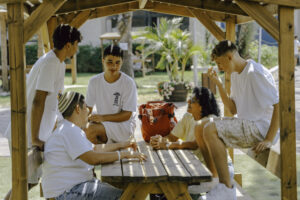
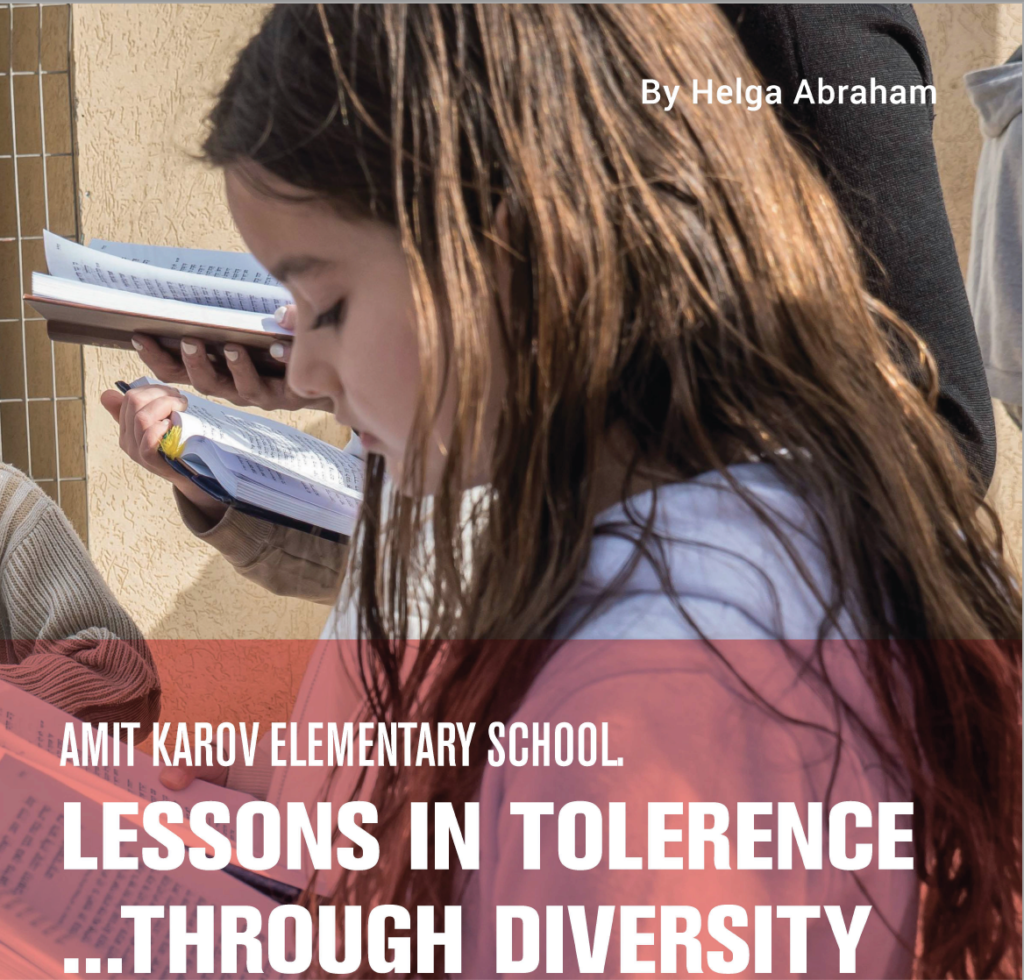
Watching students come and go between the small bungalows that serve as their classrooms-some girls dressed in skirts, others in pants, some boys wearing kippot, others bareheaded-one marvels at the scene and at the relaxed, happy atmosphere. The religious/secular divide is so acute in Israel, particularly in educational institutions, which are completely separate, that it is rare to see children from diverse sectors mix together, learn together, play together and be the best of friends. But at AMIT Karov “tolerance and acceptance” are keywords. From a very young age, the children are taught to accept the other.
How did an establishment of such ease and forbearance come to be?
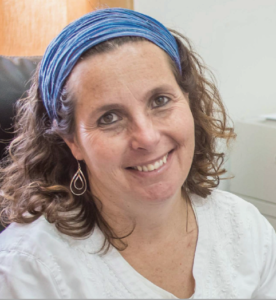
Principal Liat Bar Sheshet
In 2011, while traveling in Asia with her family, experienced educator Liat Bar Sheshet received a call from a group of parents who had launched an “alternative” elementary school in Tzur Hadassah and wanted her as its principal. “There was a lot of confusion at the beginning as the parents were split: some wanted an ‘alternative’ school, while others wanted a mixed religious/secular school,” she recalls. But it was a challenge she could not refuse.
Taking up the reins of the school in 2012, Bar Sheshet had to define what “alternative” meant in practice. “I looked into the anthroposophical method to education, which is a creative, child-centered approach, and decided, together with the parents, that it suited our goals. So, we adopted it, in a non-rigid manner, and created a unique model in Israel: an anthroposophic school that is also a mixed religious/ secular school.” Asked why she considered it important to create a mixed school, Bar Sheshet answers, “because this is Arn Yisrael. We need to acknowledge that the religious and the secular are part of our nation and both are valid.”
“The kids here do as they want, they dress the way they want to dress and they know they will be accepted,” says sixth-grader Na’arna Mannheim. She herself is religious, but her best friend Mika Ben Yosef is not. The two see each other regularly out of school and the evident respect they have for each other’s “differences” is heartwarming. “My parents are secular,” says Mika, “but they wanted me to learn about religious people so that I would not feel alien to them.”
The choice is very much part of the ethos of AMIT Karov. The day begins with: the students choosing to attend the morning prayer service or take part in a dialogue class with their homeroom teacher. Na’arna attends the service while her friend Mika attends the dialogue class. The day I visited the school was Rosh Chodesh Adar, and the morning service included a joyful Halle! service in the schoolyard. And every Rosh Chodesh, the teachers are treated to a festive meal prepared and brought in by the parents.
Staff member Yael Tal, who teaches art, Bible studies and science, kvells about the school. “AMIT Karov is an exceptionally vibrant school because it combines two things that are very important to me: tradition and openness. There is a great sense of acceptance of the ‘other’ here and it’s wonderful to hear talk in a tolerant manner.” English teacher Stacey King agrees: “In Israel, in particular, it’s important to build bridges between the different communities.”
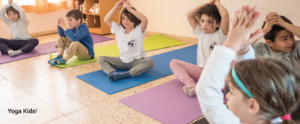
The array of non-core subjects offered to the children is also astounding: Arabic, creative writing, yoga, carpentry, agriculture, knitting, movement, guitar-many of them compulsory. While in one class a group of first-graders are doing yoga stretches on mattresses, elsewhere, secondgraders are busy knitting under a cluster of trees, boys and girls alike.
The anthroposophical approach is particularly evident in the main morning class, which is devoted each month to a different subject that recurs cyclically during the school year. For this class, all the children are issued one large notebook in which they write and draw their lessons and a pretty cloth holder containing coloring pens. “We approach each subject from a variety of perspectives,” explains fourth grade classroom teacher Noam Regev, “through stories, art, poems, writing and also movement. For math, we stand in a circle then divide in half, then in quarter, etc. In this way, the subject becomes more meaningful day by day.”
Sixth-grader Amiad Shachar likes the school’s open approach: “It’s a different way of learning here, and we have a big selection of elective subjects. I study Arabic, guitar and creative writing.” Classmate Alon Ezrachi studies carpentry and music while his friend Yotam Cook is in the agriculture class. “We grew carrots, lettuce, parsley and coriander this year, and today we picked the plants and made a salad,” he says proudly.
The boys also like the fact that the school has practically no exams or tests and does not give grades. Instead, the students receive attractive interim and end-of-year certificates. “Our certificates are very aesthetic,” says Bar Sheshet. “They contain comments, colorful drawings, stories, and poems. We discuss the child’s weak and strong points. And we have found that if we focus on the good side, we get good results.”
Last year, the school won AMIT’s annual elementary school prize for its innovative work and promotion of mixed religious/secular education.
Helga Abraham was born in Egypt and grew up in London. She is a former radio producer with Canadian Broadcasting and Kol Israel. She now lives in Jerusalem where she works as a journalist and translator.