
By: Doctor Erica Brown
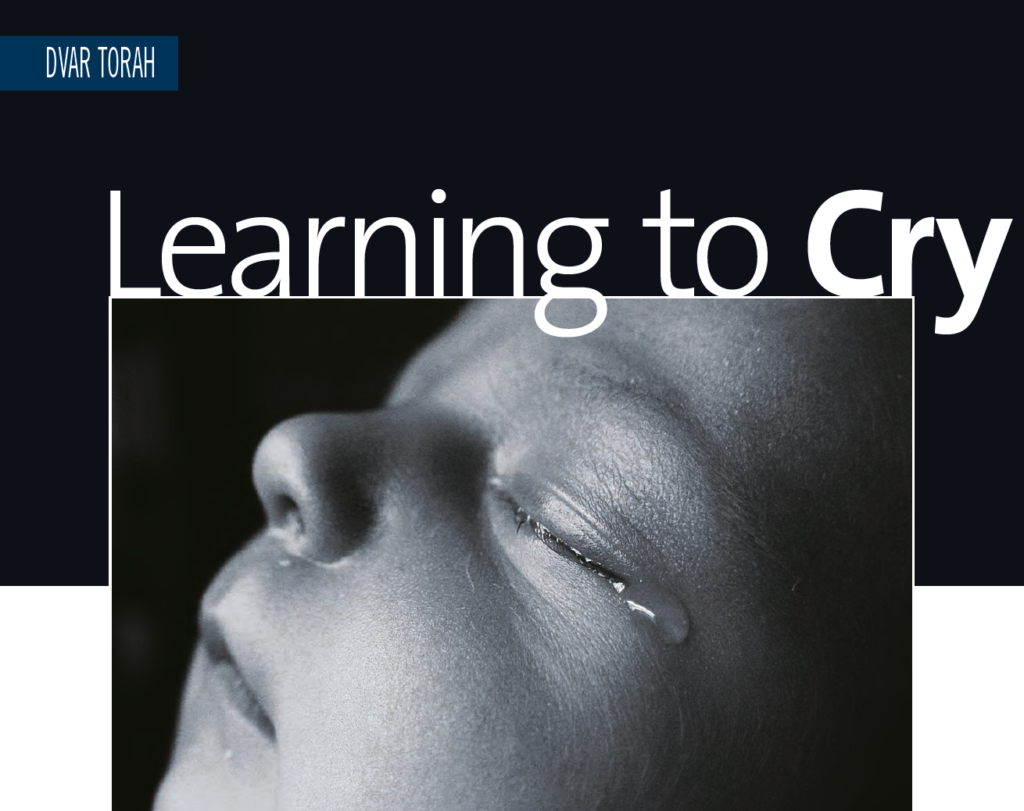
When we were babies, no one taught us to cry. It was our primal instinct to scream out when in pain or discomfort. Crying is a sign of life, and when we were infants, crying was our primary mode of communication. But as we grew older, many of us learned how not to cry; we hardened ourselves to insults and offenses. As we tried to stand tall in the face of adversity, we heard “hold the drama” or “man up” or some other dismissive phrase that suggested implicitly that it was time to outgrow tears.
Such a “manly” point of view cannot be true for the religious personality, especially on momentous days when our prayers and our texts are filled with reasons to weep. Who can read U’netaneh Tokef and remain dry-eyed? My daughter’s joke that our row in shul during the Yamim Noraim is the splash zone. The tears of Rosh Hashanah and Yom Kippur are a form of spiritual catharsis for us, a recognition of the brokenness of our world. There are tears for the concern of what the year may bring, for the sad moments of the year past, for those no longer at the yom tov table. And there is emotional liberation in those tears, in giving oneself permission to cry.
In Rabbi Israel Meir Lau’s remarkable autobiography, Out of the Depths, Lau mentions a young survivor after liberation who had lost his parents and who heard an older survivor address several hundred orphans in France. The young listener thanked the speaker for a gift: the ability to cry again. “When they took my father and mother, my eyes were dry. When they beat me mercilessly with their clubs, I bit my lips, but I didn’t cry. I haven’t cried for years, nor have I laughed.
We starved, froze, and bled, but we didn’t cry.” This young man thought he had a stone for a heart. “Just now, he said, I cried freely. And I say to you, that whoever can cry today, can laugh tomorrow….”
The capacity to cry means we’re truly human. In an exquisite sermon delivered by Rabbi Norman Lamm on Rosh Hashanah, he states, “Ours is an age which has forgotten how to cry.”1 He laments the fact that the machzor, which was once smudged in tears, is, for many of us, white and clean. He then categorizes three types of tears: the tears that come when our myths of security are shattered, the tears of the hopeless, and the tears of those who cry over reality as a first step in changing that reality. Jewish tears, he writes, should always represent the first category; as a people, we cannot lose hope, even when our most treasured myths collapse.
Humbly, I offer another type of tears, the tears I believe we must shed on our holiest days of the year. They are the tears of broken relationships, when—if we are lucky—the emotional callouses we’ve built up soften ever so slightly and force us to admit uncomfortable truths about ourselves and our own accountability. Hatati – I am wrong. I have hurt someone. I am distant from God. I am far from someone I love. I am far from myself.
Perhaps the best biblical illustration of these kind of tears is embodied by a figure we meet in the Bible long before his birth and then after death, when his bones were lovingly carried to the Land of Israel. In Genesis, our biggest crier was also our most significant savior: Joseph. On any number of occasions related to his brothers, Joseph cries. His are not the lone tears that trickle down the cheek in silence but the great, gulping tears of suffering and then relief. In Genesis 45, Joseph sent all of his Egyptian courtiers out of his chamber when he finally revealed himself to his brothers. If he was trying to spare himself embarrassment, it did not work: “His sobs were so loud that the Egyptians could hear, and so the news reached Pharaoh’s palace”
In the final chapter of the Joseph narratives, he once again cries when his brothers beg for their personal safety after the death of Jacob. “And Joseph was in tears as they spoke to him” [50:17]. We feel Joseph’s pain when he realizes that the happy reunion he allowed (five chapters) earlier was not to be as happy as he thought. He had granted his brothers forgiveness, but they never fully accepted it. The relationship between them was still strained. He thought they were reconciled; he cried when he realized they were not. And time was running out. Joseph dies in the very same chapter.
Rav Kook in Orot HaTeshuva makes an important distinction between specific and general repentance. Specific repentance targets a particular behavior, character trait or action. The penitent expresses regret and commits to a different future, following the steps carefully outline in Maimonides’ “Laws of Repentance.” General teshuva, however, cannot point to anything specific. It is a malaise, an overwhelming feeling that I am not myself, or the world is not itself, or a relationship is not working, and I have contributed mightily to its dysfunction. This teshuva is, in many ways, much harder to weep over and much harder to repair because, without a name or a label, it feels like grasping a cloud.
Yet, this season of introspection creates many markers along the road to transformation for us to sit with ourselves in silence, in community, with family, in the beating of a chest, in the vulnerability of a sukkah. All of these moments beg us to confront ourselves, to ask if we have opened up our hearts enough to feel what we pray. In Devarim, we read that God helps us achieve this state: “Then the Lord your God will open up your heart and the hearts of your offspring to love the Lord your God with all your heart and soul, in order that you may live” [30:6]. The word to open here is “u’mal”—to circumcise. God makes a little hole in our hearts, taking off the layer of hardness that prevents us from real feeling. Our job this season is to make that hole bigger. As Leonard Cohen wisely wrote, “There’s a crack in everything. That’s how the light gets in.”
1. Rabbi Norman Lamm, “Three Who Cried,” given on the first day of Rosh Hashanah at the Jewish Center in Manhattan (September 29, 1962).
2. I discuss this sermon at length in “Teaching God to Cry,” In the Narrow Places (Koren/ OU, 2011): 77-80.
Dr. Erica Brown is an associate professor at George Washington University and the director of the Mayberg Center for Jewish Education and Leadership. She is the author of ten books. Her forthcoming book, Jonah: The Reluctant Prophet will be published by Koren/OU in the fall of 2017.