
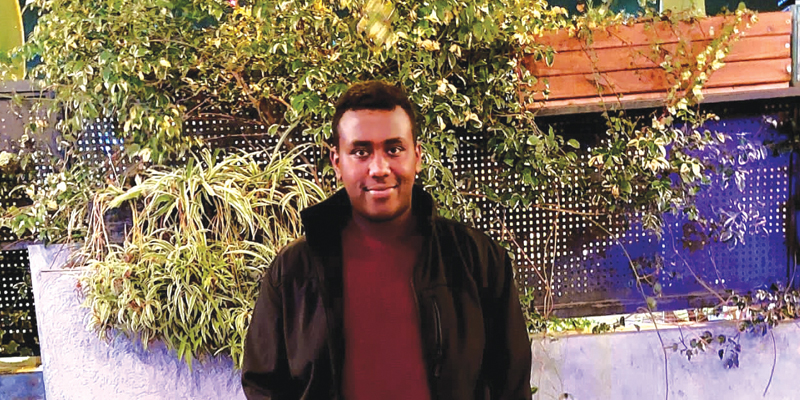
At 17, Itamar Mekonen doesn’t like wasting time. He enjoys ball games—football, baseball, and tennis (“though I’m not much good at tennis,” he says)—but he plays them in his spare time rather than at school, “where I can be learning stuff I can’t manage on my own.” He’s looking ahead to his mandatory Israel Defense Forces (IDF) service a little over a year from now with the same mindset.
“I’m getting fit so I’ll have a better chance of being accepted by a top unit—hopefully the Golani [Infantry Brigade],” he says. “I want to contribute during my three army years, to do something really worthwhile.”
This is a very different young man from the restless, willful boy who began seventh grade at the AMIT Kfar Batya educational campus in Ra’anana five years ago.
“My older brother Avishai was there, and other kids from my elementary school were going, so I went too,” says Itamar. “It turned out to be the very best decision of my life!”
Itamar’s brother Avishai, now 22, had been a challenge, recall his Kfar Batya teachers. But with help and support during his six years in the school, he became a diligent and successful student. Today, he’s an officer in the IDF. And while Avishai was spirited, his younger brother made him look like a model pupil.
“Looking back, I can see I made problems for my teachers,” says Itamar contritely. “I acted out and behaved however I felt. I found studying really hard. My attention was patchy, and in the classes I found difficult or that didn’t interest me, I made no effort at all.”
Academic education to prepare for life in a technological world was new to the Mekonen family. Itamar’s parents were born in an isolated Ethiopian village. They trekked with their 4-year-old daughter, Tali, to the planes that brought them and some 6,000 other Ethiopian Jews to Israel during Operation Moses in 1984. Itamar’s mother found work as a cleaner and his father as a hospital orderly—jobs they still hold today. Three years later, they welcomed their second child and first sabra, Aviva. Today, Tali teaches kindergarten and Aviva is a stay-at-home mom.
After a 15-year break, the Mekonens rounded out their family with three more children in five years: Avishai and Eden, both currently serving in the IDF, and lastly Itamar. Itamar is aware that he’s the only student of Ethiopian-Jewish descent in Kfar Batya, “but nobody cares who comes from where,” he says. “There are kids here from all kinds of families—new immigrant and veteran, rich and poor. I have a bunch of friends, three or four of them really close, and we just think of one another as people.”
At times, Itamar’s future at Kfar Batya hung in the balance, as he disrupted classes and failed to complete assignments.
“My amazing good fortune is that Kfar Batya isn’t a regular school that gives up on troublemakers,” he says. “Our teachers are more like family. They care about us, want us to do well, and go out of their way to make that happen. You can be totally open with them, and they still accept you. Yaron [Carmi], the principal, was my 11th grade homeroom teacher this past year, and he really invested in me, like a dad. He called every morning to wake me so I’d get to school on time. He understood me better than I understood myself, and knew how to make me give my best.”
Placed in one of AMIT Kfar Batya’s supportive classes for low-achieving students on each grade level, Itamar has flourished and is expected to finish 12th grade next summer with full matriculation.
“I’ve always found schoolwork hard, especially subjects like math that don’t interest me,” he says.
“I enjoy history and Bible, and my optional subjects are psychology and law. Perhaps I’ll continue with one of them, but it’s all at least four years away, after IDF service, so I’ve got time to think about it. Whatever decision I reach, I’ll have in my hand the ticket to better things that Kfar Batya has given me. It’s shown me how to live a different life and how to get there.”