

By Robert E. Sutton
Mention unions and Jews in the same breath, and the first things that usually come to mind are the ILGWU, sweatshops, long hours, low wages, strikes, and Samuel Gompers, the labor union leader. Some cynics will immediately shout, “they’re ruining the country.” Others will maintain that unions are the backbone of the middle class worker, keeping the playing field as level as possible. Still, others will invoke the history of the labor movement and the significant Jewish influence on improvements in the contemporary workplace.
When did the Jews become involved in a labor organization or establish their own unions? If you answered the late 19th to the early 20th century, you’re mistaken. The first Jewish unions or guilds originated well before then.
HELLENISTIC APPROACH
The renowned archaeologist and Biblical scholar William Albright suggested that centuries before the Jews became part of the Hellenistic empire, associations of private Jewish citizens organized for their mutual social, religious, cultural, and economic benefits. These guild-like fellowships included artisans, merchants, and scribes.
In cities, there was a custom that different trades inhabited separate and distinct areas. Jerusalem had a bakers’ street, a goldsmiths’ district, and a potters’ street, and in the area of the tribe of Benjamin has situated the valley of the woodworkers. Even the names of the craftsmen denoted their specific trade. While the prefix ben before a surname commonly denotes a son of, it also can be used to signify members. So the name Malchia ben Ha’tzorfim translates to Malchia, member of the goldsmith’s group, and Chananyah ben Ha’rachim was Chananyah of the perfumer’s group.
During the period immediately preceding the destruction of the Second Temple, the guilds held absolute monopolies in their districts. The government recognized the power of the guilds and granted them the legal right to exclude any newcomers from competing in their areas. The legal defense of the guilds continued into the rabbinic period. In the third century, for example, the wool weavers of Pum-Nehara lodged a complaint against outside wool weavers. Rabbi Nehara, the local Judge, settled the matter in favor of the weavers. The Talmud even refers to a baker’s strike.
The guilds also encouraged training through apprenticeships, especially encouraging that sons of members be taught their father’s skills. A famous rabbinic reference in this regard states that “A father who fails to teach his son a trade virtually teaches him robbery.”
ROMAN RULES
In the early part of the Roman Era, the second largest Jewish center of population was in Egypt, and Alexandria was the hub. In Alexandria, there were four major Jewish occupations: artisans, farmers, shippers, and merchants. Most all had organized guilds. During this period, the guilds began to take on a new course of benevolent care for its members. Each guild had its separate area in the synagogue. If a guild member was in economic trouble, he could turn to the guild for assistance for himself and his family. Social service became an important and distinctive function of the Jewish guilds.
Roman law dictated all forms of commerce, trade, personal legal status, and organizing. With Alexandria being a port city, many Jews worked on commercial ships that sailed the Mediterranean. Because of their numbers, the Jewish sailors petitioned the Roman government and were permitted to organize a guild of Jewish sailors as a corporation under Roman law.
BYZANTIUM AND SPAIN.
From the beginning of the 4th Century of the Common Era, the Byzantine Empire forbade Jews from forming or joining existing guilds. The existing guilds, of course, were controlled by the government, which discriminated against the Jews.
Roger II of Sicily, sacked Athens and quickly moved on to the Aegean Islands, where he pillaged the silk factories and carried off the Jewish damask, brocade and silk weavers. Roger took them back to Palermo where they formed the basis for the Sicilian silk industry. Manuel, needing to revive his own very lucrative silk industry, decided to entice Jewish silk workers and merchants from other foreign lands. He issued an edict granting the Jews permission to establish guilds and self regulate in accordance with Byzantine law.
In 1336, Pedro IV of Aragon granted recognition to the Jewish guilds of Saragossa. Besides the economic function played by the Saragossa guild, it also had many social duties. Sick care was vital: the guild wardens were obligated to visit the ailing twice a week, on Mondays and Thursdays. On Shabbat, the duty of bikur cholim was not only a mitzvah, but also mandatory. The guild took part in all family services of its members, from brit milah, to weddings, to death.
Also in the 14th Century, the Rashba, Rabbi Solomon ben Abraham Adret of Barcelona, delivered a unique response to the question of the autonomy of the guilds. He declared that any regulation instituted by a guild would be as binding upon guild members as a law of the Torah. In effect, the Rashba was stating, “Each guild is a city upon itself and does not require the consent of the non-guild Jewish community…each group is permitted to conduct its affairs and to prescribe fines and punishments which are not in the laws of the Torah.” The Rashba gave the guilds self-rule over a broad range of issues. He supported his ruling with quotes from the Talmud and Tosephta. The Jewish guilds in its separation of the guild and the kahal were ahead of the times. In later years, the Christian guilds in Poland and Lithuania would separate themselves from their town councils, which were ruled by the church.
EASTERN EUROPE
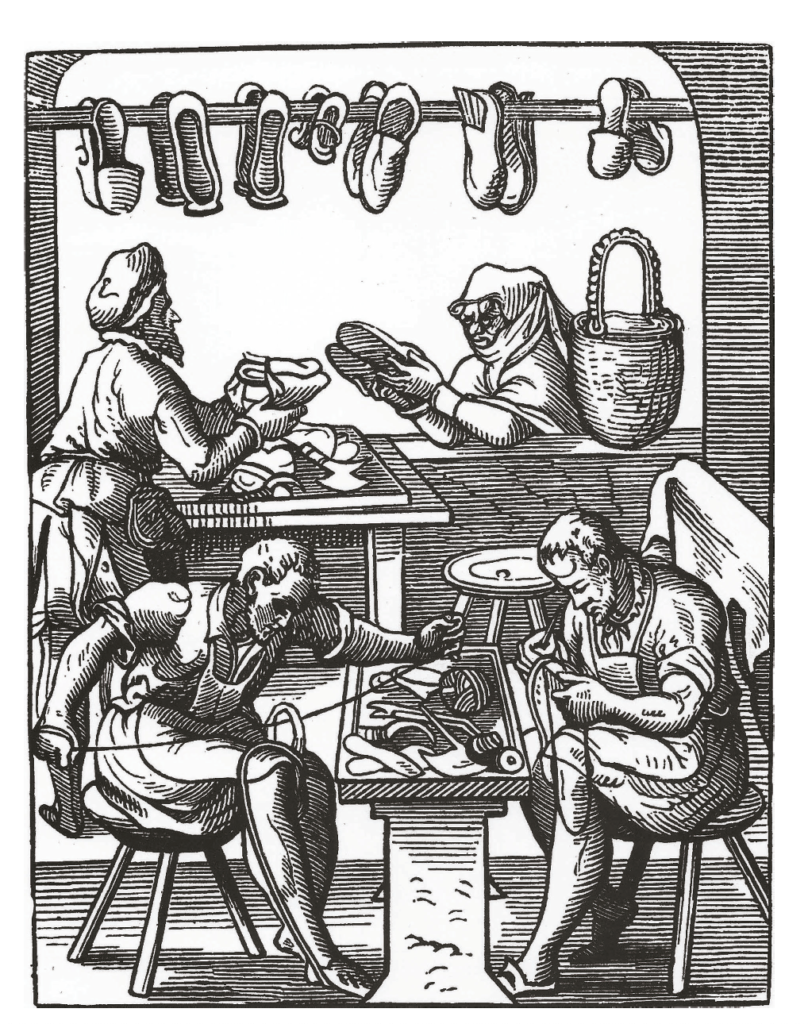
In Prague, the Jewish shoemakers’ guild was becoming more refined in their functions. The status of master, journeymen, rules concerning apprentices, product standards, size of output, dues, and penalties was strictly enforced. Guild members were absolutely forbidden to “steal” customers from each other and make disparaging remarks about competitors’ wares. On Fridays during the summer, work had to stop at 3 pm and 1 pm in the winter ¬– the same for the eves of festivals. One of the more fascinating regulations was that on every Shabbat, all shoemakers were required to attend a course on Jewish law given by a scholar of note. Any member not attending had to provide half a pound of candles to the school for the poor.
In another area of Eastern Europe, the tailor’s guild of Ungarisch-Brod forbade individual guild members from accepting orders from the lord of the town or the army unless all members of the guild benefited.
Some of the secular regulations instituted by the Jewish guilds were influenced by the regulations of Christian guilds and other outside influences. However, many important features of the guilds were taken from Jewish law and custom.
By the 18th century, the Jewish guilds were on the verge of disappearing. The relationship between the guilds and the leadership of the Jewish community had become cold and contentious. In Eastern Europe, open clashes occurred between the guilds and the community. Eventually, the guilds’ economic influence and regulations were erased. Guilds morphed into havurot (associations) that were mainly involved with religious, cultural, and social activities.
A few thousand years have passed since the first Jewish workers banded together to form a rudimentary labor guild. The genes of those guilds are part of us still. In 1920, the Histadrut – The General Federation of Laborers in the Land of Israel – was established. The aim of the Histadrut was to organize the economic activities of Jewish workers. Today, with over 800,000 members, it is one of the most influential institutions in Israel.
Robert E. Sutton is Editor in Chief and Creative Director of AMIT Magazine.