
By Anat Rosenberg
More than a decade ago, historian Merav Mack thought of doing a small survey of Jerusalem’s old libraries, as she said, “to know what exists in them and see what needs to be digitized, who needs help, and how can we preserve them.” She got the support of the Institute of Historical Research in London, estimating that she needed between three and six months of funding to complete the survey.
“We’re talking about the really early time of digitization and I came in as a historian,” she said. “I knew what I wanted from archives and libraries, and I thought, but what do librarians and archivists want to do with their collections, and how do they want the material to be preserved and digitized? Jerusalem seemed to be a wonderful case study because it had a lot of ancient archives and libraries, and I knew it extremely well already.”
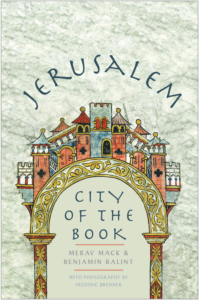 After completing her survey, which was published as a 2007 report simply titled “Jerusalem’s Historical Libraries and Archives,” Mack moved on to other pursuits, but somehow kept getting pulled back to her research from Jerusalem. In 2014, she was asked to update her report for Open Jerusalem, an interdisciplinary project aimed at connecting the holy city’s diverse archives and historiographies. At the same time, many of her friends and colleagues — including Benjamin Balint, an author and translator (whose mother, Judy, has written for this magazine)—suggested she transform the story of these libraries into a book. Mack took Balint up on the offer and they co-authored “Jerusalem: City of the Book,” recently published by Yale University Press.
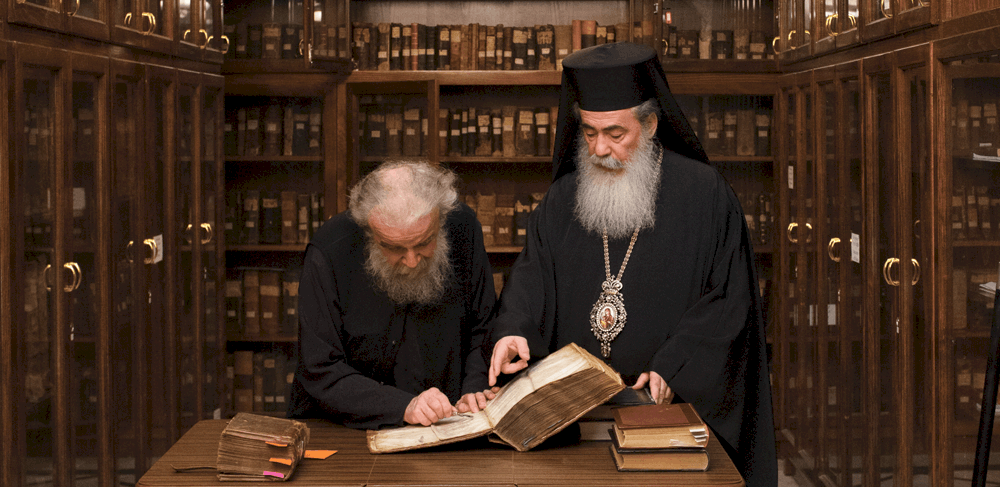
Balint vividly recalls when Mack told him about her survey: “I said to her, ‘Well, this is more than just an academic subject. It really seems from what you’re saying that this is a way of telling the story of Jerusalem’s diverse communities.’” Joined at times by photographer Frédéric Brenner, known for his visual record of the Jewish Diaspora, the two explored about 20 of Jerusalem’s libraries, some small and private and some large, including the National Library of Israel. They visited the Greek Orthodox library, the Ethiopian Orthodox library, al-Khataniyya, a library housed beneath the
Al-Aqsa Mosque, the manuscript library of the Armenian Patriarchate, the Monastery of Saint Mark’s Syriac library, and Jerusalem’s most extensive Hasidic library, among others. They also studied texts at the Israel Antiquities Authority and some inscriptions around the city. They immersed themselves in the different neighborhoods, religions, and traditions, and came to understand that “the old binary way of looking at Jerusalem, as east and west, as a divided city, was kind of simplistic,” Balint said.
“The more we looked into it, the more we found that the communities of Jerusalem sort of anchor themselves in the city through their continuous textual presence,” said Balint. “For example, the Armenian patriarch was very proud of the fact that his library’s texts go all the way back to the 10th century; same with the Greeks. In other words, it’s a way of rooting oneself or showing continuity in the city.”
They also found that not everyone wanted to share their communities’ roots with the public. In fact, Mack and Balint detail the great lengths they went to (including traveling to Ethiopia) in order to gain access to these libraries and archives, some of which are off limits to almost everyone. The reasons for keeping people out are as diverse as the libraries themselves: In some cases, like the Syriac library, the guardians are ashamed of the library’s state of disrepair; in others, like the Greek Orthodox Patriarchate, they fear theft or are concealing a secret; while in others, like the Karliner Hasidic library, it is the trauma of loss. The archive of rare Hasidic manuscripts and books that was amassed by the Karliner-Stoliner Hasidim was looted during the Holocaust, and the memory of that tragedy has not dissipated.
“Since the Second World War, they’ve been trying to rebuild that library,” said Balint. “The rabbi [Baruch Shochat, the current Karliner rebbe] has a very knowledgeable member of the community who goes around to book auctions all over the world and tries to find books with the original watermark. In rare cases, they’ve found books that were stamped, and they snapped those up, of course.”
Despite the obstacles in gaining access to these libraries, Mack and Balint both said that the gatekeepers ultimately grew on them and became an inextricable part of the story. “The funny part, or the interesting part, was that at some point we both realized that we actually fell in love with these custodians,” said Mack. “You learn to really appreciate those characters and realize that they are as much our story as the books and libraries are. And indeed, in the book itself, we spend a lot of time talking about them.”
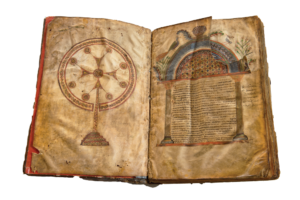
The book also delves into Jerusalem’s place as a source of inspiration for texts going back millennia as well as how the city is depicted in those texts. As Balint put it, they were looking at texts that originated elsewhere and were “ingathered” to Jerusalem, such as manuscripts in the Ethiopian Orthodox library that were brought over on the backs of pilgrims, as well as those that were created in Jerusalem and radiated outward, both literally (texts that were stolen) and figuratively.
“In both cases, there’s this difference between the real Jerusalem and the imagined Jerusalem,” said Balint. “In some cases, people who had never been here had a very strong sense of what the city’s significance is projected onto this blank screen of Jerusalem—all their fantasies, religious, apocalyptic, or messianic.”
To be sure, Jerusalem still elicits strong opinions and a sense of ownership among those who revere it, and as much as the city is a point of contention among its various communities, Balint and Mack were also gratified to discover some pleasant revelations. In one incredible story, they had heard about a Palestinian who saved a Jewish library after its owners fled during the War of Independence. They knocked on doors in the Old City until they found that man’s daughter, who told them the story from her father’s perspective. “That’s one example in our book in which we talk about how communities also preserve each other’s memories, not just their own,” said Balint. “There are rare cases of transcending the usual divisions.”
In another fascinating story, Mack and Balint visited the Dominican library in Jerusalem, where the librarian, a monk, told them, “The Dominicans of Jerusalem have this story that modern Hebrew was, in a sense, born right here.” He took them down some stairs and showed them a shelf of old Semitic dictionaries and grammars that Eliezer Ben-Yehuda consulted as he wrote his dictionary.
“He would walk down to the Dominicans every day because theirs was the only library in the city that had these resources,” said Balint.” He would spend many hours there and some of the books still have his notes and his underlinings.”
What helps unite these diverse communities is their reverence for books and manuscripts, and Mack’s initial survey helped raise awareness about their value. “From 15 years ago, when I first entered these archives, to today, I see a big, really dramatic change in the attitude of all those little places: They realize that what they have is actually important.” (She and Balint have succeeded in connecting some of these libraries with organizations that can help them digitize their archives, although in some cases their offers were declined.)
Mack and Balint are working on an exhibition related to their book scheduled to be displayed in 2024 at Israel’s National Library. It seems like the perfect opportunity to unite these neighbors, most of whom never interact with one another in the city they all hold dear, in the same room.