
By Helga Abraham
Appropriately, AMIT’s women’s day event took place in Herzliya, the coastal town that has become in recent years a hub of hi-tech companies and start-ups. The theme of the event was “inspiration.” “The aim was to inspire young girls to think outside the box and dream big,” said marketing coordinator Danelle Rubin. Already, as early as grade 7, AMIT students, girls as much as boys, become familiar with advanced technology, innovation, and entrepreneurship through elective courses in their own schools or via AMIT’s Academy of Entrepreneurship and Innovation which opened two years ago in Ra’anana.
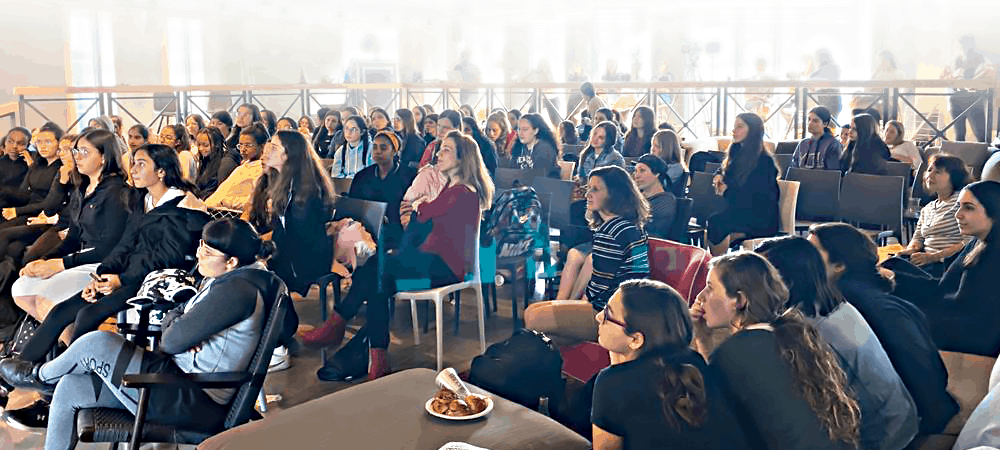
But the Herzliya event was a rare opportunity for girls from different schools to mix together, exchange ideas and hear directly from women who work in the top ranks of hi-tech or run their own companies. One hundred students from six schools (AMIT Renanim Science and Technology High School for Girls, Ra’anana; AMIT Kiryat Malachi High School; AMIT Ashdod Arts & Sciences High School; AMIT Wasserman Torah, Arts & Sciences High School for Girls, Maaleh Adumim; Ulpanat AMIT Lehava, Kedumim; and AMIT Anna Teich Ulpana, Haifa) took part in the event. “This was an occasion” said Galia Kedmi Fragman, Director of the Academy and organizer of the event, “for our students to meet innovative Israeli women who are breaking barriers and who have a story to share.”
A high-flyer herself, Kedmi Fragman partially left the world of hi-tech to devote herself to education, “I first became interested in education when my oldest son began school. He was often bored, and I realized the system was using old-fashioned methodologies that needed changing. I wanted to see students become passionate about learning.” So Kedmi Fragman started volunteering in AMIT schools, teaching computer science and then developing a three-year entrepreneurship course for AMIT students that became the basis of the Academy.
After enjoying coffee and snacks, the girls settled down excitedly to hear the first speaker, Kedmi Fragman. Instead of emphasizing the need for academic knowledge and qualifications, she recounted a turning point in her career. In her late 20s, she was asked by the Israeli company she worked for to go to London and open the company’s first overseas branch. She was terrified. She knew no one in London and, having just met the man who would become her future husband, she was reluctant to leave Israel. Nonetheless, she accepted. Totally on her own in a strange city, she set about the task of opening a new branch. She told her young audience that this period in her life was an important learning experience: “I was alone a lot and this helped me to discover my strengths and my weaknesses. I also developed a network of close friends, and I discovered a whole new cultural world.” She stressed that, while it is important to recognize our fears, fear should not prevent us from moving forward. “Don’t be afraid,” she counseled, citing the words of fearless heroine Pippi Longstocking (known as Bilby in Israel): “I have never tried that before so I’m sure I’ll be able to do it just fine.”
Coming from a totally different world, business woman Chedva Kleinhandler described the steps that slowly led her to establishing her own company and becoming one of the first female entrepreneurs in the ultra-orthodox world. After marrying at the age of 18 and becoming a mother, she decided she wanted to study. “I never liked technology and never thought I would have my own start-up,” she recounted, “but I liked language and words, so I became a translator. Then I started a lifestyle blog which became a highly successful design outlet, then a marketing agency which led to consulting jobs with clients around the world and finally, in 2017, I launched my own start-up.” Kleinhandler’s company, Emerj, is a platform that uses mentoring to improve conditions in a workplace. Throughout her career, she told her young audience, “I always made a point of learning from others.”
During the break, I talked to 9th graders from Maaleh Adumim, a small town on the periphery of Jerusalem, who are studying an innovative course at school entitled “Architecture and Entrepreneurship.” “In the first stage, we learn all kinds of skills,” explained Eden L., “technical skills like 3D printing and laser cutting and entrepreneurial skills such as development, presentation and marketing a product.” The students then focus on a particular architectural site and have to transform it from 3D to 2D. While Eden chose a Japanese temple, Talia V. chose Athens University. “I have always liked Greek architecture,” she said, “and I wanted a building that is not too well known.” She said that she drew an important piece of advice from Kleinhandler’s story: “I learned that I don’t have to do everything in one go, and it is best to move ahead in stages.”
Panel speaker Meiran Benita, a mentor at the Academy and also a successful entrepreneur, recounted that her family’s experience running a small company inspired her to establish Helpfulpro, a company that provides staff for small independent companies who cannot afford full-time employees. “Don’t give up on your dreams,” she told the girls, “but always cross-check with yourselves that the path you have chosen is right for you.”
A group of 9th graders from Ra’anana, who are completing their second year in the Academy’s entrepreneurship course, explained that they were chosen for the course not because they were good in math but because of skills such as creativity and the ability to think for themselves. In the first year of the course, they learned programming, how to develop an app, identify problems and find solutions. In the second year, they focused on a specific project. “We conceived and built a company to mediate between NGOs and businesses that want to contribute to society,” explained Hadas A. who designed the logo for the company. But after a year’s development work, the girls came up against a major hitch. As often happens in the business world, they discovered that someone else had already come up with the same idea, and a similar company already existed. Quandary! It looks like the girls will have to go back to the drawing board.
The audience then heard from top cyber expert, Meital Arik, who was in charge of the entire cyber security system of the last Israeli elections. Arik recounted how a dull army posting, which she did not like and was considered a dead end, ultimately proved vital to her career and led to top management positions. “I looked around me and saw that I could learn a lot from that posting. Appreciate the gifts you receive,” she told the girls, “even if they may seem at first to be negative or useless.”
Arik and her fellow speakers epitomize the changing face of Israeli society. More and more talented young women are breaking the “glass ceiling” in Israel and assuming top positions in the business and hi-tech world. It is estimated that, today, women fill one third of all industry positions, 22 percent in technology positions and 18 percent in technology management positions. Full of enthusiasm, the girls attending the event were in no doubt about women’s capabilities. Eden L. declared firmly: “Women are more suitable to hi-tech than men because they are smarter. Men got ahead in the past because they are physically stronger. Today, you don’t have to be strong to succeed, just smart.” Tehila V. added that “women don’t just look at the big picture, they also focus on small details.”
Perhaps the most moving of the speakers at the event was 22-year-old Daniella Gigi. From a young age, Gigi worked as a volunteer helping autistic children and youth. She discovered, from this experience, that autistic youth had great difficulty being accepted into the IDF. So, at the age of 16, Gigi launched her own project to help autistic youth enter the army and succeed in their military service. “If there is something that annoys you in society,” she told her audience, “ask yourselves what are you going to do about it and try to take action.” Talia V. found all the speakers interesting but was most impressed by Gigi. “The fact that she launched her own organization at 16 is amazing,” she said. “For me she is a role model.” Fellow student Eden L. saw things differently: “I don’t think 16 is too young. We can do it even younger. I would like to do something that helps weaker groups.”
A group of 7th graders from Kiryat Malachi, a development town in the south of the country, who travel once a month to study at the Academy, came away invigorated by their women’s day event. “All the speakers spoke really well,” said Eliane H. “They gave us a lot of confidence.” For her part, Hadar M. retained this important message: “Keep on trying. If you fail, try again.”
AMIT Academy of Entrepreneurship and Innovation
The Academy enables groups of students from AMIT schools across the country to acquire the fundamentals of hi-tech and entrepreneurship. In the first year, they learn basic building blocks such as programming, how to develop an app, identify a need, find a solution, and start a company. The students work in small groups and, by the end of the year, they have built the rudiments of a company. In the second year, which is called “maker space,” they work with a variety of materials to create an actual solution or product. In the third year, they learn how to put their product on the market, pitch their idea, and find investors.